Supplemental Security Income vs Social Security Disability
One program rewards work history, the other measures current need.
Supplemental Security Income and Social Security Disability Insurance sound like two flavors of the same benefit, and that resemblance causes real financial harm to people who assume one can substitute for the other. Both acronyms begin with S and S, both are run by the Social Security Administration, and both require proof of disability under the same medical standard. Nothing else about them matches. Two applicants with identical diagnoses, identical doctors' notes, and identical limitations can end up eligible for completely different programs, one program, both, or neither, depending entirely on their work history and household finances. The medical file never settles the question by itself. When someone applies to the wrong program, the rejection letter that arrives months later often reads like a verdict on the severity of their condition, when it is really a verdict on their bank balance or their payroll record, and that misunderstanding can discourage a person from ever filing again.
What each program is: one is insurance you earned, one is a safety net you qualify for
SSDI functions as insurance. It is funded through FICA payroll taxes, the same withholding that funds retirement benefits, and it pays out to a worker who has accumulated enough work credits and then becomes disabled to the point of being unable to work. A person collecting SSDI is collecting on a policy they paid premiums into for years, in the same structural sense that a homeowner collects on a fire insurance policy after a loss. SSI works on the opposite logic. It provides minimum basic financial assistance to older adults and to people with disabilities whose income and resources fall below strict limits, and it draws not from payroll contributions but from general U.S. Treasury revenue. No prior work history is required, and none is relevant. The SSA administers both programs and applies the same strict medical definition of disability to both. That shared standard is precisely why the two get mistaken for siblings. That shared medical gate is the only thing the two programs actually share. Everything downstream, who qualifies, how much they receive, when benefits start, what healthcare comes attached, follows from whether the program is treating disability as an insured event or as a condition of financial need. Both programs do insist that an applicant's impairment be medically determinable, expected to last at least 12 months or result in death, and severe enough to prevent substantial gainful activity. Short-term disability, partial disability, and temporary conditions fail both programs equally. That common filter is strict, but passing it is only step one.
Who qualifies for SSDI
SSDI eligibility runs on work credits, not on current net worth. A person with no savings and a thin credit record may be denied, while someone with substantial assets and a solid earnings history can qualify without hesitation, because SSDI asks what a worker contributed, not what a worker currently owns. The standard credit requirement scales with age, and the SSA builds in exceptions for younger workers who have not had decades to accumulate a work record. Workers under 24 may qualify with as few as 6 credits earned in the 3-year period before the disability began. Workers between 24 and 31 may qualify with credits covering roughly half the time between age 21 and the onset of disability. Consider a 28-year-old who worked steadily for four years before becoming disabled: she may still meet the threshold, because the system is not a flat "ten years or nothing" rule but a sliding scale tied to age and timing. SSDI carries no asset or resource test of any kind. A beneficiary can own a home outright, hold a retirement account, or have meaningful savings, and none of it affects eligibility, because SSDI eligibility is about insured status, not household wealth. The program also extends beyond the worker who earned the credits. A disabled adult child, or a spouse who is 62 or older, or a spouse of any age who is caring for the worker's child under 16 or a disabled child, may draw benefits on that worker's earnings record. That family-member pathway gets overlooked constantly, and people who never worked a qualifying job themselves sometimes rule themselves out of SSDI without realizing they might qualify through a parent's or spouse's record. Because the credit arithmetic and the family-member rules intersect in ways that are easy to misjudge, free eligibility tools like Brevy exist in part to walk someone through whether their specific work history, or a family member's, actually clears the threshold before they invest weeks in a formal application.
Who qualifies for SSI
SSI asks a different question entirely: not what did you contribute, but what do you have right now. A person with no work history at all qualifies on exactly the same financial terms as someone with thirty years of steady employment, provided both fall under the income and resource limits. The individual resource limit has been fixed since 1989, unchanged through more than three decades of inflation, housing cost growth, and wage growth. A program meant to catch people with "very limited resources" has held that bar frozen in place since the year the limit was last set. SSI also counts in-kind support as income. Free rent from a family member, groceries supplied by a relative, utilities covered by someone else in the household, all of it can count against the monthly payment and reduce it, a rule that blindsides a lot of applicants who assume only cash income matters. SSI's reach extends further than SSDI's in one specific way: it covers adults 65 and older regardless of disability status, and it covers children with disabilities, making it the only federal disability cash benefit available to someone who has never held a job. A free benefits navigator, the kind Brevy offers, can help map a household's actual finances, including in-kind support most applicants would never think to disclose, against SSI's thresholds before the SSA does it for them in a denial letter.
How the benefit amounts and healthcare coverage differ in practice
The dollar amounts diverge sharply. The maximum SSDI payment in 2026 runs well above the maximum SSI payment, which is capped at a fixed monthly figure for individuals and a somewhat higher combined figure for couples. The formulas behind those numbers work nothing alike: SSDI calculates a benefit from a worker's lifetime earnings record, so two SSDI recipients with different wage histories receive different checks, while SSI pays a flat federal rate that then gets reduced by whatever countable income the recipient has. One formula rewards earnings history; the other flattens everyone toward the same baseline and then subtracts.
Healthcare timing affects coverage more immediately than either check amount does. In most states, an SSI recipient qualifies for Medicaid automatically upon approval, with no waiting period. An SSDI recipient qualifies for Medicare only after 24 months of receiving disability payments, a two-year gap during which many newly disabled workers have no coverage tied to their disability benefit. The one exception is ALS: a person approved for SSDI with an ALS diagnosis receives Medicare immediately, with the waiting period waived. For anyone newly disabled and facing immediate medical costs, SSI's instant Medicaid access can matter more than SSDI's larger check, since a benefit that arrives in 24 months does not help with a hospital bill due now.
There is a second, quieter cost buried inside SSDI that SSI recipients never face. The standard Medicare Part B premium for 2026 rose to $202.90 a month, and for SSDI recipients enrolled in Medicare, that premium comes straight out of the disability check. SSI recipients on Medicaid pay nothing comparable. That deduction narrows the gap between the two programs' cash benefits for anyone who is both an SSDI beneficiary and a Medicare enrollee, and it is easy to overlook when comparing the two programs on their headline payment amounts alone.
Payment timing differs too. SSI can begin paying as early as the first full month after filing. SSDI carries a built-in five-month waiting period before benefits start, though it can pay retroactive benefits covering up to 12 months before the application date if the applicant can show they were already disabled during that window. SSDI also extends to family: a worker's spouse and dependent children can draw auxiliary benefits on the same record. SSI generally does not extend benefits to family members in that way, since it is built around one individual's financial need rather than one worker's earnings record.
How working affects benefits by program
The two programs treat a paycheck in fundamentally different ways, and that difference causes some of the most damaging mistakes applicants make. SSDI uses a bright-line test called Substantial Gainful Activity: earn above that monthly threshold, and SSDI benefits can stop. But SSDI also builds in a nine-month trial work period, which lets a recipient test whether they can return to work without immediately forfeiting benefits, recognizing that returning to the workforce after a disabling event is rarely a clean, instant transition.
SSI works on a sliding scale instead of a cliff. Earnings above a modest monthly threshold, after certain exclusions, reduce the SSI payment by fifty cents for every additional dollar earned. The SSA also excludes a small initial portion of earned income, and a smaller general income exclusion, from the calculation each month, so a person working a limited part-time job sees their SSI payment reduced, not eliminated.
The mistake this produces is specific and avoidable. Picture someone on SSI who hears about the SSDI earnings limit, perhaps from a friend or a forum post, and assumes it applies to their own benefit. They quit a part-time job that was perfectly compatible with SSI's gradual reduction formula, convinced they were about to lose everything, when in fact the SGA threshold they'd heard about never applied to their program. What changed was not their eligibility but their understanding of which rules governed it, and that confusion cost them income they never needed to give up. Anyone uncertain which set of work rules applies to their specific benefit would do well to verify it directly, rather than apply a rule borrowed from the other program.
Concurrent benefits: when both programs apply
Many applicants assume they have to pick one program or the other, but a meaningful number of people qualify for both at once. This is called concurrent eligibility, and it applies when a person's SSDI benefit is low enough that they still fall within SSI's income and resource limits. Two people with the same diagnosis can land in different places on this spectrum entirely: one might qualify only for SSDI, another only for SSI, and a third for both, depending on their income, their resources, and the specifics of their work history.
The typical concurrent recipient has a recognizable profile. It is usually someone who worked part-time, or in low-wage jobs, for years before becoming disabled, accumulating just enough work credits to qualify for SSDI but at a benefit amount that falls below the SSI federal benefit rate. In that situation, SSI can "top up" the SSDI payment, bringing the recipient's total income up to the SSI maximum, provided they also meet SSI's resource limits.
The healthcare consequence of concurrent eligibility is substantial. A person receiving both programs gets Medicaid through SSI immediately and Medicare through SSDI once the waiting period runs out, which can close the healthcare coverage gaps that trouble SSDI-only recipients during that 24-month wait. For someone managing a complicated medical condition, having both forms of coverage layered together removes a source of real financial exposure. Concurrent eligibility is not an edge case or a bureaucratic loophole; it is a built-in feature of how the two programs were designed to interact, and failing to apply for both when both apply means leaving money and coverage on the table that the system was built to provide.
How hard it is to get approved
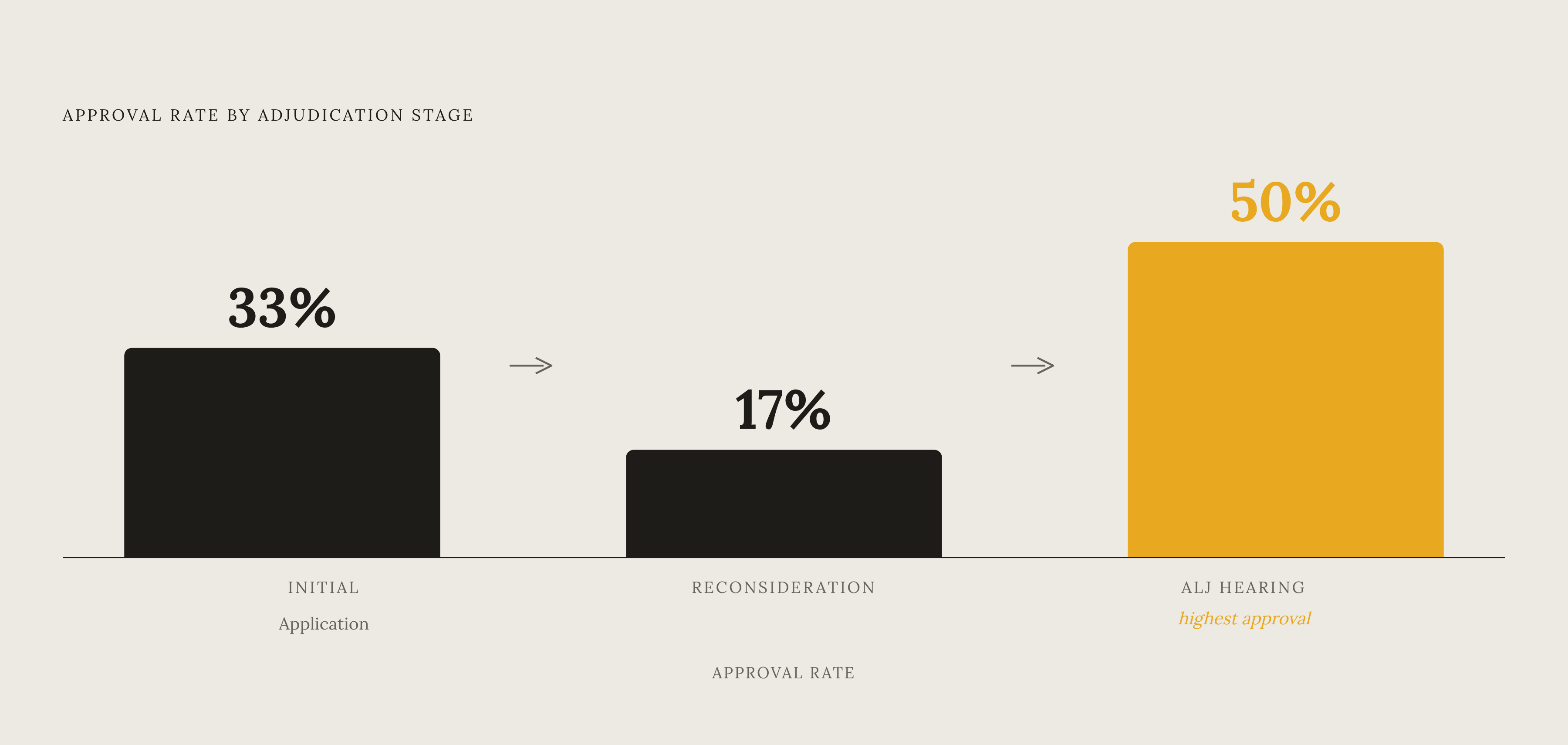
Meeting the medical and financial criteria on paper is not the same as getting approved quickly, or at all on the first attempt. The SSA's own numbers show how steep the climb can be. In FY 2025, of initial disability applications decided, roughly a third were approved. At reconsideration, the first level of appeal after an initial denial, only about one in six were approved. At the hearing level, before an administrative judge who reviews the case in person, roughly half were approved. That pattern tells its own story: initial denials are the norm rather than the exception, and the odds of approval actually improve the further an applicant pushes into the appeals process. Giving up after an initial denial, which is the single most common outcome at that stage, forecloses the stage where approval becomes most likely.
SSI applicants face an added layer of scrutiny that SSDI applicants do not. Because SSI eligibility depends on financial circumstances, not just medical ones, an application can be denied on non-medical grounds entirely, over a resource limit technicality or an income calculation, regardless of how well-documented the underlying disability is. That dual gate, medical and financial, means an SSI denial requires figuring out which gate it failed before deciding how to respond. None of this is reason to expect a fast resolution. It is reason to expect a process that rewards precision on the front end and persistence through the stages that follow it.