SNAP Eligibility for Seniors on Fixed Incomes
Most seniors miss out because they wrongly assume fixed incomes exceed the limit.

Most older adults who qualify for SNAP never apply, and the reason has little to do with awareness campaigns or outreach budgets. The USDA Food and Nutrition Service found that in 2020, only 46% of eligible older adults were actually enrolled. More than half of the seniors the program was built to serve are going without it. The gap traces back to one wrong assumption, repeated across millions of households: a Social Security check or a small pension looks like "too much income" to qualify for food assistance. That assumption holds for a working-age household under standard SNAP rules, but it does not hold for a household with a member age 60 or older, because the program applies a different, more forgiving set of rules to that age group. Three structural differences do the work here: the removal of the gross income test, an uncapped medical expense deduction, and the absence of any asset test, and together they mean a senior's income on paper is almost never the number that determines eligibility. A study out of UTHealth Houston adds a further correction to the usual story: among SNAP-eligible individuals surveyed, stigma turned out to be less pervasive a barrier than researchers expected. Low expectations about benefit size mattered more than embarrassment or shame, and so did a lack of help filling out applications and confusing paperwork requirements. The sections that follow walk through each rule in turn, showing how a senior who looks over-income at first glance can still land well under the threshold once the actual formula is applied.
How seniors are exempt from the gross income test that disqualifies most households
Standard SNAP eligibility runs through two separate income checks, and an applicant has to clear both of them. The first is a gross income test: total income before any deductions, measured against a flat ceiling. The second is a net income test, applied only after deductions are subtracted. Fail the gross test and the application ends there, regardless of what deductions might have applied afterward. That first gate is where most people assume seniors get stuck, picturing a Social Security payment that looks too large on paper to clear a strict cutoff.
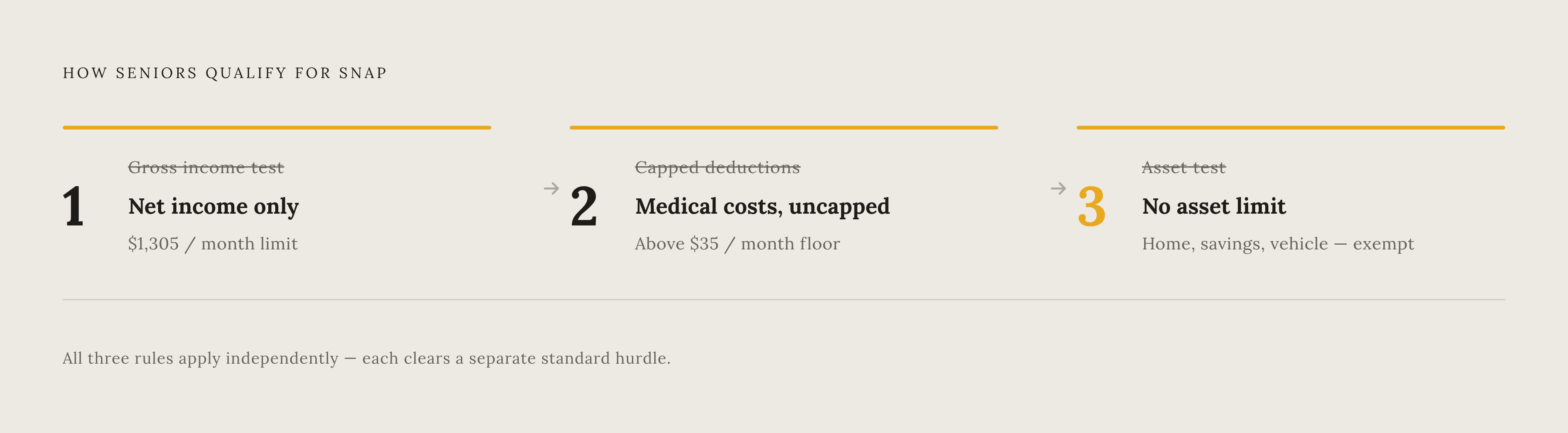
USDA's official SNAP eligibility rules state that households with an elderly or disabled member follow special rules, and one of the biggest differences is that the gross income test is waived for them. A senior applicant is judged only on net income, which is what remains after deductions are subtracted from gross income. For FY2026, the net income limit for a one-person household is $1,305 per month, with a higher limit for a two-person household, but that number only matters after the deductions have already been applied. A senior whose monthly check exceeds what would disqualify a younger applicant under the gross test is still eligible under the net income test. That senior moves straight to the net income calculation, where medical costs, housing costs, and other deductions can pull the final number well under the limit.
So a prior denial should not be treated as a permanent answer. A senior turned down years ago, when the application may have been processed under assumptions about gross income, could qualify today once the net income path is applied correctly. The gross income test does not sit between that senior and the benefit.
The medical expense deduction and what qualifies
Clearing the gross income test is only the first piece of the puzzle. The medical expense deduction does the most work for seniors and is the one most often missed. Households with a member age 60 or older, or a member receiving disability benefits, can deduct out-of-pocket medical costs that exceed $35 per month, with no ceiling on how much can be deducted above that floor. You lower net countable income by a dollar for every dollar spent on qualifying medical expenses beyond that $35 threshold. A standard, younger household cannot claim this deduction. It exists specifically because SNAP recognizes that medical costs eat into a fixed income in ways that gross income figures do not capture.
The list of expenses that count toward this deduction is longer than most applicants expect. Medicare Part B and Part D premiums qualify, and so do prescription drug copays, and so do over-the-counter medications when a doctor prescribes them. Copays for doctor, dentist, and vision appointments count, along with dental work, dentures, eyeglasses, and hearing aids and their batteries. Walkers, wheelchairs, and canes qualify as mobility aids, and so does transportation to medical appointments. Nursing home costs count too, as long as the individual is expected to go home. Twenty-one states have also adopted a Standard Medical Deduction, a flat monthly amount available to seniors whose expenses clear the qualifying threshold, which spares the applicant from having to itemize every receipt.
Consider how this plays out for a senior whose gross income looked disqualifying at first glance. A monthly Medicare Part B premium combined with ongoing prescription copays can push qualifying medical costs well above the $35 floor, and every dollar above that floor comes straight off net countable income. That reduction alone can drop a senior's net income below the $1,305 limit for a one-person household, even when their gross income looked too high to bother applying. For a caregiver helping a senior who was denied in the past, rising Medicare premiums or prescription costs since that last application are a strong reason to ask for a fresh look at eligibility, since the deduction that was too small then may be large enough now.
How the uncapped shelter deduction compounds savings for seniors with high housing costs
The medical expense deduction is not the only one that works in a senior's favor, and the two stack together rather than replacing each other. In FY2026, standard SNAP households face a cap on how much they can deduct for shelter costs each month, so rent or mortgage payments can only reduce net income so far. Elderly and disabled households face no such cap.
When rent, mortgage payments, and utility costs for a senior household exceed 50% of net income, every dollar above that threshold is fully deductible, with no ceiling cutting off the benefit the way it would for a younger household. This excess shelter deduction covers rent or mortgage payments, property taxes, homeowner's insurance, and utility costs, including heating, cooling, and basic telephone service. If a senior pays steep rent in an expensive city, this deduction can reduce net income substantially, apart from whatever the medical expense deduction already removed. Owning a home outright does not shut the door on this deduction either: mortgage payments, property taxes, and homeowner's insurance all count the same way rent does for a renter.
Because the medical deduction, the shelter deduction, and the standard SNAP deduction all apply independently, they compound. A senior with high medical costs and high housing costs can see both deductions pull net income down together, often landing well under the net income limit even when gross income alone would have looked disqualifying under the rules a younger household faces.
Assets and savings do not disqualify seniors from SNAP
The third assumption that keeps eligible seniors from applying is about savings, not income. Many assume that a retirement account, a paid-off house, or an owned car will count against them the way it might for a loan application or another government benefit determination. Under SNAP, households with a member age 60 or older face no asset test. Retirement savings, a home with no mortgage left on it, and a vehicle simply are not counted toward eligibility.
A senior with a meaningful amount in retirement savings but a modest monthly income can qualify based on that monthly net income alone, regardless of what sits in the bank. This misconception runs deep: plenty of seniors who own their home outright and have put something aside for emergencies assume that combination disqualifies them automatically, and it does not. Owning assets is not a factor the SNAP formula considers for adults 60 and older.
The benefit amount seniors can expect
Once net income is calculated using the deductions above, the monthly SNAP benefit follows a formula that is more approachable than it might sound. You get the maximum monthly allotment for your household size, minus a fixed percentage of net monthly income. Even a senior whose net income sits close to the eligibility limit still receives something: one- and two-person households that qualify get a guaranteed minimum benefit of $24 per month in FY2026, even in cases where the formula on its own would produce a lower number. The maximum allotment for a one-person household in FY2026 varies by household size, and you can find current figures through NCOA's published SNAP income limit guide. If a senior's medical deductions bring net income well below the limit, the benefit comes in meaningfully higher than that $24 floor, often closer to the maximum allotment for their household size.
Benefits arrive on an EBT card that works like an ordinary debit card at authorized grocery stores, supermarkets, and many farmers markets, so there is no separate paper coupon or visible transaction method that marks the purchase as different from any other.
How to apply for SNAP as a senior
Applying for SNAP is handled state by state, but several provisions in the process exist specifically to reduce the burden on older applicants. An application has to be filed in the state where the applicant currently lives, and USDA maintains a state directory listing contact options for every state. A senior can apply at a local SNAP office in person, through a state agency website where online applications are offered, or by calling the state's toll-free SNAP information hotline, and this matters for seniors who may not have reliable internet access or feel comfortable navigating an online portal. When a senior cannot visit an office or manage a phone interview alone, an authorized representative can file the application and sit in on the interview on their behalf, as long as the senior designates that person in writing ahead of time.
After you submit the application, the state agency reviews it, conducts an eligibility interview that is usually done by phone, and requests verification documents before it issues a decision. If a household has very low liquid resources and income, or if combined income and resources fall below monthly rent or mortgage and utility costs, it may qualify for expedited processing, which gets benefits out faster than the standard timeline. Many states also offer a simplified or shortened application just for senior-only or elderly and disabled households, so there is less paperwork. Once approved, seniors can qualify for certification periods of up to 24 months, or up to 36 months in states that have adopted the Elderly Simplified Application Project, rather than the standard 12-month cycle most households face. That means fewer recertifications and less repeated paperwork over time.
Before starting an application, it helps to gather proof of identity, proof of income such as a Social Security award letter or pension statement, proof of housing costs including a lease, mortgage statement, or utility bills, and documentation of out-of-pocket medical expenses such as Medicare premium bills, pharmacy receipts, and insurance statements. Having these documents ready before the interview shortens the back-and-forth that otherwise slows the process down.
Access barriers drive the remaining enrollment gap
Understanding the rules solves one part of the enrollment gap, but a meaningful share of eligible seniors who already grasp the eligibility picture still never complete an application. The research from UTHealth Houston pointed to low expectations about how much benefit they would even receive, a lack of anyone available to help them through enrollment, and application challenges such as complicated forms and what felt like strict qualifying rules. So these practical obstacles mattered more than cultural stigma when you look at why eligible people stayed unenrolled.
SNAP enrollment increasingly depends on online applications, and that shift creates a real obstacle for older adults who lack reliable technology access, an obstacle that is sharper still in rural areas where broadband access is thinner and in-person office options may be farther away. None of this changes what the rules say about who qualifies. It does mean that closing the enrollment gap depends as much on removing friction in the application process, phone hotlines, paper options, authorized representatives, simplified forms, as it does on correcting what seniors believe about their own eligibility.