Dual Eligible Status for Medicare and Medicaid Recipients
How 12 million Americans with both Medicare and Medicaid navigate coverage gaps.
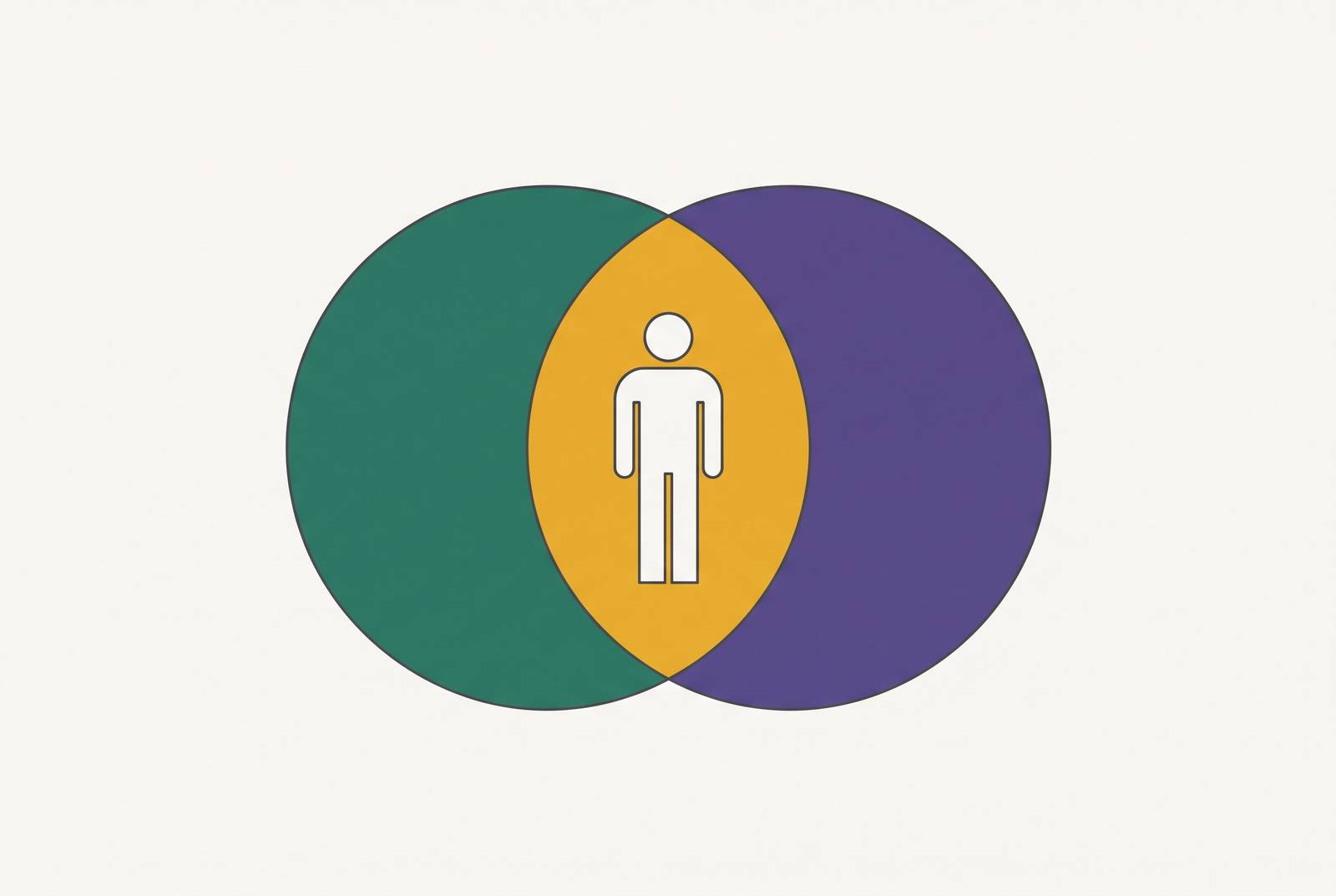
Roughly 12 million Americans, maybe as many as 13.6 million depending on which federal data book you're reading, carry both a Medicare card and a Medicaid card at the same time. That overlap is called dual eligible status, and it is not a minor administrative footnote. It is the mechanism that determines whether someone with a fixed Social Security check and a chronic illness can afford a nursing home stay, a dental crown, or the copay on an insulin prescription. Dual eligibility works because Medicare and Medicaid divide labor: Medicare pays first, for the hospital stays and doctor visits and prescription drugs, and Medicaid fills in behind it, covering premiums, cost sharing, and, for some, an entire second layer of long-term care and behavioral health benefits Medicare was never built to provide. This piece walks through who actually qualifies, what tier they land in, what each program pays for, and what that means once someone (or their caregiver) sits down to figure out where they stand.
Who qualifies: the Medicare and Medicaid pathways that must both be satisfied
Getting to dual eligible status means clearing two separate gates, because Medicare and Medicaid run on different eligibility logic.
Medicare eligibility comes down to three doors. Turning 65 opens one. Qualifying for Social Security Disability Insurance opens another, though only after a 24-month waiting period that catches a lot of people off guard when they first apply. And a diagnosis of End Stage Renal Disease opens a third, regardless of age, which is part of why the dual eligible population skews younger than most people assume.
Medicaid eligibility runs on a different axis entirely: low income, limited assets, and some qualifying basis tied to age or disability. Because states administer their own Medicaid programs within federal guidelines, the exact income and asset cutoffs shift from state to state. What counts as "low income" in Maine is not the same number as what counts in California.
Most people who reach full dual status get there one of two ways. Supplemental Security Income recipients often gain Medicaid eligibility alongside their SSI status, so if someone already qualifies for SSI, the Medicaid half frequently follows without a separate application. The other route runs through the Medicare Savings Programs, which serve as the entry point for partial-benefit duals and split into four income-based sub-categories, each covering a different slice of what a beneficiary owes out of pocket. There's also a spend-down pathway that gets overlooked constantly: someone with income too high to qualify for Medicaid outright can still get there after a hospitalization or a long nursing home stay eats through their income to the point where it falls under the threshold. That pathway matters most for people who never thought of themselves as "Medicaid eligible" until a medical crisis changed the math.
For 2025, the QMB income limit, the most common Medicare Savings Program entry point, is $1,304 a month for an individual and $1,763 for a couple, with asset limits of $9,660 and $14,470 respectively. Those numbers sound precise, and they are, but they don't tell the whole story: some states, Connecticut and Maine among them, set higher MSP income thresholds, and California handles asset rules differently than most. A beneficiary's state determines what partial-benefit coverage actually looks like on paper.
None of this happens automatically for everyone who qualifies. Asset limits trip people up, the paperwork burden discourages plenty of eligible applicants, and a fair number of people simply don't know these programs exist. The system does not reach out and enroll people who qualify; it waits for them to find it.
Who dual eligible beneficiaries are: a demographic and health portrait
Ask most people to picture a dual eligible beneficiary, and they'll probably describe someone in their 80s. That picture is only two-thirds accurate. Roughly 66% of dual eligibles are 65 or older, but the remaining 34% are under 65 and qualify through long-term disability, a share large enough that it should reshape how the whole population gets talked about.
Income tells its own story. About 64% of dual eligibles live on less than $20,000 a year per person, compared with just 9% of Medicare beneficiaries who don't have Medicaid. That's not a small gap; it's the difference between a population living close to the edge and one with some financial cushion. Racial disparities track a similar pattern: 52% of dual eligibles are people of color, versus 18% among non-dual Medicare beneficiaries, a split that mirrors long-standing structural gaps in income and asset accumulation rather than anything specific to health policy. Educational attainment follows the same shape. About 34% of dual eligibles have less than a high school degree, compared with 7% of non-dual beneficiaries.
Health status is where the numbers get harder to look past. Some 44% of dual eligibles report fair or poor health, compared with 14% of non-dual Medicare beneficiaries. Nearly half, 48%, have at least one limitation with an activity of daily living like bathing or dressing, against 21% for non-duals. And 36% report some form of cognitive impairment, more than triple the 12% rate among beneficiaries without Medicaid.
Within the dual population itself, full-benefit duals carry the heavier load. They skew younger than partial-benefit duals (36% under 65, versus 28%), report more ADL limitations (50% versus 39%), and have far higher rates of intellectual or developmental disability (15% versus 5%). Among under-65 dual eligibles specifically, the conditions documented include spinal cord injuries, cerebral palsy, rare genetic disorders, ESRD, ALS, and serious mental illness such as schizophrenia and bipolar disorder.
Why does any of this matter for a piece about eligibility tiers and payment structures? Because it explains why the two-program overlap exists in the first place. Neither Medicare nor Medicaid, on its own, is built to serve someone managing a spinal cord injury on a fixed income with a cognitive impairment layered on top. This population needs both programs working together, and when coordination between them breaks down, it's the people with the least financial slack who absorb the consequences.
What Medicare covers, what Medicaid adds, and where the two programs divide the bill
Medicare, as the primary payer, handles the core of medical care: inpatient hospital stays under Part A, outpatient visits under Part B, post-acute services like skilled nursing, home health, and hospice, and prescription drugs through Part D. That's the foundation every dual eligible beneficiary stands on, regardless of tier.
What Medicaid adds depends entirely on which tier a beneficiary falls into. For partial-benefit duals, Medicaid's job is narrower: it pays Medicare premiums and, depending on which Medicare Savings Program category applies, some or all of the deductibles, coinsurance, and copays that would otherwise land on the beneficiary directly. For someone with almost no financial margin, that coverage is the difference between seeing a doctor and skipping the visit.
Full-benefit duals get something much bigger: an entire second insurance package layered on top of Medicare. That includes long-term care, both nursing home stays and home- and community-based services, which represents the single largest gap Medicare simply does not cover. It also includes vision and dental care, plus behavioral health services beyond what Medicare offers. This wraparound layer is what actually transforms a beneficiary's coverage from adequate-on-paper to functional in practice.
But the exact shape of "full Medicaid" isn't uniform across the country, and that's a direct consequence of how the program is funded. Medicare runs on federal dollars alone. Medicaid is a joint federal-state program, which means states have latitude over optional benefits like dental coverage or personal care attendants. Some states offer them generously. Others don't offer them at all. A full-benefit dual in one state might have a benefit package that looks nothing like a full-benefit dual's package two states over.
Dually eligible enrollees accounted for more than $200 billion of Medicaid spending in fiscal year 2023, according to MACPAC, showing the scale of what Medicaid is absorbing here. That's not a rounding error tacked onto Medicare's coverage; it's a substantial share of what Medicaid pays out nationally, which says something about how dependent this population is on Medicaid's supplemental role, not just its baseline eligibility.
Access to those wraparound benefits isn't distributed evenly, either. Qualifying for full-benefit status is one hurdle. Actually accessing the services that status is supposed to unlock turns out to be a separate one, and that gap is not distributed evenly across racial and ethnic groups.
Medicare Savings Programs: the four categories and what each one pays
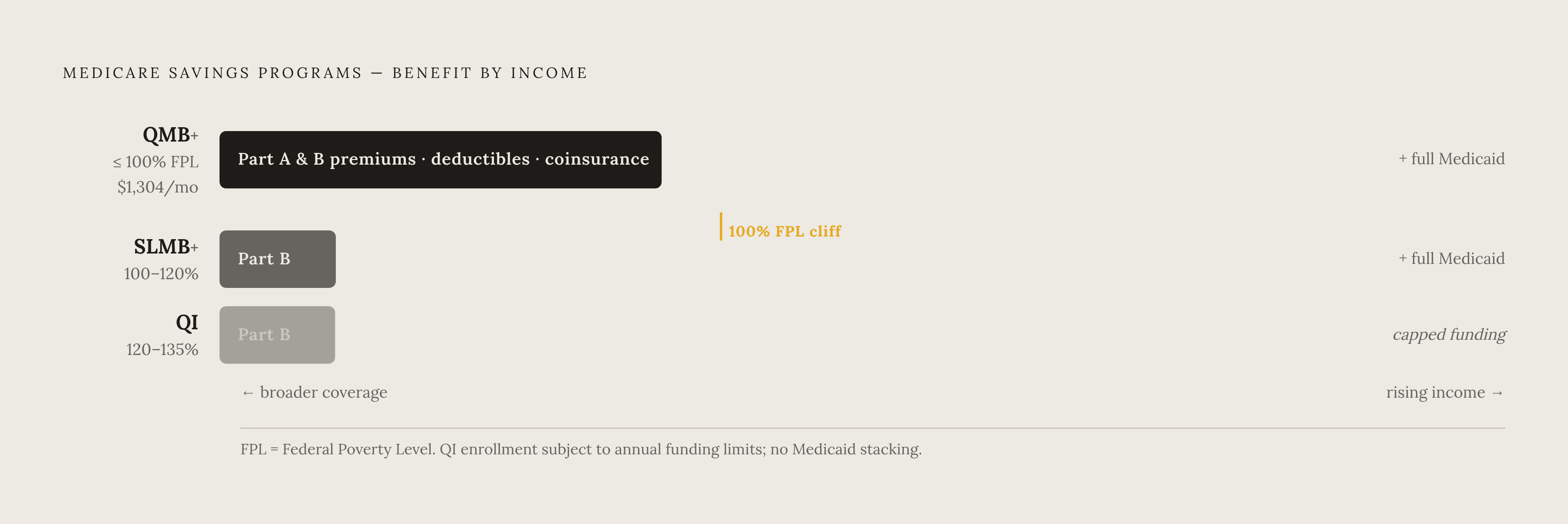
Four programs make up the Medicare Savings Program structure, and they're organized around a single, fairly intuitive logic: the higher a beneficiary's income, the narrower the slice of costs Medicaid picks up.
QMB, the Qualified Medicare Beneficiary program, sits at the top of the benefit scale and the bottom of the income scale. It covers people at or below 100% of the federal poverty level, which in 2025 means monthly income under $1,304 for an individual or $1,763 for a couple, with asset limits of $9,660 and $14,470. For someone enrolled in QMB, Medicaid pays Part A premiums where they apply, Part B premiums, and Medicare's deductibles and coinsurance. There's a QMB+ variant for people who meet the QMB income standard and also qualify for full Medicaid benefits through a spend-down or medically needy pathway, essentially stacking the full-benefit package on top of QMB's cost-sharing coverage.
Step up the income ladder to SLMB, the Specified Low-Income Medicare Beneficiary program, which covers people between 100% and 120% of the federal poverty level. The benefit narrows considerably here: Medicaid pays the Part B premium and nothing else. No deductible coverage, no coinsurance help. SLMB+ works the same way QMB+ does, adding full Medicaid eligibility on top of the SLMB income standard for those who qualify.
QI, the Qualifying Individual program, covers the band between 120% and 135% of the federal poverty level and, like SLMB, pays only the Part B premium. QI comes with a catch that trips people up: it operates on a first-come, first-served basis within a capped federal allotment, so states can and do waitlist applicants once the year's funding runs dry. The program itself became permanent under the Medicare Access and CHIP Reauthorization Act of 2015, but that funding cap never went away, so timing an application still matters.
Line those four programs up and the pattern is impossible to miss: as income rises, the benefit shrinks. QMB covers premiums and cost sharing both. SLMB and QI cover premiums only. That inverse relationship is the entire organizing logic of the MSP system, so a given income level doesn't automatically come with a given set of benefits. And as with full Medicaid, the specifics shift by state: Connecticut and Maine set higher income thresholds across these categories, California treats assets differently, and none of these figures should be taken as gospel without checking the rules where the beneficiary actually lives.
Dual Eligible Special Needs Plans: how managed care packages both programs into one enrollment
D-SNPs are Medicare Advantage plans, run by private insurers under contract with CMS, built specifically for people who carry dual eligible status. Every D-SNP is required to coordinate Medicare and Medicaid benefits to some degree, though, as it turns out, "some degree" covers a lot of ground.
Enrollment has climbed fast. In 2018, roughly 2.2 million people were enrolled in D-SNPs; by recent estimates that number has grown substantially, according to MedPAC and MACPAC data. Part of that growth just tracks the broader rise of Medicare Advantage, but part of it reflects a real policy push toward integrating Medicare and Medicaid benefits under one roof rather than two separate systems a beneficiary has to navigate independently. D-SNPs are now available in 46 states plus the District of Columbia, with a small number of states not yet participating.
CMS distinguishes D-SNPs across three integration tiers, and the differences between them are not cosmetic. Coordination-Only plans represent the floor, with relatively limited integration requirements compared to the higher tiers. Highly Integrated D-SNPs, called HIDE SNPs, go further, aligning Medicare and Medicaid managed care more closely. Fully Integrated D-SNPs, or FIDE SNPs, sit at the top: they cover both Medicare and Medicaid through the same plan, and as of January 2025, FIDE SNPs must operate with exclusively aligned enrollment, so they can no longer enroll partial-benefit duals at all.
That range matters more than the shared "Special Needs Plan" label suggests. A beneficiary enrolled in a Coordination-Only D-SNP might experience something close to the same fragmentation they'd face in traditional Medicare, just with a managed care wrapper around it. The name on the plan doesn't guarantee the coordination the name implies, and that gap is exactly the kind of detail a caregiver evaluating plan options needs to look past the marketing to find.
Default enrollment adds another wrinkle. CMS has approved plans across a number of states to auto-enroll certain dual eligibles into D-SNPs. That raises a real question: does auto-enrollment expand access for people who'd otherwise fall through the cracks, or does it quietly narrow consumer choice for people who might have picked differently if asked? Both things can be true at once, depending on the plan and the person.
On the consumer protection side, 2025 introduced two new enrollment windows. The Monthly SEP lets a dual eligible beneficiary disenroll from a D-SNP and move into Original Medicare on a monthly basis, rather than waiting for an annual window. The Integrated Care SEP allows monthly enrollment into integrated D-SNPs specifically. Together, they give beneficiaries and caregivers more room to correct course if a plan turns out not to fit.
One structural shift closes out this section: the Financial Alignment Initiative, also known as the Duals Demonstration and the predecessor model for integrated care, ended in December 2025 across Illinois, Massachusetts, Michigan, Ohio, Rhode Island, South Carolina, and Texas. With that model discontinued, D-SNPs are now the primary vehicle for integration between the two public insurance programs going forward, for better or worse.
Why dual eligibles account for a disproportionate share of spending in both programs
Start with the asymmetry, because it's stark: dual eligibles make up 21% of the Medicare population but, according to older MedPAC figures, have historically accounted for something like 31% of Medicare spending and 40% of Medicaid spending. Those figures come from an earlier Commonwealth Fund newsletter rather than the most recent data, and the MedPAC/MACPAC Data Book may reflect updated figures, but the direction of the gap has held for years: a relatively small slice of each program's enrollment drives a much larger slice of each program's costs.
Why does that gap exist? It's tempting to chalk it up to low income alone, but the real driver is clinical complexity. Per-person costs climb with the number of chronic conditions a beneficiary manages, and dual eligibles carry multiple chronic conditions at far higher rates than the broader Medicare population, as the health portrait earlier in this piece lays out. Low income is the eligibility trigger. High clinical need is the cost driver.
There's a structural piece to this too, and it's one that neither program can fix on its own. The two public insurance programs run on separate payers, separate incentive structures, and separate administrative systems, so when a hospitalization gets billed to one program but the recovery that follows requires home care funded by the other, no single entity owns that handoff. Nobody is on the hook for making sure the transition actually works. Avoidable hospitalizations, delayed placement into post-acute care, gaps in medication management between settings: these are the kinds of coordination failures that generate real costs, paid out by both programs, without either program bearing responsibility for having caused them.
The $200 billion Medicaid spent on dually eligible enrollees in fiscal year 2023 isn't background noise here; it's a direct measure of how much weight Medicaid carries as the supplemental payer for this population. That's not a marginal add-on to Medicaid's budget. It's a substantial share of total outlays.
The 2025 budget reconciliation law made changes that KFF expects will reduce the number of low-income Medicare beneficiaries enrolled in Medicaid, and depending on how states respond to the resulting fiscal pressure, some optional benefits could shrink further. That's an active policy development, not a settled outcome, and its downstream effects on dual eligibles remain genuinely uncertain.
What beneficiaries and caregivers need to do once they identify their tier
Everything in this piece points back to one starting question: full-benefit or partial-benefit? The action plan diverges sharply depending on the answer, so getting that classification right comes first, before anything else.
For someone who lands in partial-benefit territory, the next move is checking which Medicare Savings Program category actually applies, and then confirming premiums and cost sharing are being covered the way that category promises. This is where things go wrong more often than people expect: plenty of eligible beneficiaries are sitting in a lower MSP category than their income actually qualifies them for, and some aren't enrolled in any MSP at all despite meeting the income and asset limits outlined earlier. Given the state-by-state variation in thresholds, from Connecticut and Maine's higher limits to California's different asset rules, that verification has to happen locally, against the beneficiary's actual state of residence rather than the federal baseline numbers alone.
For full-benefit duals, the task shifts toward the wraparound services themselves: confirming which optional benefits, dental, vision, home- and community-based long-term care, personal care attendants, are actually offered in that beneficiary's state, and whether a D-SNP might make sense as a way to bring Medicare and Medicaid benefits under one plan rather than juggling two separate systems. Given how much the integration level varies between Coordination-Only and more deeply integrated plans such as HIDE SNPs, that decision deserves a closer look than the "Special Needs Plan" label alone provides. The financial and care-quality consequences of that decision are substantial, given the figures that follow. Every figure in this piece, the $200 billion in Medicaid spending, the 21% share of the Medicare population, the disproportionate rates of chronic illness and cognitive impairment, all point to the same underlying fact: this is a population with the least room for error, navigating two federal programs that were never designed to hand off responsibility to each other cleanly. Knowing which tier applies is the first step precisely because it's the one piece of information that makes every subsequent decision, about MSPs, about wraparound benefits, about D-SNP enrollment, actually actionable.