Medicaid Waiver Programs for Home and Community-Based Care
Medicaid waivers, not Medicare, pay for most home care—but eligibility rules vary widely by state.
Four in ten adults think Medicare is what pays for a parent's home care or nursing services once money runs low, according to KFF polling. It doesn't, and that single misunderstanding sends families scrambling in the wrong direction at the worst possible time, often after a fall or a diagnosis has already forced the question. Medicaid, not Medicare, covers close to two-thirds of home care spending in the country, and it does so mainly through a set of programs called Home and Community-Based Services waivers. Understanding how those waivers work, who they're built for, and where they fall short is the difference between a family that gets help and one that finds out too late what it missed.
Medicare's home health benefit is short-term and tightly medical: skilled nursing, physical therapy, wound care, the kind of thing tied to a specific diagnosis and expected to end. Medicaid's HCBS waivers cover the opposite problem, the slow, ongoing, non-medical support (bathing, dressing, supervision, transportation) that most families actually need for years, not weeks. The Congressional Research Service puts total Medicaid long-term services and supports spending at $257.0 billion in calendar year 2023, or 45.6% of the $563.7 billion spent nationally on long-term care. More than half of all Medicaid spending goes toward enrollees who are 65 and older or living with a disability, which is exactly the population these waivers exist to serve. This piece walks through how that system is built, who qualifies, what it actually pays for, and why so many eligible people never receive a dollar of it.
What HCBS waivers are and the legal authority behind them
The legal foundation sits in Section 1915(c) of the Social Security Act, added to give states a way to deliver services outside of nursing homes and institutions without violating Medicaid's normal rules. Under standard Medicaid law, a state has to offer a covered service the same way, statewide, to everyone who qualifies. Section 1915(c) lets a state ask the relevant federal agency to waive that requirement, which is precisely what allows a state to cap enrollment, limit a program to certain counties, or target a specific group like people with intellectual disabilities. That waiver of normal rules is where the program gets its name.
Every 1915(c) waiver has to clear four federal bars regardless of which state runs it. Cost-neutrality is the first: the state has to show, on paper, that serving someone through the waiver won't cost more than institutional placement would have. Health and welfare protections come next: the state has to monitor enrollees and intervene if something goes wrong. States also have to hold providers to defined standards, and every enrollee needs an individualized, person-centered plan of care rather than a one-size-fits-all service package.
1915(c) isn't the only route, though it's the dominant one. KFF counted 258 programs running through 1915(c) authority in 2024, against just 14 running through Section 1115 demonstration waivers. Four states, Arizona, New Jersey, Rhode Island, and Vermont, skip 1915(c) entirely and deliver all of their home and community-based care through 1115 waivers instead. States can also fold personal care into their regular Medicaid state plan (a number of states did this in 2025) or use the Community First Choice option, adopted by 10 states.
Why does this patchwork exist at all? Because of an asymmetry baked into Medicaid from the start: nursing facility care is a mandatory benefit that every state has to offer, while nearly all home and community-based care is optional. Basic home health services are the exception, mandatory in every state, but everything past that (personal care, respite, day programs) is something a state chooses to offer or not. That's the root of why HCBS coverage looks so different depending on where someone lives. It's also why the historical trend matters: HCBS accounted for a mere sliver of total Medicaid LTSS spending decades ago, and by 2022 that figure had climbed to 64.6%, according to CRS data. Four decades of policy have pushed steadily away from institutions and toward home-based care, even though the legal default still favors nursing facilities.
How states structure waivers around specific populations, and why that shapes what any one family can access
States didn't build one HCBS waiver each. They built systems of waivers, often five or six per state, each one carved out for a different group of people. KFF's count puts the number at over 300 separate Medicaid home care programs operating across the country in 2024, and most of them are population-specific by design.
Two groups dominate: people with intellectual or developmental disabilities, and older adults or people with physical disabilities. Forty-eight states run at least one I/DD waiver, and several of those states run multiple separate I/DD programs simultaneously, often splitting by severity of need or by age. Forty-six states run waivers for older adults and people with physical disabilities, with some states maintaining three or more such programs. A family navigating this isn't looking at one waiver. It's looking at a menu, and picking the wrong item from that menu can cost months.
Because coverage isn't uniform across these waiver types, the population a person falls into shapes what services are actually on the table. Supported employment, help finding and keeping a job, is covered by 47 states under I/DD waivers but by only 15 states under waivers for older adults or people with physical disabilities. Flip it around: home-delivered meals show up in 41 states' waivers for older adults and people with physical disabilities, but fewer than 10 states extend that same benefit to I/DD waivers. A handful of services stay fairly consistent no matter which waiver someone lands in: equipment and technology, home modifications, home-based personal care, and day services appear across most programs regardless of population.
That inconsistency has a very practical consequence. Applying to the wrong waiver doesn't just fail to help, it burns time that a waiting list (covered later in this piece) makes expensive. Getting the population match right on the first attempt matters more than most families realize going in.
Delivery method varies too. Twenty-six states now run their 1915(c) waivers through managed care plans, according to KFF's 2025 survey. But managed care hasn't taken hold in I/DD waivers the same way: only a small share of the 47 states offering I/DD waivers use managed care to administer them. Why the gap? I/DD services tend to be more specialized and longer-term than the acute, rotating needs managed care plans are built to coordinate, and states have been slower to hand that population's care over to a plan model.
Who qualifies: the income, asset, and functional eligibility rules that determine access
Two separate gates stand between an applicant and a waiver slot, and clearing one doesn't clear the other. Financial eligibility asks whether someone's income and assets fall low enough. Functional eligibility asks whether their physical or cognitive needs are severe enough. Both have to be true at once.
On the financial side, the federal ceiling for HCBS waiver income eligibility is 300% of the Supplemental Security Income limit, which works out to $2,901 per month in 2025. That's notably higher than the income limit for standard Medicaid, a deliberate design choice that recognizes many people needing long-term care have modest income from Social Security or a pension that would otherwise disqualify them. Assets are a tighter constraint: the standard Medicaid asset limit of $2,000 per person applies in most states. States have some room to set their own thresholds below the federal ceiling, and the rules shift by waiver even within a single state, so checking the specific program's numbers isn't optional, it's the first step.
Functional eligibility asks a different question entirely: can this person manage basic activities of daily living, like eating, bathing, and dressing, without help? For most waivers, the bar is an institutional level of care: the applicant's needs have to be severe enough that, absent the waiver, nursing facility placement would be the likely alternative. That standard exists because of the cost-neutrality requirement covered earlier: if the waiver only serves people who'd never have needed a nursing home anyway, the cost-neutrality math falls apart.
The 2025 reconciliation law created a new category of 1915(c) waiver for people who don't meet that institutional level of care standard, opening the door, in theory, to earlier intervention before someone's needs escalate. KFF's assessment is that uptake will likely be modest, though, given that the same law cut federal Medicaid spending and requires that any new waiver not lengthen wait times for the waivers already running. States have limited appetite to build something new when the incentive structure actively discourages it.
Roughly 5.1 million Medicaid enrollees use home care of some kind, and about half get it through a waiver rather than through the standard state plan, per KFF's 2025 numbers. Waiver enrollment has also been outpacing institutional care: CRS data shows waiver enrollment grew 5.1% from 2021 to 2022, versus just 0.8% growth in nursing home enrollment over that same stretch. And a substantial share of Medicaid home care users are also enrolled in Medicare, dual eligibility that shapes which program pays for what and who ends up coordinating a person's care across both.
What services HCBS waivers actually pay for, and what they don't
A useful way to think about coverage here is as a floor and then a variable ceiling above it. The floor is Medicaid's mandatory home health benefit, required in every state: part-time nursing services, home health aide services, and medical supplies and equipment. No waiver is needed for these; they're baseline Medicaid.
Above that floor, most waiver programs converge on a similar core: personal care assistance with bathing, dressing, eating, and mobility; home modifications and adaptive equipment like ramps or grab bars; adult day services; respite care to give family caregivers a break; and, in many programs, non-medical transportation to appointments or day programs. Where the waiver gets population-specific, as discussed above with supported employment and home-delivered meals, coverage splits sharply by which group the waiver serves.
What waivers consistently won't touch is room and board. Medicaid cannot pay for housing costs, full stop, even in an assisted living setting where personal care is being delivered on-site. That distinction trips people up constantly: a waiver might pay for the aide who helps someone dress in an assisted living facility, but the rent for that unit is the family's responsibility. Standard medical services stay on the state plan side of Medicaid rather than moving into the waiver, and anything beyond a state's per-participant spending cap simply isn't covered, no matter how clearly needed.
That spending cap is where cost containment becomes visible in day-to-day service delivery. Of the states responding to KFF's survey, 44 responding states constrain waiver spending somehow, whether through enrollment caps (37 states) or overall spending limits (15 states). Thirty-eight states limit spending on specific services within the waiver on a per-participant basis. Thirty-eight limit spending on specific services within the waiver, and 34 cap the actual quantity of personal care hours an enrollee can receive, regardless of documented need. Fifteen states told KFF they're planning new cost-containment measures for fiscal year 2026, a number that suggests the squeeze is tightening rather than easing.
One more compliance layer causes all of it, the HCBS settings rule, finalized in 2014 with a state compliance deadline of March 2023. It requires that wherever HCBS is delivered, the setting has to be genuinely integrated into the community and has to protect an enrollee's privacy, dignity, autonomy, and control over their own money. As of KFF's most recent survey, many states report full implementation across their waivers, while others report only partial implementation, so the rule's promise (that a group home or day program actually functions like part of the community rather than an institution in disguise) is still a work in progress in a lot of places.
Self-direction and family caregiver payments: how some waivers let families pay a relative to provide care
Self-direction flips the standard service model on its head. Instead of an agency assigning whichever worker is available, the enrollee, or someone acting on their behalf, decides who provides care, what gets delivered, and in some programs, how the Medicaid dollars allocated to their plan actually get spent. It's the difference between being handed a schedule and building one.
The model has grown fast. More than 1.5 million people were self-directing their HCBS as of 2023, reflecting substantial growth in recent years. The vast majority of states pay family caregivers through at least one Medicaid home care program, which tells you this isn't a fringe option anymore, it's mainstream practice.
What self-direction actually grants varies, but a few features appear in almost every program. States with self-directed programs universally grant what's called employer authority: the enrollee can hire, train, and fire their own workers, including relatives. Many states let the enrollee set the actual payment rate for their caregiver rather than having the state or an agency dictate it. A large share of states let the enrollee decide how to split Medicaid funding across the different services they're authorized to receive.
Who counts as an eligible paid caregiver depends heavily on the state and even on the specific program authority within that state. Many states exclude legally responsible relatives, spouses, or parents of minor children, from being paid under certain programs, on the theory that some caregiving obligations already exist by law and shouldn't be compensated twice over. But a fair number of states carve out exceptions under their HCBS waivers specifically, and adult children, siblings, and other relatives are permitted as paid workers in most programs. None of this is standardized enough to generalize past "check the specific state's rules," which is frustrating for families trying to plan ahead but reflects how decentralized this system really is.
CMS added a wage floor rule in May 2024 that matters here too: at least 80% of Medicaid payments for homemaker, home health aide, and personal care services now has to go directly to the worker's compensation, not administrative overhead. That rule covers agency-based providers operating under 1915(c), 1915(i), 1915(j) Agency with Choice, and 1115 waivers, along with related state plan options. It explicitly carves out self-directed models where the beneficiary sets the worker's own rate, since there's no agency skimming a margin in that arrangement to begin with. The rule's whole purpose is making sure Medicaid dollars end up in a caregiver's pocket rather than absorbed by administrative costs somewhere upstream.
For a family member who cuts back hours or leaves a job to provide care, this payment mechanism is what turns an unpaid, invisible obligation into something recognized and compensated, even if the rate rarely matches what full-time employment would have paid. Figuring out whether a given state's waiver allows this, and which relatives qualify, is exactly the kind of research most families have no roadmap for, and it's an area where benefit-navigation tools built specifically to parse state-by-state waiver rules can shorten a search that otherwise takes weeks of phone calls to state Medicaid offices.
Waiting lists: the structural barrier between qualifying and actually receiving services
Qualifying for a waiver and receiving services from it are two entirely different things. Because states can legally cap enrollment under 1915(c) authority, waiting lists form whenever demand for slots outpaces the number available. This isn't a paperwork backlog or an administrative failure. It's a designed feature of a program that was built, from its legal foundation, to let states control enrollment.
The scale of it is hard to overstate. Over 600,000 people sat on waiting lists or interest lists across 41 states as of 2025, and that population grew 14% in just one year, from 2024 to 2025, per KFF. Zoom out further and the picture doesn't improve: between 2016 and 2025, the number of states running waiting lists has bounced between 37 and 41, meaning this has been a persistent structural condition for nearly a decade, not a temporary spike tied to any one budget cycle.
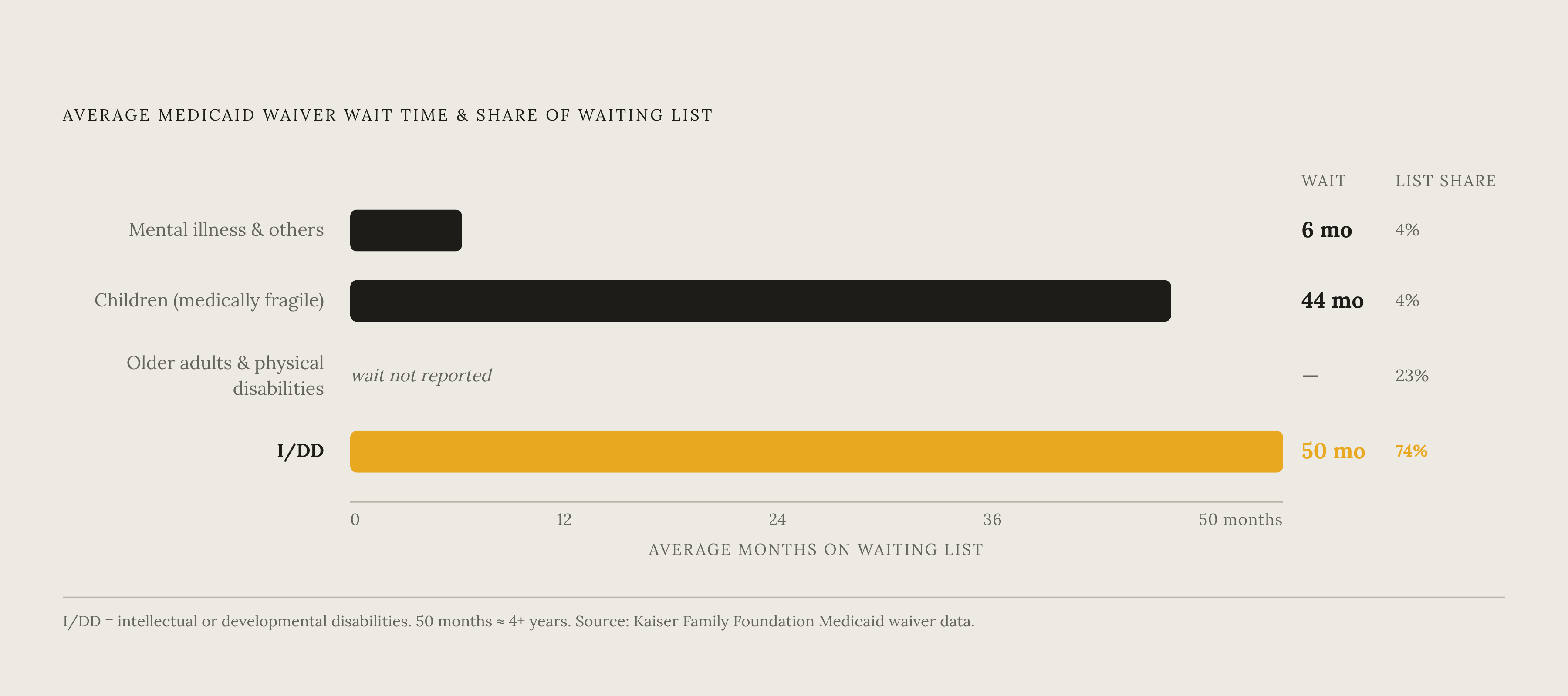
Average wait time across all waivers hit 40 months in 2024, according to CRS, but that average hides enormous variation by population. People with mental illness wait an average of 6 months. Children wait an average of 44 months. People with intellectual or developmental disabilities face the longest wait of any group, averaging 50 months, over four years, before a slot opens up. And it's the I/DD population that dominates these lists overall: they make up 74% of everyone on a waiver waiting list nationally. Older adults and adults with physical disabilities account for another 23%, and the remaining 4% is split across children who are medically fragile or technology-dependent, people with traumatic brain or spinal cord injuries, people with mental illness, and people living with HIV/AIDS.
State examples put a finer point on the abstract numbers. Wisconsin identified nearly 9,000 children in 2025 who qualified for a waiver but hadn't been enrolled in one. Indiana stood up a brand-new waiver for older adults that same year, and the list for it filled to nearly 13,000 people almost immediately, before most of those applicants had received a single hour of service.
What the official waiting list counts don't capture matters just as much as what they do. States that don't offer a given service at all have no waiting list for it, because there's no program to wait for, which makes the absence of a service invisible in the data. People already enrolled but receiving fewer hours than their care plan authorizes, because no provider in their area has capacity, don't show up on any list either. Neither do the people who never applied in the first place because nobody told them the program existed, which loops back to the very problem this piece opened with: a family that thinks Medicare is the answer never gets as far as learning Medicaid waivers exist to ask about.
There is a partial bridge available for people stuck on a list. Personal care through the regular Medicaid state plan, or specialized state plan HCBS benefits where a state offers them, can sometimes fill part of the gap while someone waits for a waiver slot. Families who know to ask specifically about these alternatives can reduce, though rarely eliminate, the gap in care during what might be a multi-year wait.
One structural fix is on the horizon, though it won't arrive quickly. Starting July 9, 2027, a new CMS final rule on access to Medicaid services will require states to report standardized information about their waiting list populations. Right now, comparing wait times or list sizes across states is genuinely difficult because each state tracks and reports this data differently. Standardization won't shorten anyone's wait, but it should make the scale of the problem visible in a way that's currently obscured by inconsistent recordkeeping.
How federal budget cuts are reshaping what states can actually deliver
Every mechanism described above, the population-specific waivers, the eligibility gates, the self-direction options, the waiting lists, operates inside a funding envelope that federal budget decisions directly control. Because HCBS is optional Medicaid spending while nursing facility care is mandatory, home and community-based services sit closer to the edge of the knife when federal Medicaid dollars tighten. States facing budget pressure have a legal option nursing homes don't offer them: they can cap, freeze, or shrink an optional waiver program without violating federal law, whereas cutting mandatory nursing facility coverage isn't on the table in the same way.
The 2025 reconciliation law referenced earlier in the eligibility discussion illustrates this dynamic directly. It opened a new waiver category for people below the institutional level of care threshold, expanding, on paper, who could theoretically qualify. But it paired that expansion with federal Medicaid spending cuts and a requirement that any new waiver avoid lengthening wait times on existing ones. That's a fairly narrow needle for a state to thread: build something new, serve a broader population, and somehow don't let anyone already waiting wait any longer. KFF's own assessment is that uptake on this new waiver type will likely stay low, precisely because the financial incentives built into the same law work against expansion rather than for it.
The cost-containment trend already documented in this piece, the enrollment caps, the per-participant spending limits, the hour restrictions on personal care, reads differently once framed against tightening federal Medicaid dollars. Fifteen states reported plans for new cost-containment strategies heading into fiscal year 2026, and that number sits inside a broader pattern where states are managing waiver programs as a cost center to be controlled rather than a service to be expanded. One might ask whether the newer, less restrictive waiver category and the tightening cost controls are actually pulling in the same direction at all, or whether they represent two different policy impulses, expansion on paper and contraction in practice, running side by side inside the same law.
None of this happens in isolation from the waiting list crisis covered earlier. A state under budget pressure has little room to open new waiver slots, which means the 600,000-plus people already waiting nationally have limited reason to expect that number to shrink meaningfully in the near term. Federal rules, like the 2027 reporting requirement on wait list data, will make the size of the problem more visible to the public and to policymakers. Whether that visibility translates into new funding, or simply better documentation of a shortage that persists regardless, is the open question this piece leaves for the next round of state budget cycles to answer.
Sources
- Medicaid Home Care (HCBS) in 2025 | KFF
- A Look at Waiting Lists for Medicaid Home- and Community-Based Services from 2016 to 2025 | KFF
- What is Medicaid Home Care (HCBS)? | KFF
- Medicaid Section 1915(c) Home- and Community-Based Services Waivers | Congress.gov | Library of Congress
- medicaid.gov
- Home & Community Based Services Authorities | Medicaid
- kff.org
- macpac.gov