Medicare Advantage vs Original Medicare
Lower premiums come with network limits and potentially higher out-of-pocket costs.

Medicare Advantage and Original Medicare both cover the basics of hospital and doctor visits, but the way they handle cost, provider access, and extra benefits diverges enough to change a person's financial exposure by thousands of dollars a year. In 2026, 55% of eligible beneficiaries, 35.2 million out of 64.2 million people with both Parts A and B, have chosen Medicare Advantage, up from 19% in 2007. That shift is worth noting as context for how the market has moved, not as a verdict on which structure actually serves a given person better.
Original Medicare is Parts A and B, run directly by the federal government on a fee-for-service basis. Part A covers inpatient hospital stays, skilled nursing facility care, hospice, and some home health services. Part B covers doctor visits, outpatient care, preventive screenings, and durable medical equipment. Neither includes prescription drugs, so anyone relying on Original Medicare typically needs a standalone Part D plan bought separately. What Original Medicare does offer, unconditionally, is access to any of the roughly 1 million providers nationwide who accept it, across every state, the nation's capital, and its territories. territories.
Medicare Advantage, or Part C, is different in kind, not just in detail. It's sold by private insurers approved by a federal health program overseer, and those insurers must cover everything Parts A and B cover, at minimum. Plans come as HMOs, PPOs, and private fee-for-service arrangements. Almost 9 in 10 MA plans in 2025 folded in Part D drug coverage, and most added extras Original Medicare simply doesn't touch: vision, dental, hearing, fitness benefits, transportation. The trade producing this is structural. One system is a government program with the same rules everywhere. The other is a marketplace of competing private products whose rules shift by plan, by insurer, and by zip code. That difference is the thread running through every section below.
How costs stack up (premiums, deductibles, and the out-of-pocket ceiling)
Start with Original Medicare's numbers for 2026, because they set the baseline everyone gets compared against. The Part B premium is $202.90 a month, up $17.90 from $185.00 in 2025. The Part B deductible rises to $283, up from $257, and once that's met, the beneficiary owes 20% of the approved cost for most services, with no annual cap on that exposure. Part A carries a hospital deductible of $1,736 in 2026 (up $60 from $1,676), though roughly 99% of beneficiaries pay no Part A premium at all thanks to sufficient work history. Long hospital stays get expensive fast: coinsurance runs $434 a day for days 61 through 90 (up from $419) and $868 a day for lifetime reserve days (up from $838).
That 20% coinsurance with no ceiling is the number that should give anyone pause. A single serious illness, a cancer diagnosis, an extended hospitalization, can generate a bill that keeps climbing because there's no backstop written into the program. That's the gap Medigap policies exist to close, a point that resurfaces later in this piece.
Medicare Advantage looks cheaper on the surface, and often is, at least at the premium level. The average MA plan premium for 2026 is $11.50 a month, down from $13.32 in 2025, though enrollees still owe the standard Part B premium on top of whatever the plan charges. About two-thirds of MA enrollees are in plans with no additional premium at all. Roughly 31% are in plans that actually reduce the Part B premium through a "giveback" benefit, often by a modest amount each month, which is a nice touch but not the kind of money that changes a budget.
The number that matters more is the out-of-pocket maximum: $9,250 for in-network care in 2026. That's the structural protection Original Medicare doesn't offer at all. Once an MA enrollee hits that ceiling, the plan picks up the rest for the remainder of the year. Individual plans can, and often do, set their limit lower than the federal maximum, and many plans' median out-of-pocket limits run well below $9,250. Prescription costs apply on both sides of this comparison regardless of which path someone takes: the out-of-pocket drug spending cap is $2,100. Original Medicare enrollees pay their Part D premium separately; MA enrollees usually get it bundled into the plan.
So does a lower premium mean lower total spending? Not necessarily, and that's the honest caveat here. Copay structures, prior authorization delays, and network restrictions all factor into what someone actually pays over twelve months. The real comparison isn't premium versus premium, it's total annual exposure given a person's expected use of the health system. The Better Medicare Alliance, the leading research and advocacy organization for MA, has reported that MA enrollees spend meaningfully less annually on premiums and out-of-pocket costs compared to fee-for-service Medicare. That figure comes from an industry-aligned source with a stake in the outcome, and independent estimates vary, so it stands as one data point among several rather than a settled fact.
The provider access trade-off: freedom versus network
Original Medicare's pitch on access is simple: any of the roughly 1 million providers nationwide who accept Medicare, no referral needed to see a specialist, and the same cost-sharing no matter which of those providers a patient picks. That's a meaningful freedom, and it's easy to underrate until it's the thing standing between a patient and a specific surgeon.
Medicare Advantage generally requires sticking to the plan's network for anything that isn't an emergency. Most MA plans are HMOs or PPOs. HMOs typically require a referral from a primary care doctor before a specialist visit is covered; PPOs allow out-of-network care, but at a higher price. Prior authorization, which requires the plan to approve a service before it happens, applies to a wide range of services under MA and occurs far less often under Original Medicare, which restricts it to a limited set of cases. In 2025, the average beneficiary could choose from 42 plans across 8 insurers in their county, which sounds like abundant choice until you notice that network breadth still varies a lot from plan to plan within that number.
Geography changes the calculation. Rural counties tend to have fewer MA plan options and narrower networks, while urban and suburban areas offer broader plan choice and wider provider panels. Anyone who splits time between two states, snowbirds especially, should pay close attention here: Original Medicare travels with the beneficiary anywhere in the country, but MA plans generally only cover emergency and some urgent care outside their service area. Neither program covers routine care abroad, though some Medigap policies include limited emergency coverage for travel outside the country.
Picture a person mid-treatment for cancer, whose oncologist doesn't participate in the MA plan they're considering switching to. Or a retiree who spends winters in one state and summers in another, needing consistent access in both places. Or someone whose preferred hospital system simply isn't in any local MA network at all. In these cases, network restriction isn't an inconvenience, it's a real cost, potentially forcing a choice between changing doctors or paying out-of-network rates.
None of that means MA's network model is a problem for everyone. Someone in stable health, seeing one primary care doctor locally and rarely needing specialists, may never notice the network boundary. Someone in a dense urban market with a broad PPO that includes most regional providers is in a similar position. The constraint limits which providers someone can see, but whether it bites depends entirely on how someone actually uses the health system, a question to ask before enrolling, not after.
What MA's extra benefits cover in 2026, and what's been pulled back
The extra benefits are the headline feature of Medicare Advantage, and for good reason. Routine vision, dental, and hearing coverage now appears in 98% or more of individual MA plans for 2026. Add to that fitness programs and gym memberships, transportation to medical appointments, allowances for over-the-counter items, and meal benefits, mostly aimed at chronically ill enrollees. None of it exists under Original Medicare, which is precisely why these extras have driven so much of MA's growth over the past two decades.
But the trend line for 2026 bends the other way. According to KFF, the over-the-counter item allowance dropped to 66% of plans in 2026 from 73% in 2025. Meal benefits fell to around 57% of plans. Remote access technologies (think telehealth monitoring tools) also declined from the prior year. Transportation benefits dropped to around 24% of plans. These aren't small movements. They represent a real narrowing of what a newly enrolling beneficiary can expect to receive compared to just a year earlier.
It's not just availability shrinking, either. Milliman's analysis found that benefit value has declined too. Standalone comprehensive dental limits fell roughly 8% from 2025 to 2026. Vision hardware limits (glasses, frames, that sort of thing) dropped about 15%, the second straight year of decline. Across general enrollment MA plans, the total value of supplemental benefits fell notably in 2026.
Why now? Tighter CMS reimbursement rates have squeezed the margins large national insurers use to fund these extras, pushing many to scale back or restructure what they offer. Anyone enrolled in, or considering, an MA plan should verify the supplemental benefits plan-by-plan, every single year, during open enrollment. What sold someone on a plan a couple of years ago might not exist in the same form come 2026.
Original Medicare's parallel option isn't extra benefits at all, it's Medigap, a private supplemental policy that covers cost-sharing (copays, coinsurance, deductibles) rather than adding services like dental or vision. Medigap doesn't do what MA's extras do. It does something MA can't: it closes the gap left by Original Medicare's uncapped 20% coinsurance. And critically, Medigap can't be purchased alongside an MA plan. It's an either/or choice tied to Original Medicare, which sets up the next problem, and it deserves close attention.
Why the Medigap enrollment window is a one-way door, and what that means for switching later
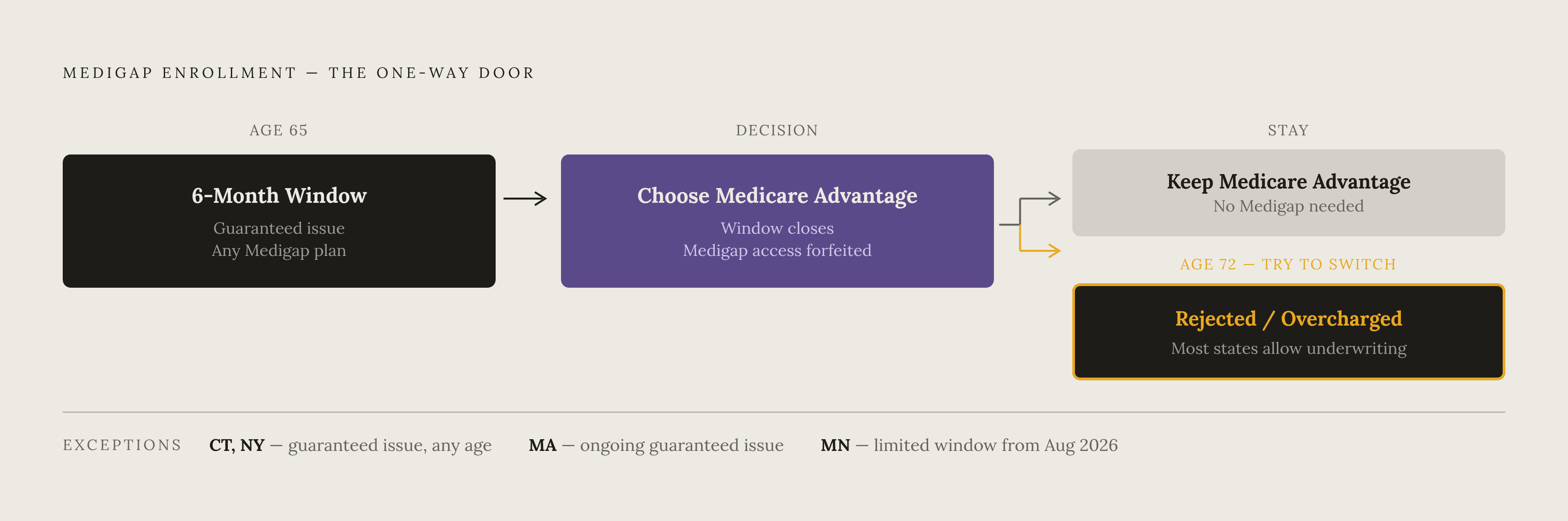
Switching from Original Medicare into a Medicare Advantage plan is easy. It can be done every year during the open enrollment window running October 15 through December 7, no health questions asked, no medical underwriting involved.
Switching back is where it gets complicated, though not in the way most people expect. The medical coverage change itself, going from MA back to Original Medicare, is simple enough to execute. The real obstacle is what happens next: getting Medigap coverage to fill the gap Original Medicare leaves open.
Guaranteed-issue rights for Medigap apply during a six-month window that starts the month a person turns 65 and has Part B in place. Inside that window, insurers have to sell a policy regardless of health status, generally without medical underwriting determining eligibility. Step outside that window, in most states, and insurers can reject an applicant for pre-existing conditions, charge substantially more, or delay coverage. That means someone who chooses MA at 65, then develops a chronic condition at 72 and wants to move back to Original Medicare, might find no insurer willing to sell them a Medigap policy at an affordable rate, or at all. Without Medigap, that person is back to facing Original Medicare's uncapped coinsurance exposure, the exact risk MA's $9,250 cap was protecting against.
A handful of states break from this pattern. Connecticut and New York require insurers to sell any Medigap policy at any time, regardless of health status. Massachusetts provides guaranteed Medigap issue rights on an ongoing basis. Minnesota had planned a limited annual guaranteed-issue window for ages 65 to 70 (usable once) starting in August 2025, but that rollout has been pushed to August 2026. Maine takes a narrower approach, requiring each Medigap insurer to designate one month a year when it must accept any applicant into its Plan A, which is a more limited policy than the fuller options.
So what does this actually mean for someone deciding at 65? Choosing MA while healthy is a completely reasonable decision, but it carries a cost that does not appear on any premium chart: the Medigap guaranteed-issue window closes, and it generally does not reopen. For caregivers helping a parent reassess their coverage years later, the math has to include a hard question: is Medigap even available to this person now, and if so, at what price? In most states, outside of the four with special protections, the answer might be "not affordably," which changes the entire calculation for switching back.
How health status, geography, and financial situation point toward one option or the other
None of this resolves into a single right answer, because the right answer depends on the specific person asking. But the dimensions above do sort into some recognizable patterns.
Original Medicare paired with Medigap tends to fit better for people managing complex or ongoing health needs, multiple specialists, cancer treatment, chronic disease management, where unrestricted provider access and predictable cost-sharing let them see any provider and avoid unpredictable bills even with a higher monthly premium. It also fits people who travel often, split the year between two states, or keep a second home somewhere warm in winter, since nationwide coverage without network limits becomes a practical necessity rather than a nice-to-have. It fits someone whose specific doctor or hospital system simply doesn't participate in any local MA plan. And it fits, urgently, anyone still inside their Medigap guaranteed-issue window who wants to lock in that protection before it closes, or anyone living in Connecticut, Massachusetts, New York, or (starting August 2026) Minnesota, where the cost of switching back later is considerably lower.
Medicare Advantage tends to fit better for people in relatively stable health with established local care relationships and little expectation of needing out-of-network providers. It suits residents of urban or suburban areas where plan choice and provider networks run wide. It suits anyone who values having drug coverage, dental, vision, and medical benefits bundled into a single plan rather than juggled across several. For someone on a tight budget, a $0-premium MA plan can mean real breathing room, and the $9,250 out-of-pocket cap offers a form of catastrophic protection that Original Medicare alone simply doesn't include. Special Needs Plans (SNPs), a category of MA plan built for people with specific chronic conditions, institutional care needs, or dual eligibility for Medicare and Medicaid, add another dimension to the picture. SNPs made up 23% of MA enrollment in 2026, and accounted for 85% of the program's net enrollment growth from 2025 to 2026, evidence that this corner of the market is becoming a primary growth engine, not a niche option.
A few questions cut through the noise faster than any chart. Do the doctors and specialists someone already sees accept the MA plan under consideration? What does realistic annual spending look like under each option, once premiums, deductibles, and likely copays are added up? Is this person still inside the Medigap guaranteed-issue window, and do they understand what's forfeited by not using it? Will they spend meaningful time outside a plan's service area during the year? Do they have conditions likely to trigger prior authorization requirements under MA?
There's no universal answer here, and that's by design, not a dodge. The right choice is the one that lines up with a specific person's health profile, their geography, and their finances, which is exactly why this piece worked through each dimension separately rather than declaring a winner. For families navigating this alongside other financial pressures, caregiver responsibilities, Medicaid eligibility questions, benefits that go unclaimed simply because nobody knew to look, tools that help surface the fuller picture of what a person qualifies for can make the Medicare Advantage versus Original Medicare decision easier to place in context, rather than treating it as an isolated choice made in a vacuum.