Medicare Initial Enrollment Period Rules
Missing this 7-month window means permanent premium penalties and coverage gaps you can't undo.

Missing a deadline inside the IEP, a fixed, 7-month window tied to your 65th birthday governing your first opportunity to enroll in Medicare Parts A, B, C, and D, brings permanent consequences. This piece walks through the structure, the timing traps, and the financial stakes in the order a person approaching 65 actually encounters them.
The Medicare Initial Enrollment Period's 7-month window
The IEP is a fixed 7-month window built around a single anchor point: the month someone turns 65. It opens 3 months before that birthday month, includes the birthday month itself, and runs 3 more months afterward. Someone turning 65 in August, for instance, has an IEP that opens May 1 and closes November 30. All four parts, A, B, C, and D, become available for enrollment during this window.
Not everyone has to take action to get started. People already collecting Social Security benefits by 65 are typically enrolled automatically in Parts A and B. Those who have not yet claimed Social Security have to apply on their own, either through ssa.gov, by phone, or in person at a local Social Security office, and automatic enrollment covers only Parts A and B. Anyone who wants prescription drug coverage still has to actively sign up for Part D.
The penalties attached to late enrollment are not arbitrary bureaucratic friction. Penalties exist to prevent adverse selection, since if only sick people waited to enroll until they needed care, the program's risk pool would collapse. That's the foundation. Everything that follows is about how the window's internal timing, not just its existence, determines outcomes.
The day you enroll within the IEP determines when your coverage starts
Enrolling anywhere inside the 7-month window counts as enrolling "on time." Enrolling at different points within the same IEP produces coverage start dates that vary by as much as several months, a gap that can leave a person uninsured after 65 even though they enrolled on time.
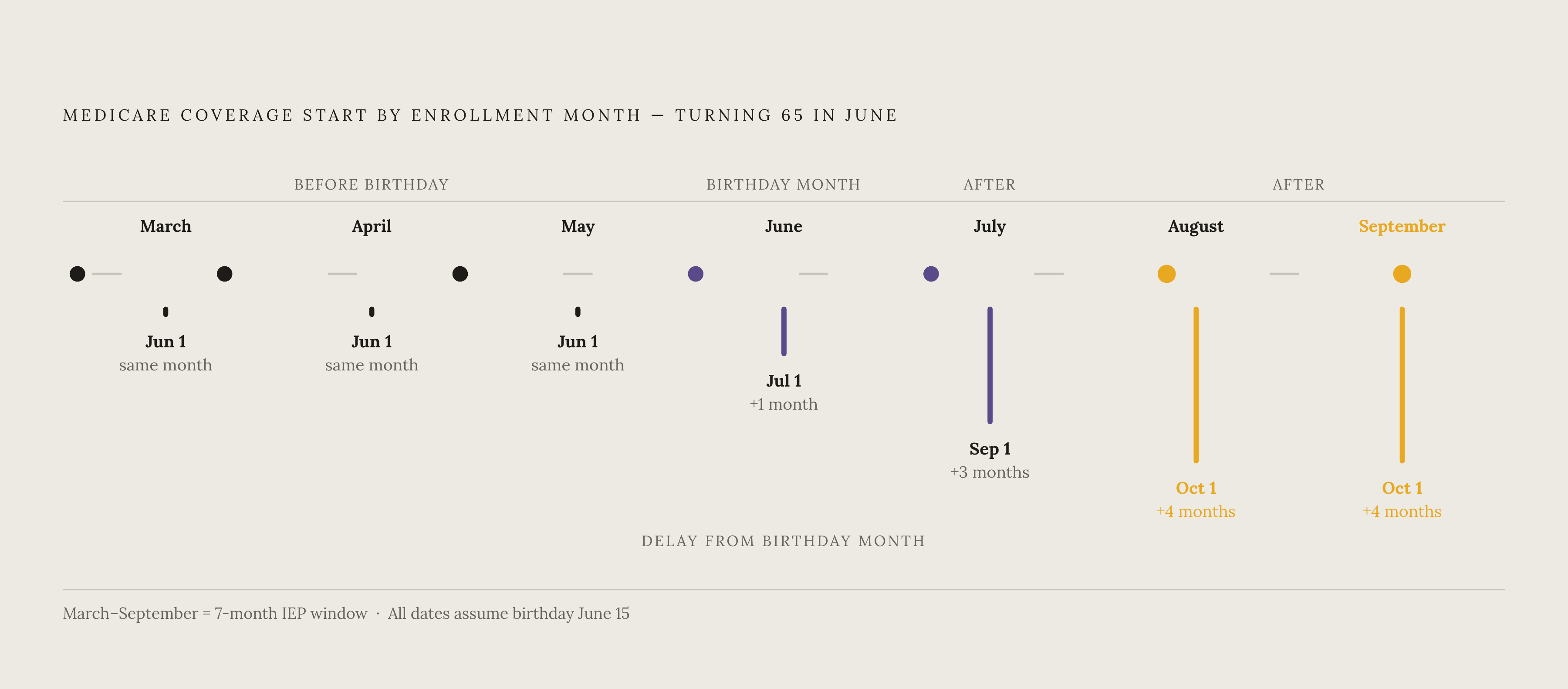
Consider someone turning 65 in June. Enroll in any of the 3 months before your birthday month, and coverage starts the first day of your birthday month.
Wait until the birthday month or later, and the start date pushes out even though nothing about the enrollment itself was late.
This matters because it's easy to conflate this delay with the late-enrollment penalty covered later in this piece. They are not the same thing. This is structural delay, not a punishment. A person can follow every rule, enroll inside their IEP, and still spend weeks or months without coverage simply because of which month inside that window they chose, while the penalty applies only to people who miss the window entirely. Confusing the two leads some people to assume they are safe as long as they enroll "sometime during their IEP," when timing inside the window carries its own real cost.
The birthday-on-the-first rule that shifts the entire window one month earlier
If a birthday falls on the 1st of any month, Medicare treats the person as eligible the month before their birthday month, shifting their entire IEP and coverage start dates one month earlier than expected.
The mechanism is a quirk of how Medicare calculates age for eligibility purposes: someone born on the 1st is considered to have turned 65 in the preceding calendar month, not their actual birth month. Someone born June 1 has Medicare eligibility beginning May 1, and their IEP is built around May, not June.
Why does this trip so many people up? Because standard explanations of the IEP rarely mention it. Most summaries describe the "3 months before, birth month, 3 months after" structure without flagging the 1st-of-the-month exception, so someone born June 1 who believes they're enrolling "the month before my birthday" by signing up in May has actually enrolled during what Medicare considers their birthday month, triggering the one-month coverage delay described in the previous section. There is no workaround. The shift applies automatically, with no exception process available.
B|Anyone whose birthday lands on the 1st should confirm the actual IEP start date directly with Social Security rather than counting backward from the calendar birthday. It's a small detail with an outsized consequence for people who miss it.
The IEP for people under 65 who qualify through disability or serious illness
The IEP is built around a different milestone for people who qualify for Medicare through disability or a serious diagnosis, and the rules shift meaningfully depending on the qualifying condition.
The 24-month SSDI waiting period means many people do not realize Medicare is approaching until it is nearly upon them. The system does build in a safety net here: after 24 calendar months of SSDI benefits, enrollment in Parts A and B happens automatically, without the beneficiary needing to file anything.
ALS follows a different, far more urgent timeline. Medicare coverage begins the same month disability benefits start, with no 24-month waiting period at all. Contrast that with End-Stage Renal Disease, where eligibility begins within a few months of diagnosis, conditioned on the Social Security tax history of either the beneficiary or their spouse. Unlike the SSDI pathway, ESRD enrollment does not happen automatically. It requires the beneficiary to actively apply, so a diagnosis alone does not guarantee coverage arrives on schedule.
The permanent penalty for missing Part B enrollment
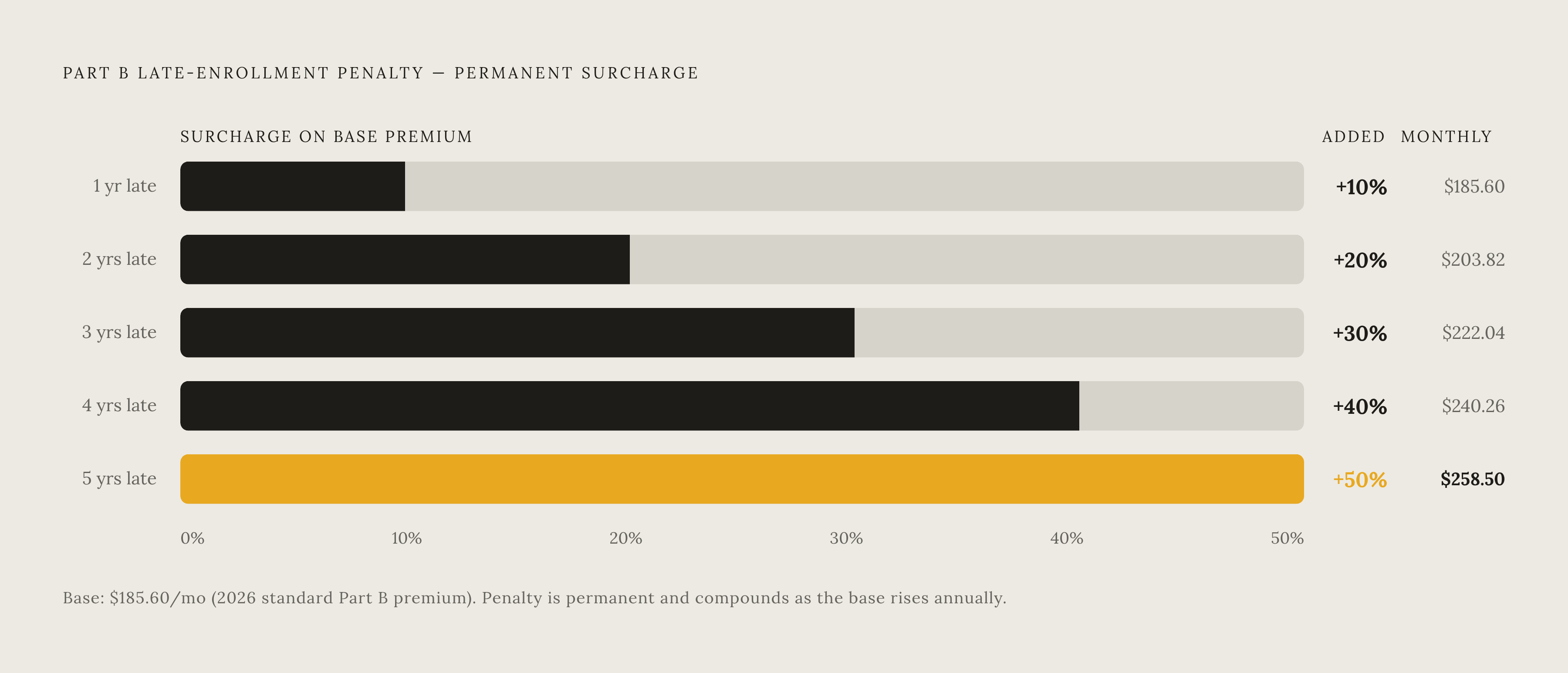
The Part B late-enrollment penalty is permanent, it recalculates upward every time the base premium rises, and across a full retirement it adds up to a real, avoidable cost, turning the stakes from inconvenient to financially serious.
The math is straightforward but unforgiving. For every full 12-month period someone was eligible for Part B but didn't enroll, the monthly premium increases by 10%, and that increase applies for as long as the person has Part B, indefinitely. The 2026 standard Part B premium serves as the baseline the penalty percentage gets applied against. It compounds against a premium that itself climbs most years, so the actual dollar penalty grows even if the percentage attached to it never changes.
Part A works differently, and the distinction matters. Most people receive Part A premium-free based on their own work history or a spouse's, so the Part A late-enrollment penalty comes up far less often, and when it does apply, it's temporary rather than permanent. Part D carries its own separate penalty, triggered by 63 or more consecutive days without creditable prescription drug coverage after the IEP closes.
The window begins 3 months before the birthday month, includes the birthday month, and extends 3 months after. Confusing one for another is how people end up assuming they are protected when they are not.
When delaying enrollment is legal
Delaying isn't automatically a mistake. Active employer coverage is the one broadly recognized legitimate reason to put off IEP enrollment without triggering a penalty, but the rules governing exactly when that exception applies get misunderstood often enough that the exception itself becomes the trap.
Everything hinges on employer size. Working for a company with 20 or more employees makes Medicare the secondary payer, and Part B can be deferred without penalty for as long as active employment and coverage continue. Fall below that threshold, and Medicare pays first, with a job-based plan covering little or nothing on claims if the person hasn't enrolled in Medicare. Missing that gap in coverage usually isn't discovered until after a medical event has already happened, the worst possible time to find out. Plenty of workers approaching 65 simply don't know where their employer falls relative to that 20-employee line, and that number decides whether deferring Part B is safe or financially dangerous.
Once employer coverage ends, either through retirement or a change in plan, an 8-month Special Enrollment Period opens, starting the month after employment or coverage ends, whichever happens firstc34.
The sharpest trap sits inside that transition, and it involves COBRA. COBRA does not count as creditable coverage for SEP purposes. Someone who leaves a job and elects COBRA has their 8-month SEP clock start ticking from the date employment ended rather than from the date COBRA coverage eventually runs out. That distinction has real teeth. A person who retires, takes COBRA for 18 months assuming they have 8 months from COBRA's end, and then tries to enroll in Medicare will find their SEP has already expired and will face permanent penalties.
Drug coverage carries a parallel wrinkle. If an employer plan includes prescription coverage that qualifies as creditable, paying at least as well as standard Part D, enrollment in Part D can also be deferred penalty-free. But that protection isn't automatic or assumed. The employee has to obtain written confirmation of creditable status from the plan each year and keep that documentation on file, because it's the proof that gets requested if Part D enrollment happens later and the penalty question comes up.
The HSA conflict: why premium-free Part A still carries a cost for some workers past 65
Here's an objection the standard advice to "just enroll as early as possible" doesn't handle well. Enrolling in Part A, even when it costs nothing in premiums, ends eligibility to contribute to a Health Savings Account for every month Medicare coverage is active, though contributions for months earlier in the same year, before Medicare started, remain allowed on a pro-rated basis. For a high-earning worker past 65 who has been using HSA contributions as a tax-advantaged retirement savings tool, that's a real financial cost hiding inside a benefit that's supposedly free.
The rule leaves no room for negotiation. Enrolling in Part A, even when it is premium-free, disqualifies a person from contributing to a Health Savings Account for each month Medicare coverage is in effect, though contributions for prior eligible months in the same year are still permitted on a pro-rated basis, creating a genuine financial cost for high-earning workers past 65 who use HSA contributions as a tax-advantaged retirement vehicle. There's no carve-out for the fact that Part A is premium-free, and no partial-year workaround beyond the pro-rating already described. This creates a documented, legitimate reason for some workers to defer even premium-free Part A enrollment, but it requires active employer coverage that qualifies as primary insurance, careful coordination, and documentation to avoid penalties when Medicare enrollment eventually begins.
This trade-off doesn't apply broadly. One might argue it's a niche concern, and in a sense it is: it matters specifically to someone still working past 65, earning enough for HSA contributions to be meaningful, actively contributing already, and employed by a company with 20 or more workers. For most people approaching 65, none of that applies, and delaying Part A over an HSA conflict would be the wrong call. But dismissing the conflict entirely would oversimplify the picture for the minority it does affect. The right move is to weigh the trade-off against individual financial circumstances rather than ignore it or treat it as a reason everyone should delay. It's to weigh it against individual financial circumstances, ideally before the IEP opens rather than after the enrollment window has already narrowed the available options.
Missing the IEP: the General Enrollment Period and its limits
Missing the IEP without a qualifying Special Enrollment Period isn't the end of the road. The General Enrollment Period offers a genuine second chance to get enrolled, but it does not erase the late-enrollment penalty already accrued. It only restores access to coverage.
The GEP runs January 1 through March 31 each year, open to anyone who missed their IEP and doesn't qualify for a Special Enrollment Period. Coverage under the GEP now starts the first day of the month after enrollment, a meaningful improvement over the older rule that held everyone's coverage until July 1 regardless of when during the window they actually signed up. This change was made by the Consolidated Appropriations Act of 2021.
Enrolling in the GEP still triggers the Part B late-enrollment penalty for every full 12-month period without coverage; the GEP provides access, not amnesty. Access, not amnesty, is the right way to think about what the GEP provides. And it only covers Part B. Parts C and D require separate enrollment steps taken afterward, on their own timelines.
Enrolling in the first three months of the IEP guarantees coverage starts exactly when someone turns 65, with no gap and no penalty. The employer-coverage Special Enrollment Period is the legitimate fallback, provided the COBRA timing and documentation traps are understood and avoided. The General Enrollment Period sits at the bottom of that hierarchy: real, available, but carrying a permanent cost that follows a beneficiary for the rest of their time on Medicare. The underlying rules don't bend for anyone's convenience, and understanding them before the IEP opens remains the only real protection against a penalty that, once triggered, never goes away.
Sources
- Medicare Enrollment Periods & Deadlines 2026 | TrustInsure NC
- When does Medicare coverage start? | Medicare
- What Is the Penalty for Late Enrollment in Medicare?
- Medicare Part D Late Enrollment Penalty: What You Need to Know
- Medicare Initial Enrollment Period (IEP) | UnitedHealthcare
- Born on the 1st of a month, Medicare backdates a month, effect on 3 months after? | Insurance Forums
- 5 things you need to know about signing up for Medicare | CMS
- Original Medicare (Part A and B) Eligibility and Enrollment | CMS