Medicare Coverage Gaps and Out-of-Pocket Costs
Original Medicare leaves beneficiaries exposed to unlimited costs with no annual cap.

Medicare covers roughly 70 million Americans, and most of them enroll believing the program handles the bulk of their health costs. It does, up to a point. Original Medicare was never built with a ceiling, and that single design omission is the thread running through every section below. This piece maps where the gaps sit, what they cost in 2026 dollars, and where beneficiaries actually have options to close them, versus where they're just stuck.
Why Original Medicare leaves beneficiaries facing unexpected bills
Start with a number: 29% of Medicare households spend at least a fifth of their total household budget on health-related costs, compared to 7% of non-Medicare households. That gap is what happens when a program has no annual out-of-pocket maximum. It is what happens when a program has no annual out-of-pocket maximum.
The Commonwealth Fund, in research cited by AARP, found that one in five adults of Medicare age faced more than $2,000 a year in total out-of-pocket health costs. That number sits oddly next to the assumption most people carry into enrollment, which is that Medicare "covers" them the way employer insurance once did.
It doesn't, and the reason is structural rather than incidental. Neither Part A nor Part B carries an annual out-of-pocket cap. Private insurance plans typically carry annual out-of-pocket limits that protect enrollees. Original Medicare has no such limit written into it anywhere. Deductibles reset, coinsurance percentages apply indefinitely, and a beneficiary with a bad year (a hospital stay, a cancer diagnosis, a slow recovery) can watch costs accumulate with no backstop in sight. Every section that follows is really just a variation on this same missing ceiling.
Part B's Unlimited 20% Coinsurance Costs to Beneficiaries Over Time
Part B is where that missing ceiling does the most damage, because Part B is coinsurance without an endpoint.
The standard monthly premium for Part B in 2026 runs $202.90. Higher earners pay more through IRMAA, the income-related monthly adjustment amount, with total monthly premiums ranging from $284.10 up to $689.90 depending on bracket. Before any coverage kicks in, there's an annual deductible of $283.
After that deductible is met, Medicare pays the large majority of the approved amount for outpatient services, and the beneficiary covers the remaining 20%. Every physician visit, every outpatient surgery, every round of chemotherapy, every piece of durable medical equipment (wheelchairs, oxygen concentrators, hospital beds) carries that same 20% exposure. Twenty percent sounds manageable for a single office visit, and it is. It stops sounding manageable across months of chemotherapy infusions, where each session's 20% stacks on the last with nothing to stop the total. No cap, no relief, just a running percentage applied indefinitely across however many services a year happens to require. That is the mechanism in full, and it is the part of Medicare that surprises people who assumed "20%" meant a small, one-time number rather than a permanent tax on treatment.
Part A hospital cost-sharing: the per-benefit-period deductible and daily coinsurance charges
Part A runs on a different clock, and it is the clock, not the dollar amount, that catches people off guard.
The Part A inpatient deductible is $1,736 in 2026, and the detail that matters most is that this deductible applies per benefit period, not per year. A benefit period starts the day someone is admitted as an inpatient and ends once they've been out of the hospital, or a skilled nursing facility, for 60 consecutive days. So a beneficiary hospitalized in March, discharged, then hospitalized again in June after a gap longer than 60 days, could owe that $1,736 deductible twice in a single calendar year. There is no annual reset working in the beneficiary's favor here, only the 60-day rule, and it trips people up constantly because they assume "deductible" means "once a year" the way it does with most insurance.
Inside a benefit period, days 1 through 60 are covered once the deductible is handled. Days 61 through 90 add a daily coinsurance of $434. Past day 90, a beneficiary draws on lifetime reserve days, priced at $868 a day, and there are exactly 60 of those across an entire lifetime. Once they're gone, they don't come back. A long hospitalization, or a bad string of them, can burn through that reserve permanently, leaving nothing in the tank for whatever comes next.
Inflation Reduction Act Changes to Part D Drug Costs
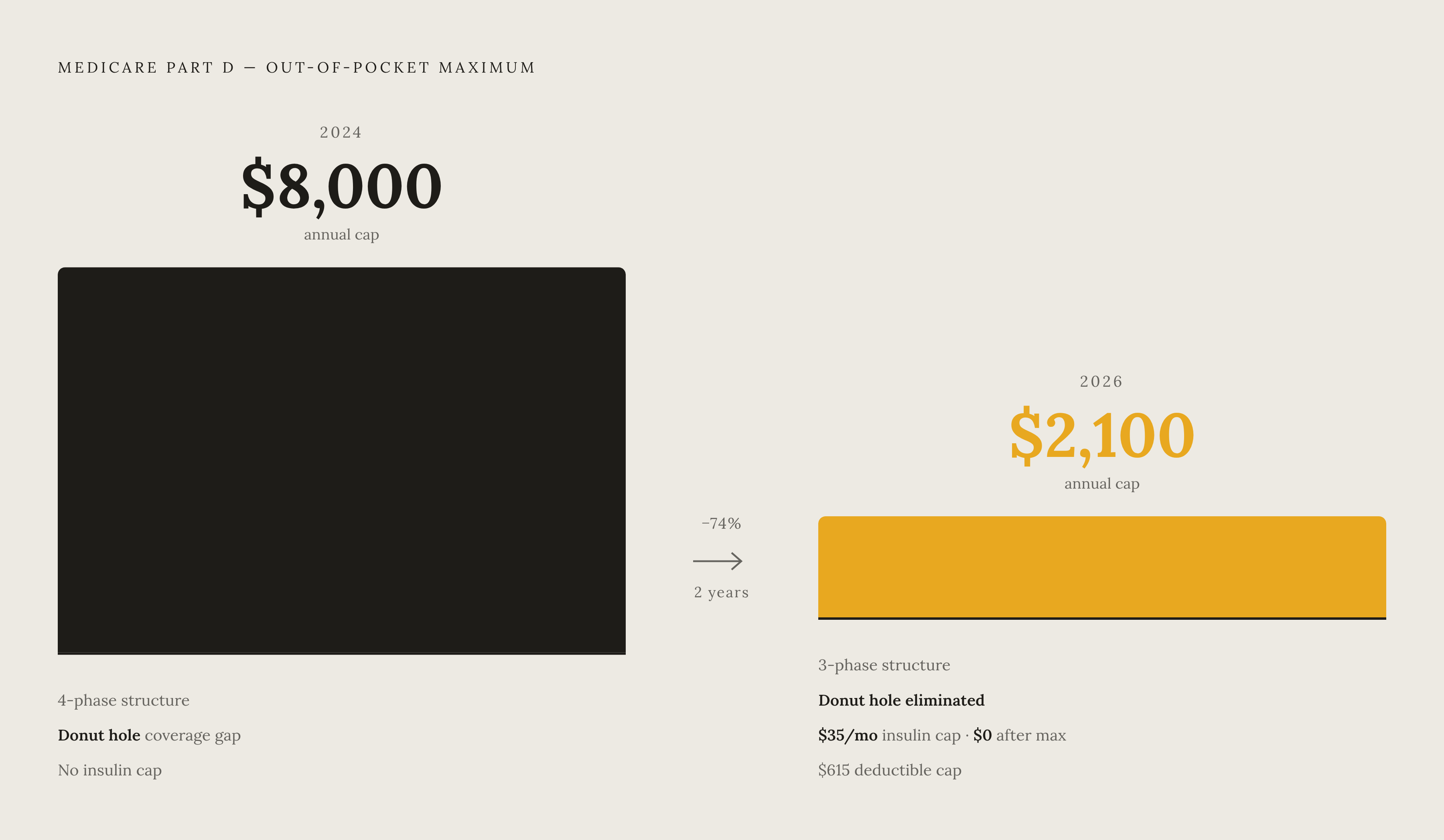
Part D has seen the most consequential legislative change of any part of Medicare in recent memory. What it left standing deserves just as much clarity. Part D has seen the most consequential legislative change of any part of Medicare in recent memory, and what it left standing deserves just as much attention.
The donut hole, the coverage gap where beneficiaries once paid a disproportionate share of drug costs after exceeding an initial coverage limit, was eliminated as of January 2025. The four-phase cost structure that had defined Part D for over a decade collapsed into three phases. As recently as 2024, the out-of-pocket maximum for Part D sat at $8,000. In 2026, the annual deductible a plan may charge is capped at $615, the out-of-pocket maximum drops to $2,100, and once a beneficiary crosses that line, covered drugs cost $0 for the rest of the calendar year. Insulin, under its own separate cap, runs no more than $35 a month regardless of type or plan. That is real relief, and measured against the $8,000 ceiling from two years earlier, it is not a small one.
But the $2,100 cap has edges, and beneficiaries who don't know where those edges sit are the ones who get caught. Monthly premiums don't count toward it, so a beneficiary is still paying that premium every month on top of whatever accrues toward the cap. Only drugs on a plan's formulary count at all, so a drug the plan doesn't cover, or covers only at a high tier, can generate real out-of-pocket spending entirely outside the capped structure. The average stand-alone Part D premium is projected at $34.50 a month in 2026, against $11.50 for the average Part D premium bundled inside a Medicare Advantage plan.
No spending cap touches formulary design, which is the deeper issue. Each plan builds its own list of covered drugs and sorts them into cost tiers, so a medication that's cheap on one plan's formulary can be expensive, or simply uncovered, on the plan next door. Two beneficiaries with the same diagnosis, enrolled in different Part D plans, can end up with wildly different annual drug costs even though both are protected by the same federal cap. The Inflation Reduction Act was never going to fix that, because a price cap cannot force two private plans to build identical formularies. That leaves the shopping burden squarely on beneficiaries, and it has to be repeated every year during open enrollment, since formularies change annually even when a beneficiary's own prescriptions don't.
The 10 negotiated drug prices that took effect in January 2026
January 2026 marked something the program had never done before: Medicare negotiated prices directly with drug manufacturers, and those negotiated prices took effect for 10 drugs under Part D.
The negotiated prices carry a minimum discount of 38% off each drug's 2023 list price. The 10 drugs chosen for this first round are brand-name medications with no generic competition, selected because they rank among the largest drivers of total Medicare spending. Between them, they treat cancer, diabetes, blood clots, heart failure, autoimmune conditions, and chronic kidney disease, conditions that together account for a substantial share of the chronic disease burden among people 65 and older.
The projected impact runs to $1.5 billion in annual out-of-pocket savings for beneficiaries and $6 billion in savings for the Medicare program overall. Those are program-wide estimates, not a guarantee for any one person, since actual savings depend entirely on which of the 10 drugs someone takes and which plan they're enrolled in. What matters beyond the dollar figures is the precedent. Direct price negotiation was barred by statute for the entire history of the program until this round, and the mechanism now exists to expand the negotiated list in future years. That is the part likely to matter most a decade from now, long after the specific 38% figure has been superseded by whatever the next round produces.
The four services Original Medicare does not cover at all: dental, vision, hearing, and long-term custodial care
Everything covered above involves cost-sharing: Medicare pays part of the bill, the beneficiary pays the rest. These four categories work differently. Medicare doesn't pay part of the bill here. Outside a narrow set of exceptions, it pays none of it.
Dental
Original Medicare covers dental work only when it's medically necessary for a separately covered procedure, never for routine care. Cleanings, fillings, extractions, dentures: none of it is covered under standard circumstances. A single crown, dentures, a dental implant, and even routine preventive visits generate real out-of-pocket costs with no Medicare coverage to offset them, and major restorative work can run into the thousands or tens of thousands of dollars. Some Medicare Advantage plans add dental benefits, but the annual dollar caps on those benefits tend to run low enough that major restorative work still lands substantially on the beneficiary anyway.
Vision
Part B covers an annual glaucoma screening for those at high risk, an annual diabetic retinopathy exam, and cataract surgery along with one pair of glasses or contacts afterward. Outside that post-cataract exception, routine eye exams for glasses or contacts go uncovered, and so does the eyewear itself.
Hearing
Original Medicare doesn't cover routine hearing exams or hearing aids, and hearing aids alone can run into the thousands of dollars. The exclusion isn't purely financial, either: skipping hearing treatment for cost reasons can carry health consequences that compound the longer they sit unaddressed.
Long-term custodial care
This is the largest gap in the entire program, and probably the least understood one. Medicare.gov states that Medicare does not cover custodial care when that's the only kind of care someone needs, and most nursing home care falls into exactly that category. Custodial care means help with basic activities of daily living: bathing, dressing, eating, transferring, using the bathroom. That is not skilled nursing, and Medicare's coverage of skilled nursing facility stays is narrow and time-limited in its own right.
A substantial share of people turning 65 will need some form of long-term care during their lifetime. Industry surveys consistently put the national median cost of a semiprivate nursing home room well into the six figures annually, with a private room running higher still. Assisted living runs roughly $74,400 a year, and a full-time home health aide runs about $6,900 a month. Medicaid remains the primary payer for long-term custodial care nationally, but Medicaid eligibility requires limited income and assets. Most middle-class beneficiaries have to spend down savings before they qualify.
Fidelity's widely cited $185,500 lifetime health care cost estimate for retirees excludes long-term care. So for anyone who ends up needing custodial care, the real lifetime number sits meaningfully above that figure, and the gap between the two is essentially the size of this entire uncovered category.
How Medicare Advantage shifts some gaps while introducing others
Medicare Advantage, or Part C, is not a patch on Original Medicare so much as a different structure entirely, and it is honest to say it fixes one of the biggest problems above while leaving several others in place and introducing at least one new one.
What it fixes is the missing ceiling. In 2026, MA plans carry an annual out-of-pocket maximum of $9,250 for in-network care and $13,900 if out-of-network care is included, a single protection Original Medicare lacks completely. Many MA plans also bundle in dental, vision, and hearing benefits, precisely the categories Original Medicare excludes. The average monthly MA premium is projected at just $14.00 in 2026, and a large share of plans carry no premium. That combination, a real cap plus extra benefits plus a low headline premium, is the pitch, and it's a genuine one as far as it goes.
It also explains the enrollment trend: a majority of Medicare beneficiaries are projected to be enrolled in Part C in 2026, and total Part C spending is projected to grow from $586 billion that year to $1.3 trillion by 2035, an average annual growth rate of 9.2%. Medicare Advantage is on track to be how most Medicare beneficiaries get their coverage within a few years. It is on track to be how most Medicare beneficiaries get their coverage within a few years.
What it doesn't reliably fix is access. Network restrictions sit at the top of that list. More MA plans are moving toward HMO structures with narrower provider networks, and hospitals and physician practices have been dropping out of MA networks over reimbursement disputes and prior authorization burdens. A beneficiary can enroll in January with a preferred cardiologist in-network, only to find that same doctor out-of-network by summer, with no recourse until the next enrollment window. Dental, vision, and hearing benefits inside MA plans also vary enormously by carrier, and the annual dollar caps on them tend to run low enough that major procedures still leave real exposure.
Skilled nursing facility coverage carries its own quiet wrinkle. MA plans must match Original Medicare's minimum SNF benefit by law, but some plans add copayments for days 1 through 20, a stretch where Original Medicare charges nothing. For a beneficiary moving from an extended hospital stay into a SNF, that copay structure can generate a bill that simply would not exist under Original Medicare's rules for those same early days. The lesson, if there is one: the cap protects against catastrophe, but it doesn't mean every dollar works the same way it would under the original program.
Prior authorization: the access gap that doesn't show up on a cost sheet
Every gap discussed so far is a dollar figure, something a beneficiary can, in theory, budget around. This last one is different, because it concerns not what something costs but whether a service happens at all, and when.
Prior authorization, the requirement that a plan sign off on a service before covering it, has historically been far more common inside Medicare Advantage than under Original Medicare. That is starting to change. Starting in January 2026, a six-year pilot program introduced prior authorization requirements for certain Part B services in six states: Arizona, New Jersey, Ohio, Oklahoma, Texas, and Washington. That is a real expansion of a practice Original Medicare beneficiaries had, until now, been mostly shielded from.
Why should that matter as much as, arguably more than, anything on a cost sheet? Because a denied or delayed authorization never appears on a bill. It appears instead as a treatment that gets postponed, appealed, or quietly abandoned. A beneficiary can plan around a known deductible with a spreadsheet and a little discipline. Planning around a claims process that decides, after the fact, if a procedure counted as necessary is a different problem entirely, and it's one dollars alone can't solve. The scale of that friction inside Medicare Advantage today is why the six-state pilot draws so much attention: it tests whether the same administrative gatekeeping shaping the MA experience is now heading into Original Medicare, a program that, until this pilot, had been defined in large part by not needing anyone's permission first.