Medicare and Employer Coverage Coordination Rules
Employer size determines which insurance pays first when you turn 65 or qualify for disability.

Medicare doesn't ask which plan you'd rather pay first. Federal rules decide that based on employer size, employment status, age, and the reason you qualified for Medicare in the first place, and none of that logic is printed anywhere on your insurance card. Get the order wrong and the consequences aren't abstract: claims bounce back unpaid, coverage gaps open when you least expect them, and a late enrollment penalty can attach to your Part B premium for the rest of your life. Age-based Medicare, disability-based Medicare, active employment versus COBRA or retiree coverage, and the kidney-failure track aren't one system with four exceptions. They're four separate rulebooks, and the single costliest habit in this whole area is assuming any one of them tells you how the others work.
The 20-employee rule for workers 65 and older
Coordination of benefits decides which plan pays a claim first, up to its limits, and which one covers whatever's left. For a worker 65 or older still on the job, the entire question turns on one number: does the employer have 20 or more employees?
At a company with 20 or more employees, the employer's group health plan pays first and Medicare pays second. Federal rules back this up: the employer must offer Medicare-eligible workers the same health benefits it offers other employees. Turning 65 isn't a legal trigger for pushing someone off the group plan and onto Medicare.
At a company with fewer than 20 employees, the arrangement flips. Medicare becomes primary and the employer plan drops to secondary, and this is where people get burned. It's the single most expensive misunderstanding in this entire topic. Someone at a small employer skips Medicare enrollment at 65 because the job's insurance seems to have them covered. Then a claim comes in and the employer plan pays nothing, because it was built to pay after Medicare covers its share first. If Medicare was never enrolled to pay first, there's nothing for the employer plan to coordinate against, and the bill lands entirely on the patient. It's the default failure mode of this rule, and it happens to people who did nothing wrong except trust that "I have insurance through work" meant the same thing at a 12-person company that it means a... It's the default failure mode of this rule, and it happens to people who did nothing wrong except trust that "I have insurance through work" meant the same thing at a 12-person company that it means at a much larger one.
Counting to 20 isn't a headcount on any given afternoon. The rule counts full-time and part-time employees together, and a worker doesn't need to be on shift that day to count toward the total. The threshold applies if the employer had 20 or more employees for each working day in 20 or more calendar weeks, in the current year or the year before, run as a rolling, cumulative test rather than a snapshot.
If a health plan covers workers from several different employers, and even one of those employers has 20 or more employees, the large-employer rule governs everyone in the plan. Someone employed by a five-person business, enrolled through an association or multi-employer arrangement, can get pulled into primary-payer status they never asked for, simply because a much bigger company shares the same plan.
The separate 100-employee threshold for disability-based Medicare
Medicare eligibility based on disability, before age 65, runs on a different rule entirely: a 100-employee threshold, not 20. Treating the two thresholds as interchangeable is one of the more expensive mistakes a plan administrator or a beneficiary can make, and it happens more often than it should, precisely because the logic feels like it should be the same.
At an employer with 100 or more employees, classified as a large group health plan under these rules, someone who qualifies for Medicare through disability and whose coverage is tied to current employment (their own job or a family member's) gets the employer plan as primary. Medicare pays second.
Below that 100-employee line, the dynamic flips. Medicare is generally primary, and the employer isn't legally required to match the coverage it gives everyone else, though nothing stops it from offering secondary coverage voluntarily. Some do. Most don't bother.
The multi-employer trap applies here too, and works almost identically to the age-based version. If at least one employer participating in a multi-employer plan has 100 or more employees, Medicare becomes secondary for every disabled participant in that plan, including people who work for much smaller member employers who'd otherwise sit under the 100-employee line on their own.
ESRD and the 30-month coordination period that overrides employer size
A kidney-failure-based category of Medicare ignores both size thresholds above. During the ESRD 30-month coordination period, the employer group health plan pays primary no matter how big or small the employer is. A five-person business's health plan still pays first during this window, and that's a genuine exception, not a loophole. It exists because dialysis and transplant care carry substantial costs that the coordination rules are designed to ensure the group health plan covers during this window.
The 30-month clock runs from the date of eligibility tied to that kidney-failure-based coverage, and confusing the relevant start date throws off every downstream calculation about when Medicare actually becomes primary.
Once the 30 months elapse, Medicare flips to primary payer and the employer plan moves to secondary. Throughout the coordination window itself, group health plans can't impose higher costs or restrict services for ESRD patients differently than for other enrollees.
What happens if someone is already on Medicare for age or disability when ESRD develops? The 30-month coordination period still kicks in, but it doesn't erase the coordination rules already governing that person's other Medicare. The two frameworks run side by side. ESRD Medicare doesn't override an existing age-based or disability-based arrangement. It layers on top of it.
Why retiree coverage and COBRA do not protect you the way active coverage does
Everything above depends on one phrase doing a lot of quiet work: "group health plan" status under Medicare Secondary Payer rules requires that coverage be tied to current, active employment. Retiree coverage and COBRA both fail that test, regardless of which employer originally sponsored the plan, and this is where the whole system stops being intuitive.
Retiree coverage looks and feels like the same insurance someone had while working. Once Medicare enters the picture, it isn't treated that way. A retired person who enrolls in Medicare gets Medicare as primary and the retiree plan as secondary, even if that retiree plan comes from a large employer that would have been squarely primary during active employment. Retirement is the switch that flips, not age.
COBRA works the same way, even though it's legally a continuation of the exact plan someone had on the job. CMS doesn't treat COBRA as current-employment coverage. Once someone is Medicare-eligible, Medicare pays first and COBRA pays second, and there's no exception for how recently the person left the job.
The trap compounds step by step. Someone turns 65, skips Medicare enrollment, and leans on COBRA instead, assuming it works like the job-based coverage it replaced. Three problems stack on top of each other from there. COBRA premiums come with no employer subsidy anymore, and the full cost often strains a fixed retirement budget in a way the same coverage never did while employed. COBRA also doesn't count as creditable coverage for Part B Special Enrollment Period purposes, though COBRA drug coverage may separately qualify someone for a Part D SEP, a different program with different rules. And when COBRA eventually runs out, that person enrolls in Part B late, and the penalty attaches for good. Do not treat COBRA as a bridge to Medicare. It was never built to be one, and the people who use it that way pay full price the entire time for coverage that was never protecting them against the one outcome they most needed to avoid.
What starts the clock in the 8-month Special Enrollment Period
Delaying Part B is only safe under one narrow condition, and the Special Enrollment Period is what makes it legally sound. It covers workers, or their spouses, who are covered by a group health plan through an employer with 20 or more employees, while actively employed. Outside that condition, delay carries real risk, penalty and coverage gap included.
What starts the 8-month clock? Losing coverage or stopping work, whichever happens first. Someone could be 68 and still fully protected, because the clock hasn't started as long as active employment and coverage continue without interruption.
Choosing COBRA or retiree coverage after leaving a job does not pause or reset that window. The clock began the moment active employment ended, and neither COBRA nor a retiree plan buys extra time, no matter how continuous the coverage feels day to day.
The same 8-month SEP applies when someone's coverage runs through a spouse's job instead of their own. The clock starts when the spouse stops working or the coverage ends, not when the Medicare-eligible person turns 65. A 70-year-old covered under a still-working 62-year-old spouse's employer plan hasn't started that clock yet, and won't until the spouse's employment or coverage ends.
HSA contributions and the Medicare enrollment trap that catches high earners off guard
A health savings account runs on an entirely different rulebook, built by the IRS rather than CMS, and the two systems collide in a way that catches people who've been contributing responsibly for years completely off guard.
Under IRS rules, enrollment in any part of Medicare, including premium-free Part A, counts as disqualifying coverage for HSA purposes. The month Medicare coverage starts, the HSA contribution limit for that person drops straight to zero. Not reduced. Zero, for the rest of the year and every year after, as long as Medicare enrollment continues.
For 2026, the contribution limits at stake are $4,400 for self-only coverage and $8,750 for family coverage, with an additional $1,000 catch-up allowed for anyone 55 or older not yet enrolled in Medicare. Those dollars become permanently unavailable the moment Medicare enrollment takes effect. Not deferred, not carried forward, just gone.
The trap is retroactive, and it has nothing to do with the enrollment date printed on the Medicare card. Delay enrollment past 65, and Part A can apply retroactively for up to 6 months. Anyone who kept contributing to an HSA during those retroactive months has, after the fact, made excess contributions, and excess contributions carry a 6% IRS excise penalty. The fix is procedural, and easy to miss if nobody flags it in advance: stop HSA contributions at least 6 months before applying for Medicare, precisely to stay ahead of that retroactive window.
Employer obligations under MSP rules and the penalties for violating them
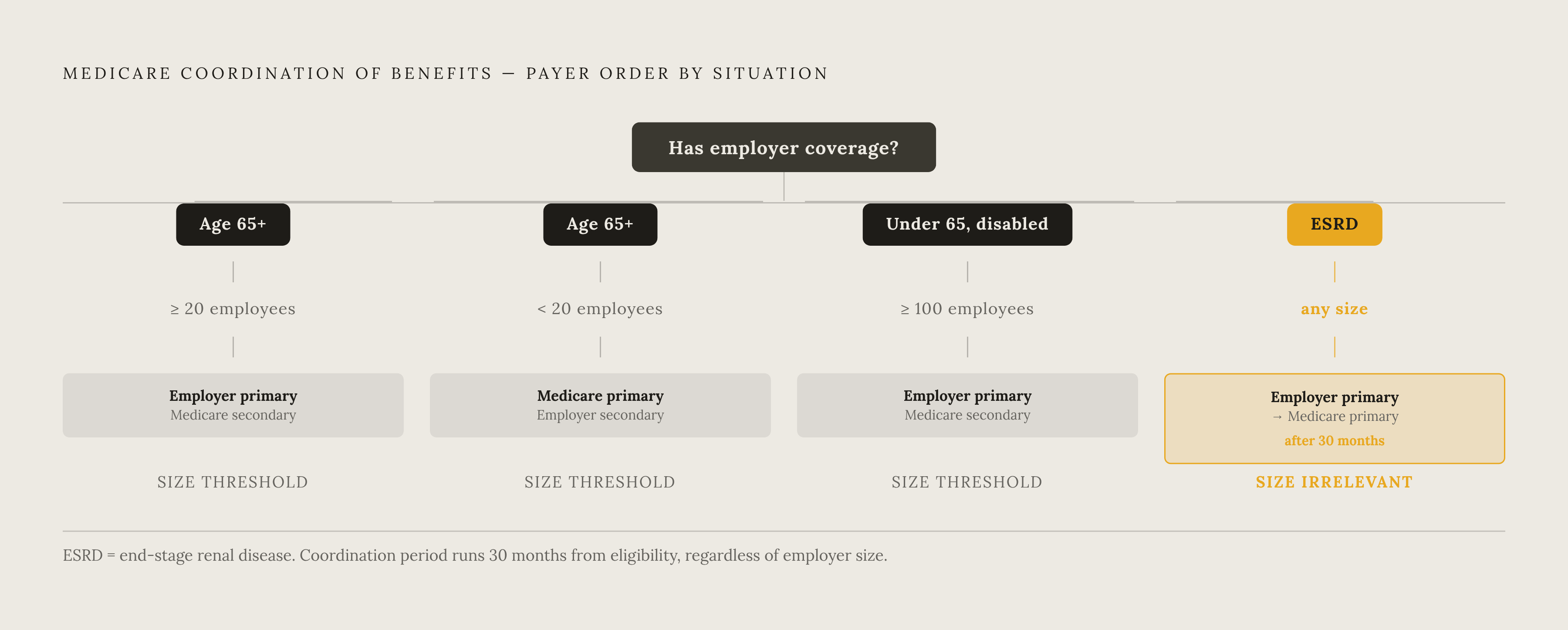
None of this coordination machinery runs on the honor system. Large employers (20 or more employees for age-based Medicare, 100 or more for disability-based Medicare) are legally barred from reducing, modifying, or denying health benefits to an employee or dependent for the sole reason that the person is entitled to Medicare. The plan has to treat Medicare-eligible workers the same as everyone else on it. That non-discrimination rule is the backbone the entire 20-employee and 100-employee framework rests on.
Employers also can't offer a Medicare-eligible employee money, or any other incentive, to drop the group health plan and rely on Medicare instead. That kind of quiet cost-shifting onto the federal program is what the Medicare Secondary Payer statute was written to stop, and the penalty reflects it: an substantial indexed civil penalty. Most employees have no reason to know an offer like that is illegal, which makes recognizing it the first, and sometimes only, line of defense against it.
Health reimbursement arrangements don't get a pass either. Once an HRA's annual benefit exceeds $5,000, it counts as a group health plan under MSP rules, closing off the obvious workaround of routing coverage through an HRA specifically to dodge coordination obligations.
Section 111 mandatory reporting is the enforcement backbone behind all of it. Responsible reporting entities, typically insurers or third-party administrators, have to report to CMS whenever someone is both Medicare-entitled and covered under a group health plan. That reporting is how CMS actually knows who should have paid first, and it's the mechanism CMS uses to pursue recovery when Medicare ends up paying conditionally on a claim that should have gone to the employer plan.
A practical decision map for the five situations most readers face
All the rules above collapse into a handful of situations that cover most people. Each one has to be worked through on its own terms, because the right move in one is often the wrong move in another, and assuming otherwise produces the mistakes described above.
Active worker, employer with 20 or more employees, age 65 or older: the employer plan is primary, Medicare is secondary, and delaying Part B is legally protected under the SEP, which starts running once employment or coverage ends. Anyone contributing to an HSA needs to hold off on enrolling in any part of Medicare, and hold off on claiming Social Security too, since claiming it triggers automatic Part A enrollment whether it's wanted yet or not. Getting the employer's MSP status confirmed in writing is the one piece of paper that settles a dispute later. Anyone not contributing to an HSA should generally enroll in premium-free Part A anyway, since it lowers out-of-pocket exposure on hospital stays at no cost.
Active worker, employer with fewer than 20 employees, age 65 or older: Medicare is primary, full stop. Enrolling in Part B at 65 isn't optional in any practical sense, and skipping it means the employer plan may pay nothing on the resulting claims, because it was never built to pay first. The SEP protection that applies to larger employers doesn't extend here. This is the small-employer trap in its purest, most expensive form, and it's the mistake this piece opened with for a reason: it's avoidable, and it still catches people constantly.
Under 65, disabled, employer with 100 or more employees: the large group health plan rule applies, so the employer plan is primary and Medicare is secondary. Coverage obtained through a qualifying family member's employer counts exactly the same as coverage through the individual's own job.
ESRD, any employer size: the employer plan is primary for the 30-month coordination period no matter how small the company is, the one genuine exception to every size-based rule governing the other four situations. Once that window closes, Medicare takes over as primary payer, and the calculation reverts to whatever standard age or disability rule already applies to that person underneath the ESRD coverage.
Five situations, four rulebooks, one lesson that runs through all of it: employer size, the reason for Medicare eligibility, and whether someone is actively working or merely holding onto COBRA are the only facts that actually matter here. None of them appear on an insurance card. All of them eventually appear on a bill, for whoever guessed wrong.