How Non-English-Speaking Parents Can Discover Medicare Benefits in Their Own Language
Free interpreters and translated materials help non-English-speaking parents navigate Medicare.

Non-English-speaking parents can learn about Medicare benefits from free interpreters at 1-800-MEDICARE, federal materials translated into their language, local SHIP counseling, and community groups that help people who speak their language. Families whose parents also qualify for Medicaid can ask about programs that pay family caregivers. The key is knowing which channel answers which question, then requesting language help before a coverage or care decision has to be made.
Why non-English-speaking Medicare beneficiaries miss benefits they already qualify for
A caregiver receives a Medicare renewal notice that her parent cannot read. Before the family can respond, someone has to explain what the notice requires and what happens if it goes unanswered. The problem begins before any choice about coverage. Renewal notices, plan comparisons, and enrollment forms can arrive in English even when the beneficiary has never communicated in English. For a person with limited English proficiency, or LEP, eligibility alone does not make a benefit accessible.
Calling for help can introduce another barrier. Phone menus in many states give prompts only in English and Spanish, so people who speak other languages may have no clear way to get help. Family members pressed into interpreting may lack the vocabulary for “prior authorization” or “tiered formulary,” or avoid uncomfortable medical and financial disclosures. A parent may then accept or decline coverage without understanding the decision. An unanswered notice, missed enrollment window, or misunderstood plan choice can mean months without coverage or hundreds of dollars in avoidable out-of-pocket costs.
The federal rights that entitle LEP seniors to free language help
Language assistance is not simply a courtesy. Title VI of the Civil Rights Act of 1964 prohibits discrimination based on race, color, or national origin by entities receiving federal funds. Courts and regulators have applied that protection to primary language, bringing virtually all Medicare-participating providers and plans within its reach. Section 1557 of the Affordable Care Act also requires health programs covered by the law to give people meaningful language access. These protections give caregivers a basis to ask for free help without having to count on a staff member’s willingness to help.
Written materials have their own requirements and limits. CMS requires Medicare Advantage and Part D plans to translate required materials when a threshold portion of the service area primarily speaks a language other than English. That is not a promise that every document exists in every language. CMS rescinded the separate multi-language insert requirement for contract year 2027 materials, effective October 1, 2026, deferring to the HHS OCR notice requirement under 45 CFR 92.11. That change concerns how plans notify people about assistance, while language-access protections remain in place.
Under 42 CFR 484.50(f), home health agencies must provide free oral interpretation and written translation to patients with limited English proficiency. A caregiver can invoke the applicable protection when requesting an interpreter at a covered appointment, seeking required translated plan materials, or challenging a refusal. Knowing the law establishes the basis for the request. Using it still requires finding the right service and asking for help in a form the parent can use.
How to reach a Medicare interpreter right now, in any language
Call 1-800-MEDICARE (1-800-633-4227) and ask for an interpreter. Medicare.gov states that this assistance is free and available around the clock, except some federal holidays. TTY users can call 1-877-486-2048. Make the interpreter request the first ask, without first trying to work through English-language coverage questions. If helping a parent make the call, stay on the line but let the parent speak directly through the interpreter and ask any questions written down ahead of time.
The call addresses immediate questions, but written resources give the parent something to revisit afterward. CMS’s multilingual outreach library includes brochures, fact sheets, infographics, and postcards in languages including Arabic, Chinese, Gujarati, Haitian Creole, Korean, Ukrainian, and Vietnamese. Match the document to the question being asked. Some resources address Marketplace coverage and immigrant families rather than Medicare, so a translated page is not automatically relevant to a parent’s enrollment.
CMS’s Office of Minority Health Coverage to Care program offers another documentary resource. Its multilingual materials include a Roadmap to Better Care, a Roadmap to Behavioral Health, a guide for people with disabilities, and preventive services flyers. Download and print relevant materials before an enrollment appointment so the parent can follow the discussion and refer back to it. Written information provides continuity between conversations. SHIP counseling adds the personalized help needed to apply that information to a particular parent’s coverage choices.
Free counseling through SHIP and what to expect from a bilingual session
The State Health Insurance Assistance Program offers free, unbiased Medicare counseling for beneficiaries, families, and caregivers. Call 877-839-2675, say “Medicare,” and ask to connect with the local SHIP office. Request language support when arranging the session. Some offices have bilingual staff or volunteers, while counselors also use interpretation services by phone or in person. Access varies by location, so the request should specify whether the parent needs a counselor who speaks the language or one who works through an interpreter.
The SHIP website offers Google Translate options for more than 200 languages at the bottom of each page. Links to other pages on the site lead to translated pages, while links to other sites stay in English. Machine translation can make mistakes, especially in languages that fewer people speak. Use the website to locate the office, then have the substantive conversation by phone or in person with language support. This way of getting help is especially useful when choosing between Original Medicare and Medicare Advantage is complex.
Before the session, write down who the parent’s primary care provider is, what prescriptions they now take, and which pharmacy they prefer. These details give the counselor a concrete basis for comparing plans and reduce what must be interpreted from memory. Bring the prepared questions and relevant translated materials. The session can then connect general explanations to the parent’s actual needs. Where language alone does not resolve the family’s concerns, community-specific programs can add knowledge of cultural expectations and household relationships.
Community programs built for specific linguistic and cultural groups
NAPCA’s multilingual helpline helps older Asian American, Native Hawaiian, and Pacific Islander adults understand Medicare, Medicaid, Social Security, SNAP, SSI, ACA Marketplace coverage, and vaccination programs. It offers separate phone numbers for English, Cantonese, Korean, Mandarin, and Vietnamese on its website. For families who speak those languages, that provides a direct starting point. A culturally informed counselor can also translate unfamiliar terms and explain options such as self-directed care in relation to family responsibilities and financial interdependence.
For other language groups, the Eldercare Locator at 1-800-677-1116 connects callers to their local Area Agency on Aging. The agency often knows which groups in the region help people who speak a given language. The Social Security Administration handles first-time Medicare sign-ups and has a Spanish-language website, along with some information online in 16 additional languages. That resource is relevant because Part A and Part B enrollment typically starts through the agency.
At a plan appointment or provider visit, the need shifts from discovering benefits to understanding decisions about care. Community Health Plan of Washington Medicare Advantage illustrates how free assistance can work in practice. Its language services include Spanish, Chinese, Vietnamese, Korean, Russian, Tagalog, Amharic, Somali, and Dari, among other languages. Members notify the doctor’s office when scheduling that they need an interpreter. This language list applies to this specific Medicare Advantage plan.
A trained medical interpreter stays neutral, relays difficult diagnoses and financial disclosures, and knows medical and insurance vocabulary. A relative may soften, omit, or misrender those details despite wanting to help. The caregiver’s role can instead be to prepare questions and record answers. That preserves the parent’s opportunity to hear the full explanation and respond directly.
For the appointment, bring a pen and notebook with questions about the illness, treatment, medication, dietary restrictions, and follow-up. Include the number to call if the condition does not improve or in an emergency, and whether the provider accepts the insurance. Ask the interpreter to repeat anything unclear. When scheduling, name the language and relevant dialect, since rarer languages may require more lead time. Some federally funded providers have reduced bilingual staffing and may rely more on remote interpretation, so confirm that a qualified interpreter is arranged before the appointment.
When the parent also qualifies for Medicaid: additional language access and caregiver pay programs
For a parent who qualifies for both Medicare and Medicaid, the search for benefits should include Medicaid’s self-directed personal care programs. These can allow a family member to receive pay for providing care. Eligibility is not automatic, and program rules vary. Trouble getting help in their language during Medicaid enrollment and renewal can keep families from learning about this support or continuing to get it.
California offers dedicated numbers for speakers of 12 languages, bypassing complex menus. Oregon immediately asks callers for their language preference using in-language terminology for 6 languages. Caregivers can cite these models when advocating for comparable treatment in their own state. A confusing menu presents an access problem regardless of the parent’s eligibility.
Most state Medicaid programs allow care recipients to hire, train, and supervise their own personal care workers, including family members. KFF’s 2025 analysis found that all states that responded pay family caregivers in at least some cases. State program names include CDPAP in New York, IRIS in Wisconsin, CDASS in Colorado, CFSS in Minnesota, Personal Choices in Alabama, and CDPASS in Oklahoma. Shared language and cultural expectations can make family caregiving especially useful, but the family still needs guidance on the applicable state rules.
To begin that conversation, ask the local Area Agency on Aging specifically about “self-directed” or “consumer-directed” personal care and whether a family member can be paid. Request a counselor or interpreter in the parent’s language at the start. An AI-assisted benefit discovery tool can help identify the state program and its income and care-need thresholds before that discussion. This can reduce preliminary calls and focus the questions.
A step-by-step action plan for caregivers starting the process today
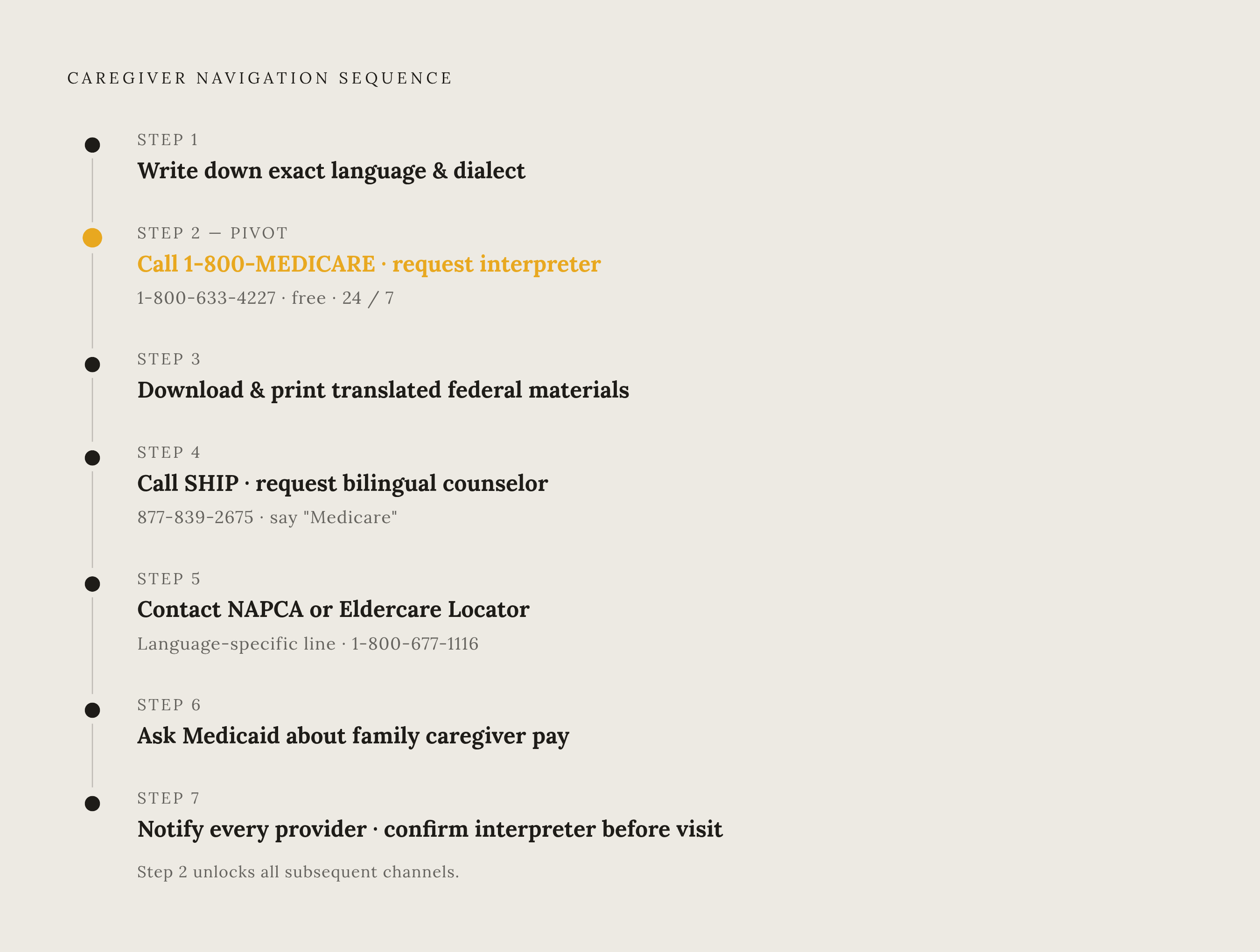
First, write down the parent’s exact language and any relevant dialect. Use that wording consistently when asking for interpretation so the request is precise from the outset.
Second, call 1-800-MEDICARE at 1-800-633-4227 and request an interpreter for the parent’s most pressing Medicare questions. TTY users can call 1-877-486-2048 for help except on some federal holidays.
Third, download and print translated federal materials that apply. Choose documents that match the issue being discussed, distinguishing Medicare information from Marketplace guidance and broader resources about using health coverage.
Fourth, call 877-839-2675, say “Medicare,” and request a local SHIP session with a bilingual counselor or interpreter. Bring the notebook, question list, translated materials, and details about the parent’s provider, prescriptions, and pharmacy.
Fifth, contact NAPCA through its language-specific number if the parent is Asian American and speaks Cantonese, Korean, Mandarin, or Vietnamese. For other community connections, use the Eldercare Locator to reach the local Area Agency on Aging.
Sixth, if the parent might qualify for Medicaid, ask that agency about self-directed personal care and who can be paid as a family caregiver in the state. Begin the conversation by requesting assistance in the parent’s language.
Seventh, tell every provider or plan office ahead of time that an interpreter is needed and state the language and dialect. Confirm the arrangement before the appointment and bring the prepared questions.
Before making these calls, an AI-powered discovery tool can save time by finding programs that might fit and the eligibility thresholds a parent must meet. Keep human counseling and professional interpretation central to coverage and care decisions, using the tool to make those conversations more focused.
Families have more pathways than an English-only notice suggests. Families often lack a map connecting an immediate question to an interpreter, a coverage choice to a counselor, and a caregiving need to the right state program.
Sources
- Understanding Patient Rights to Medical Interpreters
- Other languages
- Language Assistance - Community Health Plan of Washington - Medicare Advantage
- Medicaid’s Home Care Support for Family Caregivers in 2025
- Get Medicare information in other languages
- States Need to Improve Language Access for Medicaid Renewals - NILC