Extra Help Program for Medicare Part D Costs
Millions of eligible seniors miss out on an average $5,700 yearly drug benefit.

The Social Security Administration reports that Extra Help, the federal Low Income Subsidy program for Medicare Part D, is worth an average of $5,700 a year to the people enrolled in it. Somewhere between 2 and 3 million eligible people are not collecting it, and the gap reflects both an awareness problem and a design problem: the eligibility rules run through pathways that behave differently depending on which benefits someone already receives, and the ones outside those pathways often talk themselves out of applying before they ever fill out a form. This piece works through who qualifies, what the benefit actually pays for, and where the recent policy changes leave the roughly 2 to 3 million people still sitting outside it.
Part D covers prescription drugs, but it arrives wrapped in premiums, deductibles, and copayments that plenty of beneficiaries can't absorb on a fixed income. Extra Help exists to close that gap, jointly run by the Social Security Administration and the Centers for Medicare & Medicaid Services, and built into how Part D was designed to function for people who can't otherwise afford it. That makes it a legal entitlement, not a favor, and not something anyone should feel sheepish about applying for.
Why many eligible people aren't enrolled
NCOA estimates about 2 million eligible people go unenrolled each year, a figure that runs close to the 2 to 3 million SSA has cited as going without the benefit. That gap sits against a program that's already substantial: KFF reports LIS enrollment climbed from 13.1 million to 13.6 million heading into 2026, with 13.9 million Part D enrollees receiving LIS assistance in some form. The unenrolled population is close to the population of a mid-sized state. It's close to the population of a mid-sized state, and most of those people aren't missing out because they're careless.
The instinct is to blame this on awareness, that people simply haven't heard of Extra Help. That's the wrong diagnosis, or at least an incomplete one. The real friction sits in the eligibility structure itself: some pathways are automatic, some require an application, income thresholds are pegged to the Federal Poverty Guidelines, and separate resource limits stack on top of those thresholds. Misread any one of those conditions and a person can conclude, wrongly, that the numbers don't work out for them.
The Medicare Rights Center estimates roughly 16.5 million Medicare beneficiaries live on less than $24,600 a year with under $18,950 in savings, a population that overlaps heavily with Extra Help eligibility. Most of them likely have no idea that overlap exists. Nobody is calling to walk them through it, and the program doesn't advertise itself the way a private insurer would.
Who automatically qualifies without filing a separate application
Three groups get Extra Help without lifting a finger. People enrolled in both Medicare and Medicaid, so-called dual eligibles, qualify automatically. So do people enrolled in a Medicare Savings Program, and people receiving Supplemental Security Income from Social Security. SSA handles most standalone Extra Help applications, but for these three groups, eligibility is simply deemed: no Form SSA-i1020, no waiting on a decision letter, nothing to sign.
Enrollment in a Medicare Savings Program, which can include arrangements where Medicaid covers Part B costs, is one of the pathways that triggers automatic Extra Help enrollment. This is the detail that trips people up most. Plenty of dual eligibles have no idea they're already covered, because the enrollment happened administratively, in the background, without anything that looked like an approval letter arriving in the mail.
So what should someone in one of these categories actually do? Check plan documents, or call 1-800-MEDICARE to confirm status. Being enrolled and not knowing it means the benefit sits active and unrecognized on a monthly statement, which is its own quiet failure: a benefit that exists but goes unused because nobody flagged it for the person receiving it.
Everyone outside these three categories has to apply. That's where the real gatekeeping happens, and it's the part of the system most people misjudge.
Income and asset limits for people who need to apply in 2026
Three conditions have to be met, all at once. Enrollment in Medicare Part A and/or Part B is required, residency in one of the 50 states or the federal district that functions as a state for this purpose is required, and income and resources have to fall under specific limits. That third condition is where most self-disqualification happens, often wrongly.
On income, the 2026 threshold is at or below 150% of the Federal Poverty Level. For an individual, benefitscheckup.org and coveredusa.org put that at $23,940 a year, or $1,995 a month. For a married couple living together, the figure rises to $32,460 a year, or $2,705 a month. Alaska and Hawaii run higher because of their own cost-of-living adjustments to the poverty guidelines: Alaska and Hawaii run higher figures due to their own cost-of-living adjustments to the poverty guidelines, so anyone in those states should confirm current thresholds directly through Medicare.gov or SSA. Different sources give slightly different exact figures, since HHS adjusts these thresholds every year, so anyone close to the line should confirm current numbers directly through Medicare.gov or SSA rather than trusting a single secondhand table.
Resource limits matter just as much as income, and they talk eligible people out of applying before they even try. For 2026, an individual can hold up to $16,590 in countable resources, rising to $18,090 if up to $1,500 is set aside specifically for burial expenses. A married couple's limit is $33,100, rising to $36,100 with the burial exclusion applied. Countable resources include checking and savings accounts, CDs, stocks, bonds, mutual funds, IRAs, cash on hand, and real estate beyond a primary residence.
A primary home doesn't count toward that limit, household items and personal effects don't count, one vehicle doesn't count, and up to $1,500 per person earmarked for burial costs doesn't count. Someone who owns a modest home and a car and has a few thousand dollars set aside for burial expenses is not over the resource limit just because their name sits on a deed. That single misunderstanding, more than any other, is probably what keeps eligible people from ever submitting Form SSA-i1020.
An earned income exclusion also applies when SSA calculates countable income for people still working, so a beneficiary with wages that look close to the limit on paper may still qualify once the exclusion factors in. Nobody should self-disqualify off a gross income number alone. SNAP benefits don't count toward the Extra Help income limit at all, so food assistance doesn't knock someone out of eligibility, and medicareresources.org notes that households with dependents get higher limits still.
What Extra Help pays for in 2026
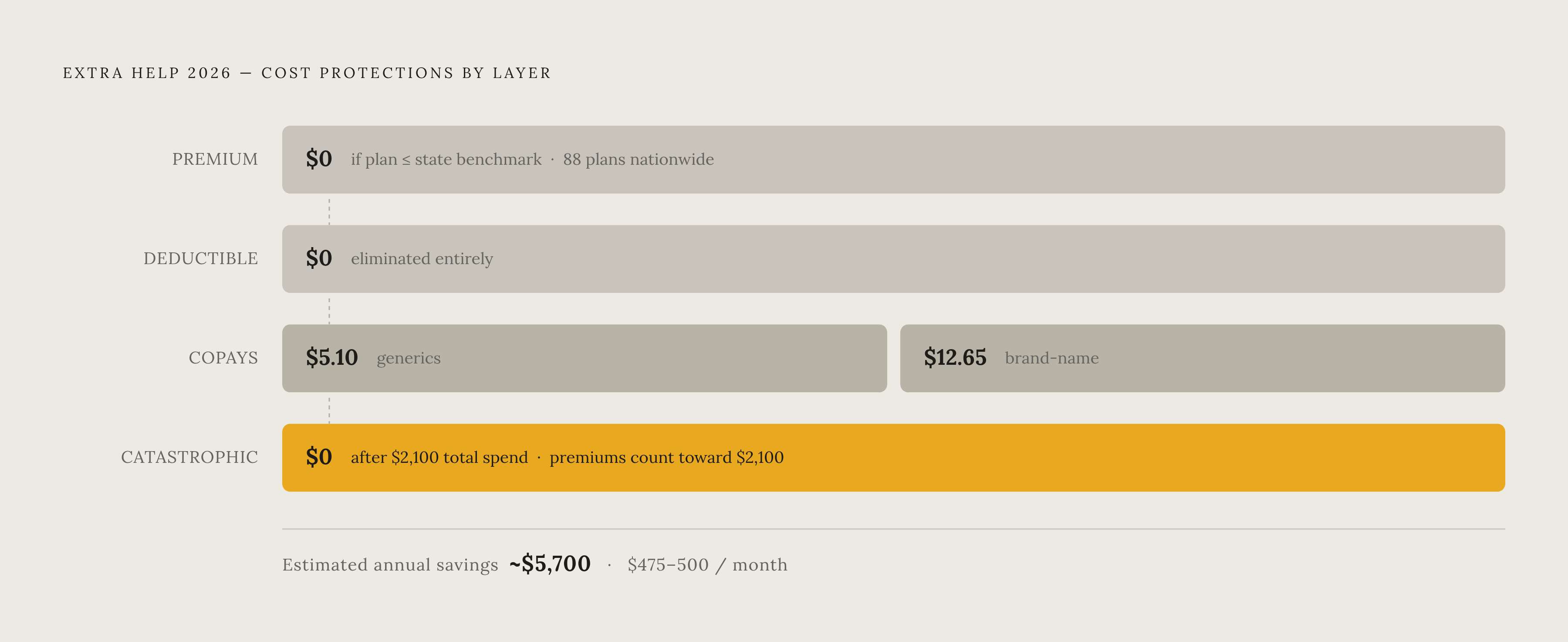
Figures from benefitscheckup.org show enrollees save close to $475 to $500 a month on prescription costs, the month-to-month version of the $5,700 annual figure cited earlier. That's money that would otherwise come straight out of a fixed income, not a marginal discount.
Premiums come first. Extra Help covers the full Part D premium as long as the enrollee picks a plan priced at or below their state's benchmark amount. If the enrollee picks a plan above that benchmark, the enrollee owes only the difference, not the whole premium. The Medicare Rights Center reports that in 2026, there are 88 benchmark stand-alone Part D plans nationwide, carrying zero premium for Extra Help beneficiaries.
The deductible disappears completely for Extra Help recipients. Not reduced. Gone.
Copayments scale by eligibility tier, and the tier determines what an enrollee pays per prescription. Medicaid enrollees receiving long-term care, whether in a nursing home or through home and community-based services, pay $0 per prescription. Those with full Medicaid and income below 100% of the Federal Poverty Level pay $1.60 for generics and $4.90 for brand-name drugs. Other Full Medicaid enrollees also pay no more than $4.90 per covered prescription. Everyone else on Extra Help pays $5.10 for generics and $12.65 for brand-name drugs. These are copay ceilings, so pharmacy-counter costs shouldn't run above them.
Then there's the catastrophic threshold, and this is the part of the benefit most people underestimate. Once total drug spending hits $2,100 in 2026, an Extra Help enrollee pays $0 for covered drugs for the rest of the calendar year. The premium amounts Extra Help pays on someone's behalf count toward that $2,100 cap. An enrollee doesn't need to spend $2,100 out of pocket to get there. Premium payments chip away at that number every month, on their own, getting people to $0 copays faster than the raw drug-spending figure suggests. The Center for American Progress projects Extra Help enrollees who reach the $2,100 out-of-pocket maximum save an average of roughly $1,100 on drug costs as a direct result.
Two more pieces round this out. There's no Part D late enrollment penalty for Extra Help recipients, which matters for anyone who delayed signing up for Part D and worried about a permanent premium surcharge. And a Special Enrollment Period opens once per quarter during the first three quarters of the year, on top of the standard Annual Open Enrollment window running October 15 through December 7, giving Extra Help recipients meaningfully more flexibility to switch plans than most Medicare beneficiaries get.
The Inflation Reduction Act change that expanded who gets full benefits
Before 2024, Extra Help split people into two tiers, full benefits and partial benefits, with partial recipients getting a smaller slice of the cost assistance described above. That structure is gone. Starting in 2024, under the Inflation Reduction Act, the partial category was eliminated, and anyone eligible for Extra Help now gets full benefits. The old two-tier framing appears in plenty of outdated advice online and is wrong.
The change wasn't cosmetic. HHS figures cited by medicareresources.org show the expansion made full benefits newly available to 300,000 people starting in 2024, people who previously would have been capped at partial assistance under the old rules.
The same law produced the $2,100 out-of-pocket cap on Part D costs that took effect for 2026, discussed above. The two provisions work together, giving Extra Help enrollees both reduced copays throughout the year and full cost protection once the cap is reached.
Anyone told before 2024 that they only qualified for partial Extra Help should look again. The rules changed substantially, and advice dated before that year no longer reflects current reality.
Bridging coverage while Extra Help enrollment processes: the LINET program
Applying for Extra Help doesn't flip a switch immediately. New enrollees who haven't chosen a Part D plan yet get automatically placed into one of the 88 benchmark plans mentioned above, but that placement can take some time to fully take effect. What covers prescription needs during those two months?
That's the job of the Limited Income Newly Eligible Transition program, LINET. Medicare enrolls a person in LINET during that transition window, giving immediate, temporary Part D coverage while the permanent plan gets established. LINET covers all Part D-eligible drugs at any pharmacy, and it comes with retroactive coverage: up to 36 months back for Full Benefit Dual Eligible and SSI-Only beneficiaries, and up to 30 days back for beneficiaries who qualify specifically through Extra Help. Humana administers LINET exclusively.
The practical implication is the one thing anyone hesitating over the paperwork should hear clearly: fear of a coverage gap between applying and getting a permanent plan assigned is not a reason to delay applying. LINET exists specifically to prevent that gap from opening, and treating it as a reason to wait gets the logic backward.
How to apply for Extra Help: three methods and what to have ready
Applying can happen at any point, before or after enrolling in Part D itself. There's no sequencing requirement locking one to the other, which surprises people who assume Part D enrollment has to come first.
Three ways to apply exist, and online is the fastest by a wide margin. Form SSA-1020, filed at ssa.gov/extrahelp, can be completed online in a single sitting. By phone, Social Security can be reached at 1-800-772-1213 (TTY: 1-800-325-0778), Monday through Friday, 8 a.m. to 7 p.m. local time. In person, a visit to a local Social Security office works just as well for anyone who'd rather sit across from a person than fill out a web form.
Whichever method gets used, a few documents on hand speed things up: income information covering wages, Social Security benefits, and pension payments; bank account balances; investment account details covering stocks, bonds, mutual funds, and IRAs; and life insurance policy information. Having these ready before starting saves a second trip or a callback later.
SSA responds by mail after processing the application. A denial isn't the end of the road, since reapplication is possible any time income or resources change, so a no today doesn't foreclose eligibility next year, or even next quarter.
State-level programs can layer on top of Extra Help in many states, offering additional pharmaceutical assistance and another tier of savings beyond the federal benefit. State Health Insurance Assistance Programs, known as SHIPs, offer free, unbiased counseling to help navigate both the federal and state pieces together. In Pennsylvania, the regional benchmark dropped from $48.06 in 2025 to $32.71 in 2026, and three zero-premium Part D plans are available there for Extra Help recipients in 2026: the Humana Basic Rx Plan, SilverScript Choice, and Wellcare Classic, according to a state-based legal assistance organization focused on health law. PA MEDI offers free counseling for residents sorting through the options.
For people juggling Extra Help alongside other benefit programs, whether Medicaid, caregiver compensation, or other assistance, some AI-powered benefit screening tools now scan for eligibility across multiple programs at once instead of requiring a separate hunt for each one. That kind of tool doesn't replace a call to SSA or a state benefits counselor, but it can catch an eligibility signal that a fragmented, program-by-program search would otherwise miss.
Policy changes in 2025 that could affect Extra Help access going forward
On July 4, 2025, President Trump signed federal legislation, popularly known as the One Big Beautiful Bill Act though it carries no official short title in the enacted law (Public Law 119-21). One provision in it has direct consequences for Extra Help's future reach, and it deserves a flat verdict rather than a shrug.
Resourcemedicare.com reports that a planned reform expanding access to Medicare Savings Programs, and by extension Extra Help since MSP enrollment feeds automatically into Extra Help eligibility, has been postponed until 2035. The law imposes a nine-year ban on implementing MSP improvements. The Center for Medicare Advocacy points to CBO estimates showing this delay saves the federal government over $66 billion over 10 years, generated precisely by keeping eligible people locked out of enrollment they'd otherwise qualify for. Call that what it is: savings produced by non-enrollment, not by efficiency. A funding cut at least admits the money was spent. This is money never claimed by people who had every legal right to it, which is a worse outcome dressed up as a budget line.
CBO also estimates the law triggers a 4% sequestration cut to Medicare broadly, projected at $45 billion in cuts for 2026 alone and $536 billion over nine years. Separately, Medicare Rights Center reporting shows the Inflation Reduction Act's own Part D improvements, including the $2,100 out-of-pocket cap discussed earlier, face their own threats to key provisions going forward.
Extra Help itself remains fully available under current law. Nothing in the 2025 legislation removes the program or narrows who can apply today. What's changed is the trajectory: the path toward reaching more of the 2 to 3 million eligible but unenrolled people has been pushed back nearly a decade. That gap won't close itself through policy anytime soon, which puts the weight back where it's always effectively sat, on individual action. The system was never built to chase anyone down and enroll them automatically, apart from the three deemed-eligible categories covered earlier. For everyone else, the application is the move, and nothing about the 2025 policy landscape changes that math.
Sources
- Medicare Part D LIS/Extra Help: Income Limits & Eligibility Chart
- What is Medicare “Extra Help?” (Medicare Part D’s Low-Income Subsidy)
- Lowering Part D Costs: Federal, State, and Local Options - Medicare Rights Center
- What You Need to Know About Medicare Extra Help and Part D Costs in 2026
- Medicare Extra Help: Save on Prescription Drug Costs
- coveredusa.org
- kff.org
- medicareresources.org