Medicaid Estate Recovery Rules After a Senior Dies
States can seize assets from a Medicaid recipient's estate after death.

Medicaid Estate Recovery, often shortened to MERP, is not optional for states. Federal law requires every state and a similarly situated federal district to run some version of it, recouping the cost of long-term care from a Medicaid recipient's estate after death. The rules governing what gets recovered, from whom, and under what conditions vary sharply by state, and understanding those variations can save a family's farm.
The legal foundation dates to 1993, when a federal budget law amended federal Medicaid law at a section of the federal code governing this area. § 1396p(b). Before that, estate recovery was discretionary. States could pursue it or not. OBRA '93 changed the calculus permanently: recovery became mandatory for certain services, and Medicaid's role shifted, at least conceptually, into something closer to an interest-free loan for long-term care. The state pays for the nursing home, the home health aide, the hospital stay tied to that care, and then, after the recipient dies, it asks for the money back from whatever is left behind.
Who qualifies for this treatment? Anyone age 55 or older who received nursing facility services, home and community-based services, or the related hospital and prescription drug costs tied to that care falls under mandatory recovery. Age doesn't matter at all for someone who was permanently institutionalized. That population is subject to recovery regardless of how old they were when they entered care.
Which assets the state can and cannot reach
Estate recovery, at its core, only reaches the "estate," a term with a precise legal meaning that trips up a lot of families who assume everything the deceased owned is fair game. The estate consists of assets held solely in the recipient's name at death, with no co-owner and no named beneficiary attached, and it does not include everything the deceased owned. The estate consists of assets held solely in the recipient's name at death, with no co-owner and no named beneficiary attached.
A solely owned home falls into that category. So do solely held bank and brokerage accounts, vehicles registered only to the deceased, personal property of real value, and whatever funds remain in a Qualified Income Trust or an Irrevocable Funeral Trust. Solely held stocks and bonds count too. If the recipient's name was the only name on the title or the account, it is very likely fair game.
But here's where it gets interesting for families doing any kind of planning, before or after the fact. Plenty of common assets pass outside the estate entirely, which means they pass outside the reach of MERP in most states. Jointly owned real property with right of survivorship transfers automatically to the surviving co-owner the moment the original owner dies, with no probate and no estate involvement. Life insurance with a named beneficiary skips the estate too, as do bank and brokerage accounts with a payable-on-death or transfer-on-death designation. IRAs, 401(k)s, and other retirement accounts with a named beneficiary follow the same rule. Real property held with a retained life estate vests in the remainder holder automatically. Assets sitting in a properly funded irrevocable trust generally sit outside the estate as well.
MERP can only reach the deceased recipient's estate assets. It cannot go after the personal assets of surviving family members, full stop. If a Medicaid recipient dies owning nothing solely in their name, having structured everything through joint ownership, beneficiary designations, or trusts, there may be no estate for the state to recover against. Nothing more can happen. That's not a loophole so much as the system working exactly as the underlying law defines it.
The single biggest variable: probate-only states versus expanded-recovery states
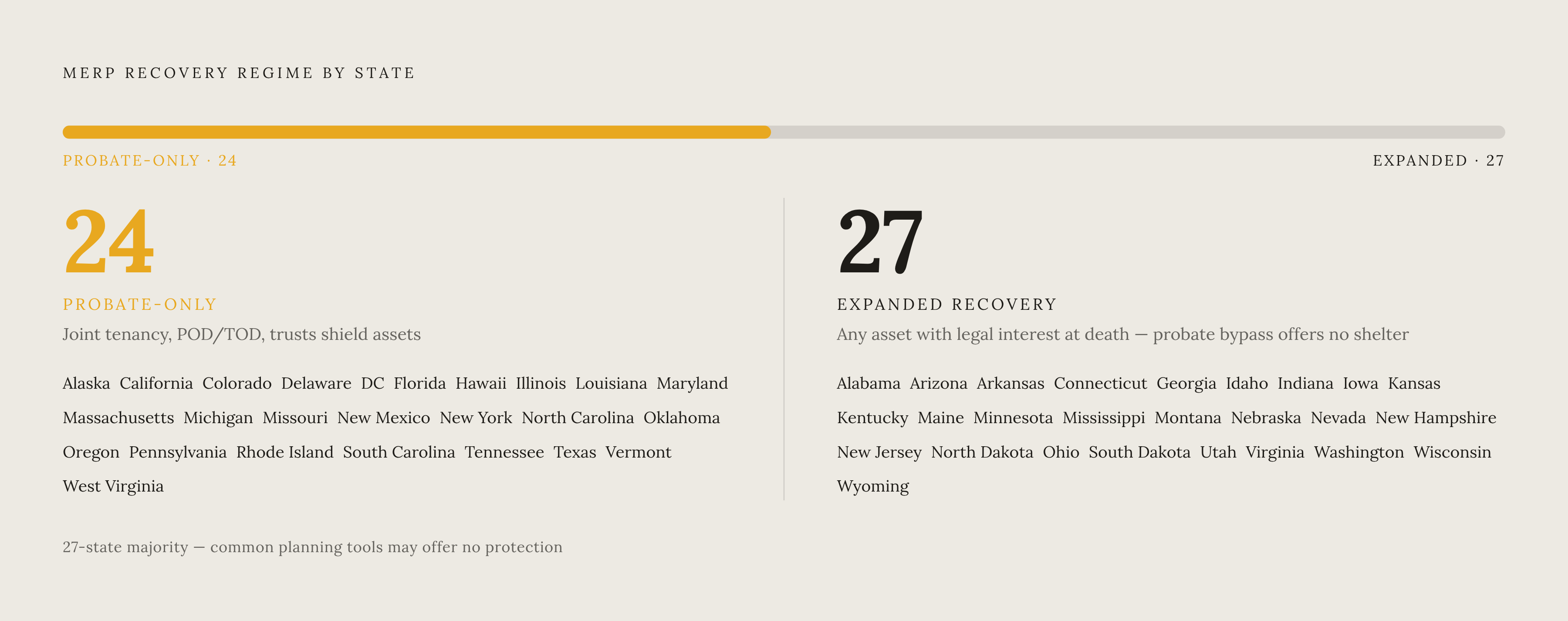
Everything above comes with an asterisk, and the asterisk is the state the recipient died in. This single distinction, probate-only versus expanded-recovery, probably matters more than any other variable in determining how exposed a family's assets actually are.
Twenty-three states plus a similarly situated federal district. run probate-only recovery. In these states, MERP can only claim assets that pass through the formal probate process, so the mechanisms described above (joint tenancy, POD and TOD designations, named beneficiaries, funded trusts) genuinely shield assets from recovery, because probate is the only route through which those assets could be reached. New York offers a clean illustration. Under New York's framework, the state agency responsible for recovering long-term care costs can only reach the deceased recipient's estate assets, so a home held jointly with right of survivorship passes to the co-owner instantly at death and never becomes part of the estate subject to claims.
Twenty-seven states take a broader approach. In expanded-recovery states, MERP can pursue any asset the deceased had a legal interest in at the time of death, even if that asset never touches probate. That list includes Alabama, Arizona, Arkansas, Connecticut, Georgia, Idaho, Indiana, Iowa, Kansas, Kentucky, Maine, Minnesota, Mississippi, Montana, Nebraska, Nevada, New Hampshire, New Jersey, North Dakota, Ohio, South Dakota, Utah, Virginia, Washington, Wisconsin, and Wyoming. A transfer-on-death deed does not protect a home in these states. A joint bank account does not automatically shield its balance. The planning tools that work reliably in a probate-only state may do nothing at all in an expanded-recovery one.
Ohio shows just how far "expanded" can stretch. Ohio has adopted both federal expansions available to states: a broader definition of what counts as the estate, and recovery not just for long-term care but for essentially all Medicaid benefits correctly paid on the recipient's behalf. There's movement to narrow this. House Bill 318, introduced in the 136th General Assembly, would modify Ohio's approach, but as of now it has not passed into law. So the expanded framework remains in effect.
Layered on top of the probate distinction is a second, related variable: some states limit recovery to long-term care costs, while others extend it to all Medicaid spending. Federal law only mandates recovery for long-term care and related services. Everything beyond that is optional. Yet 37 states have chosen to apply estate recovery to services where the federal government gives them the choice not to. That's a meaningful majority of states opting for the broader, more aggressive standard, even where the law would let them stop short.
How pre-death liens work while the recipient is still alive
Estate recovery happens after death, by definition. But states have a separate tool they can deploy while the Medicaid recipient is still alive, called a TEFRA lien, and confusing this pre-death mechanism with post-death estate recovery causes a lot of unnecessary panic among families.
A TEFRA lien can only attach to the recipient's home, and only under a specific condition: the state has determined the recipient cannot reasonably be expected to return home. This isn't a decision states get to make casually or without process. The recipient is entitled to notice and an opportunity for a hearing before the lien gets placed. And if circumstances change, if the recipient's condition improves and they do return home, the state is required to remove the lien.
A lien placed while someone is alive does not force a sale of the home, and it does not displace anyone living there. It's a recorded financial interest, nothing more at that stage, one that gets satisfied if and when the home is sold or when the estate is settled at death. Families sometimes hear "lien" and assume eviction is imminent. Eviction is not imminent. The home stays occupied, the family stays housed, and the lien simply sits on the title as a claim to be resolved later.
Hard limits also restrict when a state can place this kind of lien. The state may not place or enforce a TEFRA lien if a surviving spouse, a child under 21, a blind or disabled child of any age, or a sibling with an equity interest in the property lives in the home. These aren't discretionary considerations a caseworker weighs. They function as absolute bars, and understanding them matters just as much as understanding the lien mechanism itself.
Who is legally protected from estate recovery and what those protections mean
Federal law draws a firm line around who is protected from estate recovery, at least temporarily, and that word "temporarily" deserves emphasis, because it changes how families should think about what these protections actually accomplish.
States may not pursue estate recovery from a deceased Medicaid recipient's estate if that person is survived by a spouse, by a child under 21, or by a blind or disabled child of any age. These are mandatory deferrals. Note the word carefully: deferral, not forgiveness. The debt to the state doesn't disappear when a protected survivor is in the picture. The debt to the state remains unresolved rather than disappearing while a protected survivor is in the picture. Recovery can start up again once the protected survivor dies or the protective circumstance no longer applies: the disabled child's status may change, or the surviving spouse may eventually pass away too.
Spousal protection carries the most weight in practice, since surviving spouses are the most common protected party. While the surviving spouse is alive, the state cannot pursue estate recovery, and it cannot place or enforce a lien on a home the surviving spouse lives in. There's a related but distinct protection to understand: the spousal impoverishment provision, which shields combined assets up to $162,660 so the community spouse (the one not receiving government-funded long-term care) can keep living independently without being reduced to poverty by the other spouse's care costs.
A narrower exception covers siblings. A sibling can be protected from a TEFRA lien and from certain recovery actions if they have a documented equity interest in the home and lived there for at least one year immediately before the Medicaid recipient entered a nursing facility. Both conditions have to be met, and the one-year residency requirement is applied strictly. A sibling who moved in eight months before the recipient's nursing home admission doesn't qualify, no matter how legitimate their equity claim might otherwise be.
The estate recovery process after death: notices, claims, and priority
Once a Medicaid recipient dies, the state's Medicaid agency initiates the recovery process, and it follows a defined sequence rather than an ad hoc one.
The first step is notice. The state sends written notice to the estate's representative or to the heirs, informing them of its intent to file a claim against the estate. That notice typically asks for information the state needs to weigh the estate's size and composition against the cost of pursuing recovery. Heirs and the estate representative then have a defined window to respond: to assert that a protected-person status applies, to request a hardship waiver, or simply to provide the requested information. Missing that window can mean forfeiting options that were otherwise available. The response period deserves more attention than it usually gets from grieving families dealing with a dozen other things at once.
An estate claim from Medicaid doesn't jump the line ahead of everything else the estate owes. MERP functions as a creditor claim, subject to the same priority rules that govern any other debt against an estate. Texas offers a concrete example of how this priority actually works. Under the Texas Estates Code, § 355.102, MERP is classified as a Class 7 claim: it gets paid after several higher-priority classes of claims but before Class 8, the catch-all for unsecured claims with no specific classification. So Medicaid gets in line behind several other categories of creditor, not at the front of it.
Hardship waiver qualifications and application process
Every state has to offer some form of hardship waiver process, that much is required by federal law. But federal law stops there. It doesn't define what "hardship" means, and it doesn't dictate how the application process should work. The waiver landscape looks meaningfully different from state to state.
Some scenarios qualify as grounds for a hardship waiver across most states. If the estate asset subject to recovery is the sole income-producing asset for the heirs, a family farm or a small business, and losing it would wipe out their primary livelihood, that typically counts. If recovery would push a surviving family member onto public assistance, that counts too, since it defeats the purpose of recovering Medicaid dollars only to generate a new dependency on public benefits elsewhere. A home of modest value, generally judged against roughly half the average home value in the county, though federal guidance doesn't nail down a precise threshold, often qualifies as well. And some states, Utah and Louisiana among them, define the presence of a surviving minor or disabled child as hardship on its face, exempting those individuals outright rather than making them apply case by case.
Texas lays out one of the more detailed and time-bound processes on record. Under Texas Administrative Code Rule § 373.209, the state has to make a waiver determination within a defined window after receiving a complete application along with all supporting documentation. The qualifying criteria are specific: a family farm, ranch, or business has to have been operating on the property for a required period before the decedent's death, that property has to be the primary income-producing asset, and it has to generate a substantial share of the heirs' livelihood. Beyond that pathway, an applicant can also qualify by showing that recovery would cause heirs to lose their primary income source, that recovery would make heirs eligible for public assistance, that the decedent received Medicaid as a crime victim, or by citing other compelling reasons the state agrees to weigh.
Massachusetts takes a different structural approach, built in part around care that was provided to the recipient, though the exact mechanics of how that factors into the waiver calculation are determined at the state level and vary based on individual circumstances.
What ties all of this together, across every state and every variation examined here, is that estate recovery is neither arbitrary nor unlimited. It runs on federal minimums that every state must honor: mandatory deferral for spouses and minor or disabled children, a required hardship waiver process, restrictions on when a pre-death lien can attach. States then build outward from that floor, some sticking close to it with probate-only recovery limited to long-term care costs, others reaching further into non-probate assets and broader categories of Medicaid spending. Knowing which kind of state a family is dealing with, and knowing the specific protections and deadlines that apply, turns what feels like an unpredictable process into one that can actually be planned around.
Sources
- Can Medicaid Take Your Home? What Estate Recovery Means
- New York Medicaid Estate Recovery 2026: Probate-Only Rules Explained
- Medicaid Estate Recovery: Improving Policy and Promoting Equity
- Estate Recovery | Medicaid
- Your Guide to the Medicaid Estate Recovery Program | Texas Health and Human Services
- brevy.com