Why Family Caregivers Who Qualify for Medicaid Pay Still Go Unpaid and How to Fix It
Medicaid promises to pay family caregivers but enrollment barriers often block the paycheck.

Family caregivers can qualify for Medicaid pay and still receive nothing because eligibility does not complete enrollment. The practical fix is to identify the right state program, prepare the required agreements, and check uncapped state plan benefits before waiver routes. AI-assisted navigation can help families find those paths, while Financial Management Service agencies handle payroll and taxes once the family is enrolled. Neither can bypass a waiver waitlist.
The legal right to pay exists everywhere; the paycheck does not
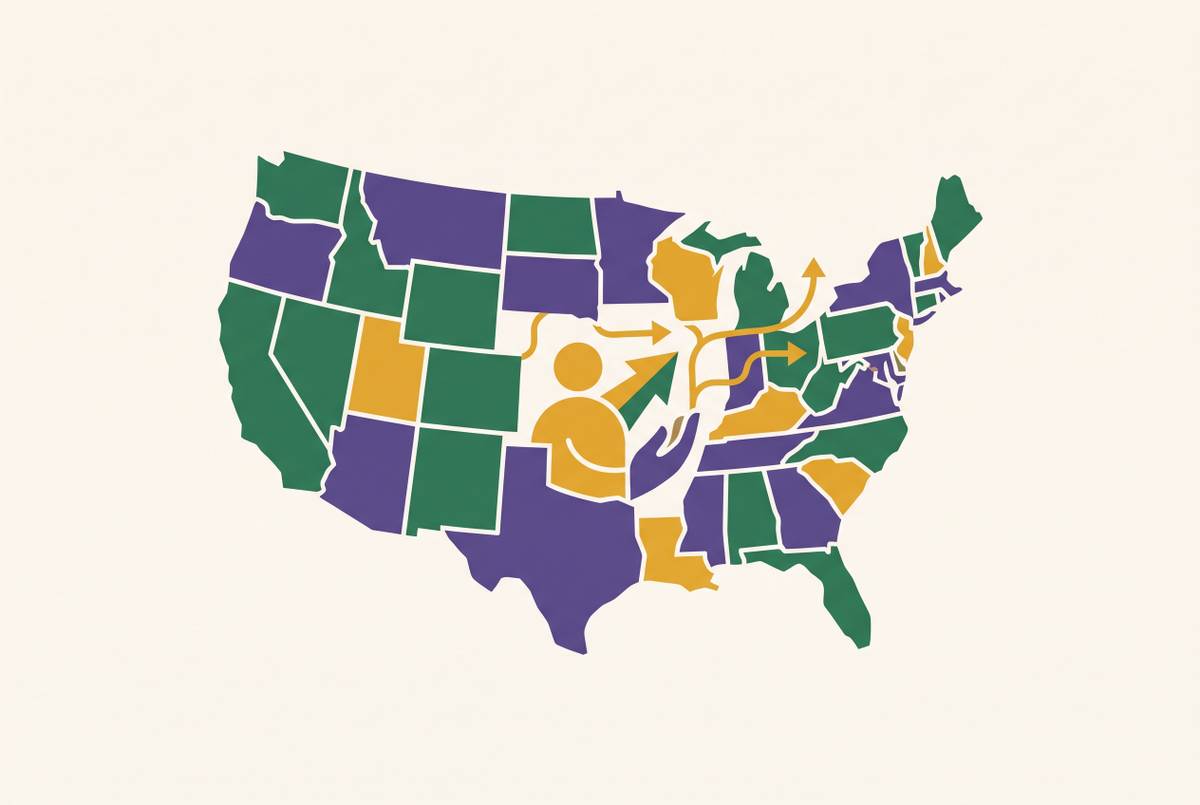
All states and D.C. offer at least one Medicaid program that pays family caregivers, yet permission to pay is not a promise of a paycheck. KFF’s 2025 survey found that every state that responded allowed family caregivers to be paid under some circumstances. Florida did not respond to that survey. The qualification “under some circumstances” is crucial because a state can authorize payment while restricting which relatives, services, and enrollment routes qualify.
What separates that authorization from money arriving at home? A family must find the right program and finish enrollment before pay can start. Medicaid self-direction provides the mechanism by allowing the person receiving care to hire a family member, with financial administration handled separately. Medicare covers only short-term skilled home health through certified agencies, while paid family caregiving runs through Medicaid and, for veterans, the VA.
What self-direction actually means and how a caregiver gets paid through it
Self-direction is a care model. States offer it through home- and community-based services, or HCBS, waivers and several state plan options, including Community First Choice, 1915(i) HCBS, and 1915(j) self-directed personal assistance. Each has its own eligibility rules. KFF’s survey found that nearly every state allowed self-direction in at least some circumstances, and all those states allowed enrollees to select, train, and dismiss workers.
The care recipient must qualify for Medicaid and typically meet a nursing-facility level of care. The state’s assessment determines the covered hours. The recipient becomes the employer, while a financial administration agency handles payroll and taxes. Payment takes the form of regular W-2 income rather than a lump sum, with an hourly wage at or above the state’s home-care base rate.
Spousal pay is more restricted than payment to other relatives, and co-resident relatives, guardians, and caregivers of minor children may face additional rules. Another distinction concerns who directs the care. Under 1915(j) and Community First Choice, the recipient’s designated representative cannot also be the paid caregiver. A relative can still be paid to provide care if someone else holds that role or the recipient directs services on their own.
The five barriers that stop eligible caregivers from collecting
The first barrier is a capped waiver slot. States may cap how many people can enroll in an HCBS waiver, so people who qualify cannot collect through that waiver while they wait. KFF’s survey documented hundreds of thousands of people on HCBS waitlists nationwide, a meaningful increase from the prior year. Eligibility does not reserve a funded place. Colorado’s 2026 budget, shaped by a large state shortfall, is projected to roughly double its adult 24-hour-services waitlist, showing how fiscal choices can extend an already uncertain wait.
The second barrier is the state’s definition of an allowable family worker. Identical care can qualify for payment in one state and not in another because the caregiver’s relationship to the recipient is treated differently. Spousal pay makes this variation especially clear. A state that allows pay for an adult child may still bar pay for a spouse, guardian, or parent of a minor. A family can therefore find the correct care benefit but still misunderstand its worker rules.
The third barrier is finding and understanding the program. States reported that program complexity discouraged enrollment, particularly when participants were uncertain about managing a care budget. The names do not make discovery easier. New York calls its program CDPAP, California uses IHSS, and Wisconsin uses IRIS. A search that works for one family may offer little guidance to an otherwise similar family across a state line.
The fourth barrier is the retroactive pay trap. A family may pay a relative for years of unpaid care believing it is settling a debt, but Medicaid treats retroactive compensation of that kind as a gift. Informal payments without a written contract can also be characterized as gifts during eligibility review. That can damage the recipient’s Medicaid eligibility.
The fifth barrier is the application-to-paycheck interval. Even without a waitlist, it can take many weeks to enroll, and the wait for a waiver can last months or years. People can sometimes get through state plan personal care programs faster. For someone who has stopped paid work to provide care, this interval leaves the care hours uncompensated without restoring the lost wages.
Why the financial and health cost of staying unpaid falls heaviest on caregivers who can least absorb it
Waiting to enroll is hardest when caregiving has already left a household with less income. In KFF’s 2024 focus groups, family caregivers often said they struggled to make ends meet and had cut their paid work hours. The losses can persist well beyond an application. Joanna, a Sacramento caregiver in her thirties, has provided unpaid care for her grandfather, grandmother, and disabled mother for over a decade and cannot hold full-time employment.
Health coverage adds another layer of exposure. KFF estimates that millions of family caregivers rely on Medicaid for their own insurance. Eligibility changes can therefore affect both the recipient’s services and the caregiver’s access to health care. A caregiver with less income and health coverage they may lose has less to draw on to keep providing unpaid care.
The public cost also deserves scrutiny. “Paying family caregivers: self-direction in medicaid personal care” found that self-direction reduced nursing home admissions by 40%. That finding supports treating caregiver payment as a means of sustaining home care, although it does not establish the savings from every individual enrollment. KFF also says self-direction can help when there are too few paid home-care workers. Nearly one in three home care workers are immigrants, and federal immigration enforcement affects their availability, adding pressure to the workforce families depend on.
How the 2025 reconciliation law changes the calculus for caregivers trying to enroll now
The Budget Reconciliation Act of 2025, signed July 4, 2025, puts more strain on the funds for these enrollment routes. KFF’s analysis cites an estimated $911 billion reduction in federal Medicaid spending over the next decade. Home care makes up a large share of optional Medicaid spending, so it is at risk when states adjust to less federal funding. State decisions can make an available route more constrained while a family is still pursuing it.
States can choose to offer family caregiver payments, respite, training, and support groups, but Medicaid does not require these benefits. Justice in Aging reports that every state cut HCBS after the extra federal Medicaid matching funds ended following the Great Recession. The current federal reductions are larger. The law also requires certain beneficiaries to meet a monthly threshold of work, training, or other qualifying activities. Caregivers who have cut back on paid work may struggle to meet the requirement because caregiving itself may not count.
Colorado’s budget adds a phased cap on paid family caregiving hours per caregiver per week, starting at 84 hours on July 1, 2026, and stepping down further by July 1, 2027, plus a provider rate cut. Nebraska offers a contrasting example of sustained investment moving thousands of people off its DD waiver waitlist over roughly 15 months. Yet only about half of offered families accepted services, and provider shortages limited access for some who did. The HCBS Access Act, reintroduced April 2026, would make HCBS mandatory and eliminate waiting lists and enrollment caps, but it remains pending legislation.
How can a family caregiver get paid through Medicaid faster, with less paperwork?
Before choosing a route, a family should establish a written personal care agreement before informal payments or a Medicaid application, because undocumented payments can create eligibility problems. It should also clarify whether the intended worker will be the recipient’s representative and check the program’s restrictions on combining those roles. Medicaid status and the functional assessment come next. Those facts show which programs meet the recipient’s needs and whether a benefit already in place offers a more direct path.
If the recipient already qualifies for Medicaid, the first program to check is self-directed state plan Personal Care Assistance, or PCA. Unlike a capped waiver, a PCA state plan benefit does not require an eligible applicant to compete for a limited waiver slot. That makes it the fastest available route where offered. Availability is the condition because not every state offers a PCA state plan benefit with self-direction. KFF’s survey distinguishes self-direction availability by program type.
If an appropriate state plan route is unavailable, the next question is which HCBS waiver serves the recipient’s population and what its current wait looks like. An aging or physical-disability waiver need not have the same wait as an intellectual or developmental disabilities, or I/DD, waiver. KFF found that I/DD waivers were the most common vehicle for family caregiver payments. Current information is essential to this comparison. Oklahoma’s recent reduction of its DD waiver wait to approximately one year and Nebraska’s elimination of its DD waiver waitlist show why families should ask the state Medicaid office or local HCBS coordinator for updated information.
If the recipient is enrolled in VA health care, VA caregiver programs are separate from Medicaid and are not subject to its waitlists or budget cuts. The Program of Comprehensive Assistance for Family Caregivers offers a caregiver stipend route. It should be pursued concurrently. A Medicaid delay does not establish whether a veteran qualifies for VA support.
For families seeking help with paperwork, the useful distinction is between navigation and financial administration. AI-powered Medicaid self-direction enrollment tools can use the state, family relationship, and recipient’s Medicaid status to help find the right program and show what paperwork is needed before applying. It handles payroll and taxes once the employment arrangement is in place. Software cannot be promised to do every task needed to enroll.
For home care agencies evaluating enrollment software, the same distinction limits what can responsibly be claimed. No named software or verified end-to-end automation capability is established here, so a vendor ranking would imply evidence that is not available. Navigation can shorten discovery and reduce avoidable application errors. It cannot create a waiver slot, override worker restrictions, or guarantee approval.
What caregivers currently waiting or recently denied should do next
For caregivers already waiting, the next step is to test whether the delay applies to every available route. Ask immediately whether a self-directed state plan PCA benefit could provide services outside the capped waiver. Then ask the Medicaid office or HCBS coordinator about emergency or expedited slot criteria, especially if the recipient’s health has deteriorated. Need can affect priority in some states. Document care hours under a written agreement during the wait, while recognizing that this creates no right to retroactive Medicaid pay and does not make every payment permissible.
For caregivers recently denied, the denial notice is the starting point. Every Medicaid denial includes appeal rights, and the notice specifies the deadline, which is typically short. Incomplete applications and assessments that miss care needs can produce denials that a fuller record or reassessment may reverse. Free assistance is available through state SHIP counselors, HCBS ombudsmen, Medicaid-focused legal aid organizations, and Area Agencies on Aging. The immediate action is to identify the deadline and seek help addressing the stated reason for denial.
KFF’s survey found that every state that responded offered caregivers at least one kind of help other than pay, such as respite, training, or support groups. Respite can provide relief coverage that allows a caregiver to take paid work temporarily. These supports do not replace a wage. For someone waiting, the clearest next move is a state plan PCA inquiry. For someone denied, it is acting on the appeal deadline with help and complete documentation.