Medicaid Programs That Pay Family Caregivers
States offer Medicaid programs that pay family caregivers, but few families know they exist.

A daughter bathes her father every morning, manages his medications, drives him to dialysis three times a week, and never files a single form for payment, though in nearly every state she could. That gap exists because the pathways to that pay are scattered across four distinct authorities, each with its own name, rules, and application process, none of which announces itself clearly to the families who need it. There is no single federal program that writes a check to family caregivers. Payment runs through state Medicaid programs, and those programs vary widely in name, structure, and eligibility from one state line to the next. Every state and Washington D.C. now has at least one Medicaid program that allows a family member to be compensated for care, yet the administration of that program looks different depending on where the caregiver lives.
The confusion compounds because eligibility is framed backward from what most families expect. A caregiver does not apply to a state and get approved to be paid. The person receiving care applies, qualifies based on income, assets, and functional need, and then, if the state's program allows it, chooses a family member as the paid provider. CARE Homecare's research confirms that payment almost always hinges on the care recipient's eligibility rather than the caregiver's, a framing inversion most families never encounter.
This is not a marginal issue affecting a small population of unusually needy households. The number of people managing their own community care through self-directed programs has grown substantially over the past decade, with millions now handling that responsibility directly, per a 2024 AARP report; millions of caregivers receive some compensation through Medicaid, VA, or other state programs, the AARP and National Alliance for Caregiving's Caregiving in the US 2025 report found, making this a mainstream labor issue rather than a niche welfare question. The infrastructure exists and is actively used. What remains missing, for most families, is a map of how to reach it.
Original Medicare coverage for family caregivers
Original Medicare does not pay family caregivers, and treating it as interchangeable with Medicaid is the single most expensive misunderstanding a family can make while searching for help. Parts A and B reimburse Medicare-certified agencies for home health services. They do not send payment to a relative providing that same care in the same home. Medicare will cover physical therapy, occupational therapy, speech-language pathology, medical social services, and part-time home health aide visits, but only when delivered through a certified agency, and it draws a hard line against adult day care, around-the-clock supervision, home meal delivery, or general homemaking help.
A handful of exceptions soften that line without erasing it. Starting in 2025, Original Medicare began covering caregiver training in certain circumstances, a recognition that family members performing clinical tasks benefit from instruction even if they are not paid for the labor itself. Hospice enrollees can access respite care at an inpatient facility, giving an exhausted caregiver a short, covered break. And the Guiding an Improved Dementia Experience (GUIDE) pilot program, running through June 30, 2032, covers respite care specifically for enrollees with dementia, a narrower but meaningful carve-out for one of the most demanding caregiving situations.
Medicare Advantage plans add another layer of complexity in 2026, with some plans offering supplemental benefits such as in-home support, respite care, post-discharge meal delivery, transportation, and over-the-counter allowance cards. These benefits shift sharply depending on the plan and the ZIP code where it is sold, and none of them amount to a wage paid to a family caregiver. A family member doing the daily work of caregiving will not find a paycheck inside any of these programs. Anyone looking for actual compensation needs to turn to Medicaid, the VA, or a state-specific program, because Medicare was never built to pay for that labor in the first place.
The four Medicaid pathways that pay family caregivers
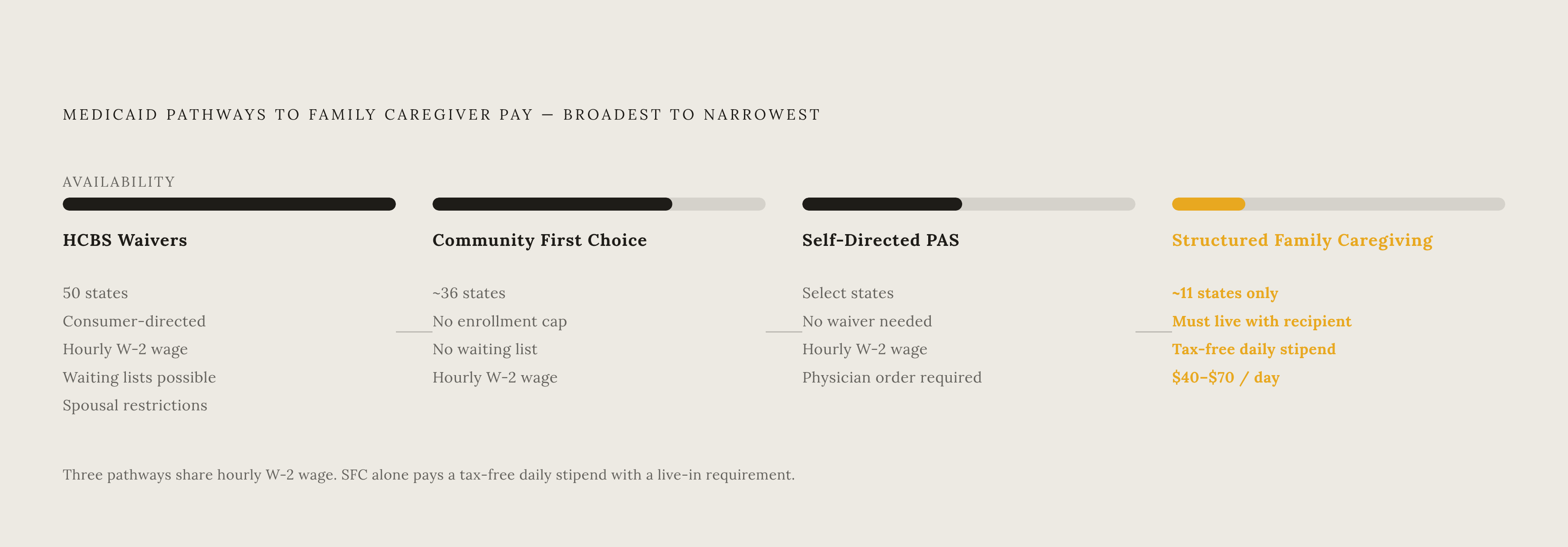
Four distinct Medicaid authorities create four different ways a family caregiver can get paid, and identifying which one applies to a given household is the first real step toward turning unpaid labor into a wage or stipend. The four pathways, as identified across the sources, are the Community First Choice (CFC) state plan option, the Self-Directed Personal Assistance Services (PAS) state plan option, and Structured Family Caregiving (SFC).
Three of the four share a common design. Under HCBS waivers, Community First Choice, and Self-Directed PAS, the Medicaid-eligible relative receives a care budget and uses it to hire, train, and pay a caregiver of their choosing, including a family member. That payment moves through a financial management agency and arrives as ordinary W-2 wage income. Structured Family Caregiving breaks from that pattern entirely. The caregiver lives with the recipient full-time and receives a tax-free daily stipend, typically running $40 to $70 a day, rather than an hourly wage.
A 2026 guide from A Place for Mom confirms this four-authority structure directly, noting that caregiver pay programs may run through a state's regular Medicaid plan, an HCBS waiver, a Community First Choice plan, or a Personal Assistance plan. Each authority carries its own administrative quirks: some cap enrollment, some do not; some require a waiver application, some operate automatically under the state plan; some pay hourly, one pays a flat daily amount. The sections that follow take each pathway in turn, starting with the one available in the broadest number of states.
HCBS waivers: the most widely available consumer-directed pathway
Home and Community-Based Services waivers exist in every state and represent the most common route into paid family caregiving, though access within a given waiver is never automatic. A waiver allows a state to fund long-term care at home instead of in a nursing facility, typically for individuals who need nursing-home-level care but can remain safely in their own home with support. The consumer-directed option, which lets the care recipient hire a family member directly, must be specifically written into that state's waiver design. It does not come bundled with every HCBS waiver by default.
Availability does not guarantee immediate access. Hundreds of thousands of people sit on Medicaid waiting lists for HCBS nationwide, since states are not required to serve every qualified applicant the moment they apply. Approval for Medicaid long-term care eligibility and approval for an HCBS slot are two separate hurdles, and a family can clear the first only to wait months or years for the second.
Examples of named self-directed programs that operate under this waiver authority include New York's CDPAP, California's IHSS, which averages around $18.50 an hour, and Wisconsin's IRIS. Each operates under its own state's rules, and each illustrates the same underlying mechanism: a waiver grants the state flexibility, and the state chooses to let a portion of that flexibility flow to family members as paid labor.
Most states impose a spousal restriction somewhere within this pathway, barring a husband or wife from serving as the paid caregiver in at least some of their waiver programs, and some states extend a similar exclusion to parents caring for their own minor children. Payment, where it is approved, comes as an hourly wage, generally set at or above the state's base rate for home care, and it is processed through a financial management agency as standard W-2 income.
Community First Choice: the federal state plan option with the broadest mandate
Community First Choice operates on a different legal foundation than an HCBS waiver, and that difference carries real consequences for families tired of waiting lists. Because CFC is a state plan option rather than a waiver, a state that adopts it must serve every individual who meets the eligibility criteria. No enrollment cap exists under CFC itself, and no waiting list can form the way one does under a waiver program with limited slots.
CFC traces back to Section 1915(k) of the Social Security Act. States that adopt it receive an enhanced federal matching rate in exchange for providing personal attendant services and supports to Medicaid-eligible individuals with disabilities. A Place for Mom's 2026 guide lists CFC as one of the four Medicaid authorities through which family caregiver pay programs are offered.
Adoption of CFC is optional, and not every state has taken it up. Families living in a state that has not adopted CFC have to look instead to an HCBS waiver or one of the other pathways described in this piece. Where it does exist, CFC functions much like a waiver's consumer-directed option: a family member can be hired and paid as the caregiver, the same spousal restrictions tend to apply, and payment still runs through a financial management agency. CFC differs from a waiver in its entitlement structure, not in the day-to-day experience of giving or receiving care.
Self-Directed Personal Assistance Services: the state plan option outside waiver authority
Self-Directed Personal Assistance Services provide a third federal vehicle for paying family caregivers, operating under state plan authority that gives states flexibility without requiring a separate waiver application. Personal Care Services (PCS) under a state plan cover help with activities of daily living, bathing, dressing, toileting, and meal preparation, and many state plans permit a family member to deliver these services as the paid provider.
Access to PCS requires a physician's order and a documented care plan, and the supervision structure varies from state to state. PCS must be ordered by a physician and follow a documented care plan; supervision requirements vary by state, and while many states require a registered nurse to supervise the care arrangement, others permit LPNs, case managers, or other qualified staff. A 2026 guide from Suncrest Care confirms that PCS commonly permits family members to serve as caregivers, provided physician certification of need is on file.
The practical distinction between PAS and a waiver lies almost entirely in administration. Because PAS runs through the state plan rather than waiver authority, it avoids the enrollment caps and waiting lists tied to waiver slots, though states retain other ways to limit the program. For the caregiver actually doing the work, the experience looks similar to a waiver arrangement: an hourly wage, processed through a financial management agency, reported as W-2 income. The same restrictions on spouses and other legally responsible relatives that apply under HCBS waivers apply here as well.
Structured Family Caregiving: the live-in stipend model available in about 11 states
Structured Family Caregiving departs from the other three pathways in both its financial structure and its physical requirements. It is the only Medicaid pathway that pays a tax-free daily stipend rather than an hourly wage, and it requires the caregiver to live with the person receiving care. That live-in condition changes who the program can realistically serve. An adult child who has already moved in with an aging parent, or a relative sharing a home out of necessity, fits naturally into this model. A caregiver who visits for a few hours a day and returns to a separate household does not.
SFC is available in roughly 11 states, including Georgia, Indiana, and Connecticut. A partial exception exists under the IRS difficulty-of-care rule, which can extend similar tax treatment to some live-in caregivers working within self-directed programs, but the stipend model builds that advantage in from the start.
The tradeoff is reach. SFC's limited state availability means most families cannot access it and must use one of the three self-directed pathways instead. Whether spouses can serve as paid caregivers under SFC depends on the state, following the same pattern of legally responsible relative rules found across the other three pathways. A family weighing SFC against an hourly waiver program is really weighing a stipend's tax advantage and relational structure against its limited geographic availability, and the right answer depends entirely on which of the two a given state actually offers.
Eligibility rules determining which pathway applies
Every pathway described above runs through two layers of eligibility, and a family has to clear both before a dollar of compensation moves anywhere. The first layer belongs to the person receiving care. The second belongs to the relationship between that person and the relative who wants to be paid.
Family caregivers are going uncompensated not from a lack of programs but from a lack of legible access to four distinct Medicaid pathways that together cover every state. That means meeting limited income and asset thresholds. A Place for Mom's guide notes that many long-term care Medicaid programs apply a strict cap on an individual's countable assets, and some states layer a monthly income cap on top of that. Most states require the senior to need help with at least two activities of daily living (ADLs), such as bathing or dressing. A physician's assessment and a formal, documented care plan generally accompany that determination, tying the clinical need to the paperwork the state will eventually review.
On the caregiver's side, relationship rules decide who can actually be hired and paid, even after the care recipient qualifies. The spousal restriction appears most often in self-directed programs, where a spouse cannot serve as the paid caregiver because the law already treats a spouse as having a legal duty to provide that support without separate compensation. Some states extend a similar logic to parents of minor children, excluding them from payment for care that falls inside an existing parental obligation. Other states take a more permissive stance and do allow spouses to be paid, so the honest answer to whether a given relative can be compensated depends on the specific state and the specific program, not on any single national rule.
That variability means a family that rules out one pathway may still qualify under another, since the four authorities apply different rules to the same relative. A family that rules out HCBS waivers because of a waiting list may still qualify under Community First Choice. A family excluded from hourly wage programs by a spousal restriction may find that Structured Family Caregiving, where offered, treats the same relationship differently. Knowing which of the four authorities governs a given state, and which eligibility rule applies to a given relative, is the actual mechanism by which unpaid caregiving becomes compensated work.