The Step-by-Step Path From Medicaid Application to Your First Paycheck as a Family Caregiver
Medicaid can pay family caregivers, but enrollment requires following five distinct steps in order.

Getting paid to care for an elderly parent or another relative through Medicaid starts with the care recipient’s eligibility, then moves through program selection, assessment, payroll enrollment, and timekeeping. An AI platform for family caregivers can help find Medicaid self-direction options and guide enrollment, but when pay can start depends on the state’s eligibility rules, care assessment, and worker requirements.
Why family caregivers miss Medicaid pay they already qualify for
KFF focus groups found that family caregivers often reported struggling to make ends meet and reducing their hours at other jobs because of caregiving demands. They were already doing the work, just unpaid. Yet knowing that Medicaid can pay relatives does not reveal which program to request, whose eligibility comes first, or what separates approval from employment. That gap can keep an eligible family from reaching payroll. The practical response is to follow the enrollment stages in order, rather than treating “apply for caregiver pay” as a single transaction.
How Medicaid actually pays a family caregiver — the mechanism behind the paycheck
Under the self-directed employment model, also called consumer direction, the care recipient directs care and hires a worker who can, where program rules allow, be a relative. A financial management agency processes the worker’s hourly wages. A family member who gives roughly 30 hours of care a week gets regular pay for approved work, with payment limited to those hours.
Under the Structured Family Caregiving model, family members are paid at a per diem rate. KFF’s 2025 report found that 11 states had adopted these programs. Availability of family caregiver pay and availability of self-direction are not identical, however. The same survey found that all responding states paid family caregivers through at least one Medicaid home care program, while Alaska was the only exception to self-direction availability.
Roles also need to be settled before enrollment. Under the federal 1915(j) and Community First Choice self-direction options, the recipient’s designated legal representative cannot also be the paid caregiver. A relative may still become the worker if someone else holds the representative role or the recipient self-directs. The distinction is between directing care and providing it.
Step 1 — Confirming the care recipient's Medicaid eligibility before anything else
Eligibility begins with the person who needs care. The caregiver’s own income and assets are not the eligibility test at this stage. For most Medicaid long-term care programs, the recipient must meet state income and asset limits, so the state Medicaid agency is the source for current thresholds. Those limits vary and can change.
The recipient must also have an assessed need for personal care or home health assistance. Most home- and community-based services, or HCBS, waivers require “nursing facility level of care,” meaning needs that would otherwise qualify the person for nursing facility placement. State plan services are entitlements for people who meet their eligibility requirements, while waivers may limit enrollment.
To begin, contact the state Medicaid agency or a local Area Agency on Aging through the Eldercare Locator at 1-800-677-1116. Ask specifically about self-directed or consumer-directed personal care and whether a family member can be the paid worker.
Step 2 — Choosing the right program among the options your state offers
HCBS waivers under 1915(c) and 1115 are the most common route for family caregiver pay in KFF’s survey. They generally require nursing-facility level of care, and many have enrollment caps or waiting lists. The HCBS State Plan Option under 1915(i), by contrast, does not require that level of need. Its individualized care budgets can allow people with moderate functional needs to hire a family caregiver.
Community First Choice, under 1915(k), is another state plan option and has no enrollment cap. It is available in Alaska, California, Colorado, Connecticut, Maryland, Montana, New York, Oregon, Texas, and Washington. The AdvancingStates 1915(k) one-pager identifies the states other than Colorado, and Colorado’s HCPF states that its program became active July 1, 2025. Availability alone does not settle who can be hired. Families still need the program’s rules on paid relatives and representative roles.
State names can make this conversation easier. Examples include CDPAP in New York, IHSS in California, CDASS in Colorado, IRIS in Wisconsin, CFSS / CDCS in Minnesota, Personal Choices in Alabama, and CDPASS in Oklahoma. Families should compare which self-directed programs are currently open to new enrollment and whether each permits a family member to be paid. That comparison keeps the choice grounded in access, care needs, and worker eligibility.
Step 3 — The functional needs assessment that determines care hours and budget
A trained assessor, typically a case manager, social worker, or nurse, evaluates activities of daily living, including bathing, dressing, eating, and mobility. The assessment also looks at instrumental activities such as meal preparation, medication management, housekeeping, and transportation. These findings establish whether the recipient meets the program’s level-of-care standard. The resulting individualized care plan specifies approved tasks, weekly hours, and a care budget.
Preparation helps keep this stage from stalling. Families usually need proof of residence, medical records or records from a physician that show the care need or disability, financial information that supports Medicaid eligibility, and records or logs of past care. Missing or late documents are a common reason applications stop moving. Preparing them before the visit gives the assessor the records needed to evaluate the request. The resulting plan is not permanent and can be reassessed as needs change, increasing or decreasing approved hours.
Step 4 — Enrolling through the fiscal intermediary and setting up payroll
The caregiver must next enroll as a worker through the designated fiscal intermediary, also called a financial management service or FMS. This agency processes payroll, withholds and remits payroll taxes, issues W-2 wage statements, and tracks authorized hours against the care budget. It also provides the employer-of-record function when the recipient is the directing employer. This stage connects the approved plan to a working payroll arrangement.
Worker onboarding usually includes a criminal background check, required state training or orientation, and standard employment paperwork such as I-9, W-4, and direct-deposit forms. Most states require caregivers to be at least 18. The worker also receives instruction on the timekeeping system before submitting hours. Enrollment is as a W-2 employee, so the payment arrangement includes employment and payroll requirements. Completing these requirements is a separate milestone from having the care itself approved.
Step 5 — Tracking hours accurately from day one and what happens at first paycheck
Each shift needs a start time, end time, and description of tasks performed, using the fiscal intermediary’s mobile app, phone-in system, or paper timesheet. Accuracy begins with the very first shift. Errors or gaps can delay payment or lead to payments being reclaimed. Hours must also stay within the approved care budget, because extra hours worked without prior authorization are not reimbursed.
The care recipient or authorized representative typically confirms or co-signs each timesheet before payroll processes it. Payment then follows the intermediary’s weekly, biweekly, or semi-monthly schedule, depending on the program. The check or direct deposit pays for approved hours at the state’s authorized hourly rate. There is no single national rate to promise. The achievable endpoint is regular wages for authorized, documented care, with the same timekeeping and confirmation process supporting each later pay period.
The waiting list problem and how to protect your place in line
A waiver waiting list can interrupt the sequence between program selection and assessment. Eligibility does not guarantee an immediate opening. KFF’s 2025 survey found that the majority of states reported at least one HCBS waiver waiting list, with substantially longer waits for intellectual and developmental disability waivers than for aging or physical disability waivers, reflecting a structural limit on access.
Apply soon and send in all the required documents, since a family’s place in line often depends on the application date and incomplete applications may be held or restarted. While waiting, ask if a state plan personal care option is available. State plan options are entitlements, so the law bars them from having waiting lists. Community First Choice may be another option where it is available, and families can also look into Structured Family Caregiving while they wait or alongside another program in states that offer it under different program authority.
KFF’s 2025 brief says the reconciliation law passed July 4, 2025, makes large cuts to federal Medicaid spending over the next decade. Because most home care programs are optional for states, waiting lists could grow as states respond. The long-term effect on those programs is not yet fully known.
Other pathways that can complement or substitute for Medicaid self-direction
Families waiting for Medicaid enrollment may have other ways to get support. Veteran-Directed Care gives veterans a self-directed budget with which to hire their own caregiver, using a structure similar to Medicaid self-direction. The programs belong to separate systems. VA and Medicaid services can sometimes be layered, though one program’s availability does not establish eligibility for the other.
Long-term care insurance may also help if a policy has cash or family-care benefits that let the policyholder use the money to pay for a relative’s care work. The terms are policy-specific. This option therefore depends on existing coverage. Medicare, by contrast, generally does not cover home care of the kind discussed here and is not a substitute route to these caregiver wages.
Support beyond pay — training, respite, and mental health resources available through Medicaid
KFF’s survey found that all states that responded offered at least one kind of help for family caregivers beyond pay, including training, support groups, or respite care. Such support was most widely available to caregivers of people with intellectual or developmental disabilities. Many waiver programs fund formal training that can improve care quality, confidence, and safety. These services help make continued caregiving workable, rather than treating enrollment as the end of the family’s needs.
Respite provides paid temporary care so the caregiver can take a break. It was available through Medicaid waivers in all responding states. Outside Medicaid, the National Family Caregiver Support Program offers respite, counseling, training, and supplemental support for unpaid caregivers. The Caregiver Action Network offers free training, education, and ways to connect with other caregivers. For families completing enrollment, asking about these resources extends the conversation from how care will be paid for to how the caregiver will be supported over time.
How to navigate the full process without losing track of where you are
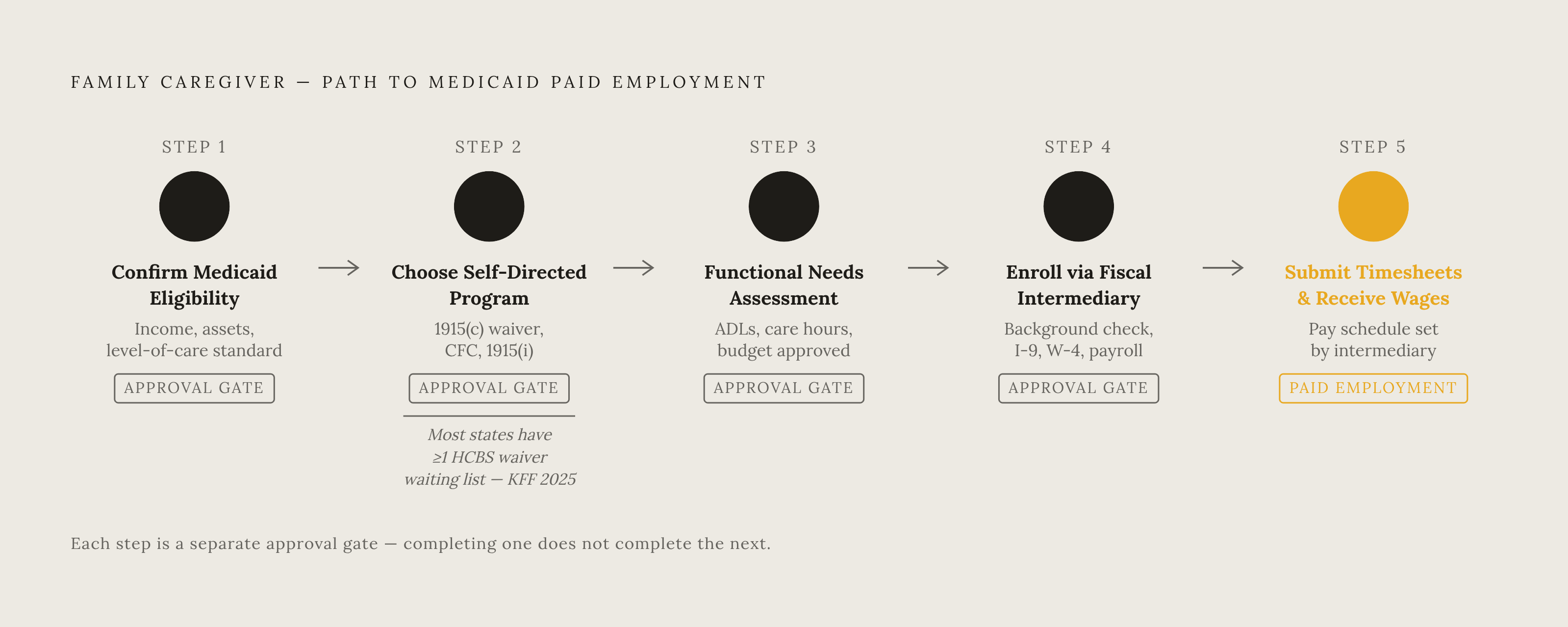
The most useful next action depends on the unfinished stage. Before choosing a program, families need to check the recipient’s eligibility and which self-directed options allow relatives to be paid. Before assessment, the priority is a complete documentation package. After care-plan approval, worker onboarding remains a separate requirement, and after onboarding, timekeeping and timesheet confirmation govern payroll. Keeping those distinctions visible helps prevent a family from mistaking progress at one stage for completion of the next.
AI-assisted benefit discovery tools can help hold this sequence together by identifying possible programs, explaining state-specific paid-worker rules, and guiding enrollment in plain language. The AI assistant at the heart of this publication’s work is designed to match families to programs they qualify for and walk them through enrollment.
That support is most useful when it identifies what remains unresolved, whether documentation, a waiver opening, worker paperwork, or the first timesheet confirmation. The path to wages exists, but each approval has a specific job. Help can make those handoffs easier to follow without obscuring who decides eligibility, authorizes care, and issues the paycheck.