Aging in Place With Medicaid-Funded Home Modifications
Medicaid waitlists delay home modifications that could prevent nursing home placement.
Medicaid's original design paid fully for a nursing home bed and nothing for a ramp that might have kept someone out of one. Section 1915(c) waivers exist to fix that imbalance, and understanding why they were built this way explains almost everything confusing about how they work today.
Why Medicaid Was Designed to Pay for Home Modifications
Before these waivers existed, Medicaid's long-term care promise ran in one direction only. Nursing home care was, and still is, a federal entitlement: any state that takes Medicaid money must pay for every person who qualifies for institutional care, with no cap on how many people enroll. Home and community-based care carried no such guarantee. A senior who wanted to stay in a spare bedroom, a converted den, or a family member's house, instead of a facility bed, had no matching entitlement to lean on. Section 1915(c) gave states a way out of that trap: it let them "waive" certain standard Medicaid rules so program dollars could flow toward home and community-based services for people who would otherwise need institutional care. The logic behind this shift has guided long-term care policy across the country ever since: keep people in their own homes and put off a move to a nursing facility for as long as it is safely possible. Home modifications sit near the center of that logic. A grab bar, a ramp, or a roll-in shower can be the one change that keeps a fall from happening, and a fall, more often than any single event, is what pushes a senior out of a home and into a facility.
What HCBS waivers actually cover when it comes to home modifications
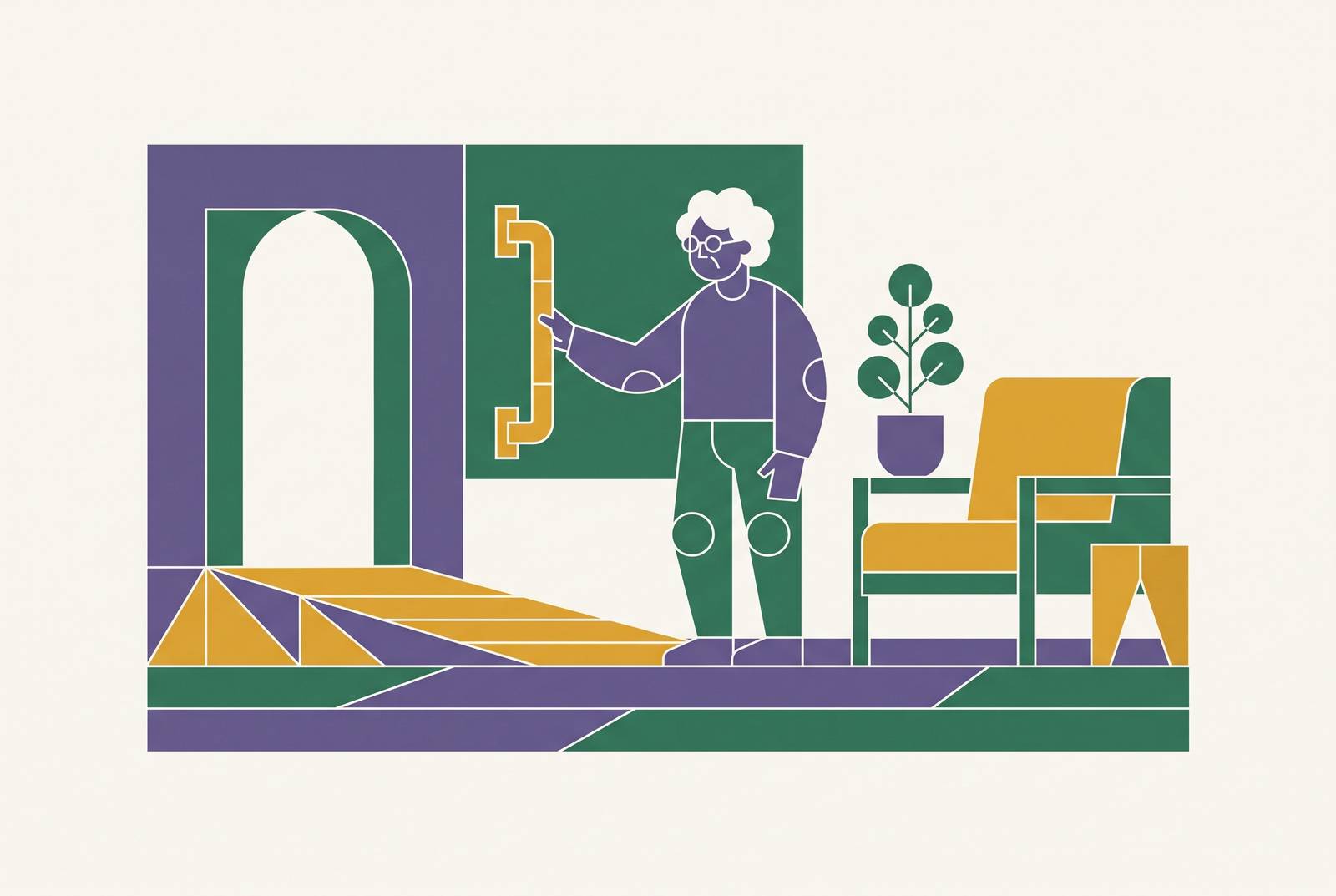
Home modifications rank among the most commonly offered services across HCBS waivers nationwide, though no two states define the benefit the same way, because the federal government sets no standard list of what counts. Most programs will pay for the basics that make a home physically navigable: wheelchair ramps, grab bars, widened doorways, barrier-free or roll-in showers, stairlifts, traction strips on slick flooring, roll-out shelving in cabinets, push-button automatic door openers, walk-in tubs, and flooring changes that let a wheelchair move freely through a room. The definition of "home" itself is broader than most applicants assume. Coverage can extend to a family member's house, a condominium, a mobile home, a houseboat, or an apartment, though renters generally need the property owner's written approval before any physical changes can begin. One gap trips up a lot of families: some state programs will pay for materials, classified as durable medical equipment, but not for the labor to install them, and where that split exists, local nonprofits and volunteer builder programs sometimes step in to cover installation at no charge. Many waiver programs also pay for an occupational therapist assessment before any work starts, and that assessment, which looks at what a person needs now and what they are likely to need as a condition progresses, is the right place to begin almost every modification project.
Who qualifies and how the eligibility thresholds actually work
Getting approved for waiver-funded modifications means clearing two separate bars, and most of the difficulty in this system lives in the second one. The first bar is financial: in most states, the income limit for HCBS eligibility as a single applicant matches the income limit for nursing home Medicaid, so money alone rarely disqualifies someone who would already qualify for institutional care. The second bar is functional, and it is where many otherwise-eligible applicants get stuck. A formal assessment has to show that an applicant's care needs rise to what's called a nursing-home level of care, the kind of need that would otherwise require institutional placement. Moderate limitations, the sort that make daily tasks harder but not impossible, typically fall short of that standard. Once someone does qualify and enroll, the state has to reassess that level-of-care determination at least once a year, so eligibility is never a one-time event. Clearing both of these bars still does not guarantee a senior gets services right away. That is where the next problem in this system begins.
The Waitlist Problem for Applicants
Qualifying for an HCBS waiver and actually receiving services are two different things, because unlike nursing home Medicaid, HCBS waivers are not federal entitlements. Nursing home Medicaid must serve every eligible applicant, with no ceiling on enrollment. HCBS waivers operate under enrollment caps that each state sets on its own, and once a state hits its cap, every new eligible applicant goes onto a waitlist. As of 2025, most states maintained some form of HCBS waiting or interest list, and hundreds of thousands of people sat on those lists nationally. How long someone waits depends enormously on the state and the specific waiver: some applicants wait a few months, while others wait more than a decade. This produces an outcome exactly backward from what the program was built to prevent. A senior who is fully eligible for home-based care but cannot get off a waitlist may end up in a nursing home anyway, the costlier outcome Medicaid designed these waivers to avoid in the first place, simply because the cheaper path is rationed by a waiting list and the expensive path is not.
Spending Caps and State-by-State Variation
Even an applicant who clears both eligibility hurdles and gets a waiver slot still faces a third variable: how much the state is actually willing to pay. Home modification does not appear on the federal government's list of required HCBS services, so each state decides on its own whether to offer the benefit at all, and if it does, how much money to attach to it. Every 1915(c) waiver still has to meet three federal tests regardless of what it covers: spending per person cannot exceed what institutional care for that person would cost, each enrollee's level of care has to be reevaluated annually, and the state sets its own cap on total enrollment. Within those federal guardrails, the dollar amounts states assign to home modifications swing wildly. Arkansas caps home modification spending at $7,500 per person for the life of the waiver. Georgia sets its lifetime cap at $10,000 per person. Iowa's Elderly Waiver allows just $1,000 over a lifetime for home modifications, an amount that covers a handful of grab bars and little else. Most states also impose an overall annual spending limit per participant, so home modifications compete against personal care aides, transportation, and other services for a share of the same capped budget. Access to a meaningful modification often comes down less to need and more to which state line a person happens to live behind.
How specific state waiver programs approach home modifications differently
Beyond dollar caps, states make different structural choices about how their waivers operate, and those choices shape the experience of applying and receiving services as much as the cap amount does. Texas runs its home modification and adaptive aid benefits through STAR+PLUS, a managed care model where residents get their healthcare through a managed care organization that coordinates both medical treatment and modification services under one roof. Oregon takes a different approach entirely with its K Plan, built under the Community First Choice option: it is structured as an entitlement, so anyone who qualifies receives services immediately as a right. Oregon's entitlement structure stands out specifically because it sidesteps the waitlist problem described above, but it remains the exception among states rather than a common model. Looking at how a state has structured its waiver, whether it runs through managed care, functions as an entitlement, or lets participants self-direct a budget, tells an applicant as much about what to expect as the dollar figure attached to the cap.
The federal policy changes in 2025 and 2026 that are reshaping HCBS access
Federal budget legislation signed in mid-2025 cut Medicaid more deeply than at any other point in the program's history, and HCBS waivers are squarely in the path of those cuts because they make up such a large share of spending that states can choose to reduce. HCBS accounts for more than half of all Medicaid spending on long-term services and supports, and roughly one-fifth of total Medicaid spending overall, a share large enough that it becomes one of the first places states look when budgets tighten. As of mid-2026, at least 18 states had either proposed or already enacted cuts to HCBS, or were otherwise moving in ways that threaten access to aging and disability services. One change moves in the opposite direction. Starting January 1, 2026, ABLE accounts opened to anyone whose disability began before age 46, up from the previous cutoff of age 26, which makes millions more Americans eligible to use these tax-advantaged savings accounts for home modifications while leaving Medicaid enrollment untouched. That expansion helps a real number of people, but it does not come close to offsetting cuts measured against the largest Medicaid reduction in the program's history.
Other funding sources that work alongside or instead of Medicaid waivers
Medicaid waivers remain the largest public funding source for home modifications among seniors with significant care needs and low income, but several other programs reach people the waiver system leaves out or runs short on. The Older Americans Act, through Title III-B and III-D funding, sends federal dollars to state units on aging, which pass them down to local Area Agencies on Aging. These agencies run their own home modification programs, covering items like grab bars, ramps, raised toilet seats, stairlifts, and sometimes larger bathroom conversions, with eligibility based on age, generally 60 and older, and need rather than a nursing-home level of care determination. Contact the local Area Agency on Aging or call the Eldercare Locator at 1-800-677-1116 to find the entry point in any community. Veterans have a separate set of options through the VA, including the Specially Adapted Housing grant, which covers building, remodeling, or purchasing an adapted home for veterans with certain service-connected disabilities and provided up to roughly $121,000 in 2026, and the Special Housing Adaptation grant, which covers a narrower set of modifications at a lower ceiling. None of these sources replace what a Medicaid waiver provides for a senior with high, ongoing care needs, but they matter a great deal for someone who doesn't meet the nursing-home-level-of-care threshold, who is sitting on a waitlist, or who needs to stretch a modification budget past what a waiver's cap allows.
How to Find and Apply for Your State's HCBS Waiver Program
Applying for an HCBS waiver means working through a state agency rather than a single national system, and understanding the right order of steps is often what separates a family that gets services from one that gives up partway through. The process starts with Medicaid eligibility itself: waiver access requires being a Medicaid enrollee, so the first call should go to the state Medicaid office to confirm financial eligibility before pursuing any specific waiver. From there, an applicant needs to find out which waivers the state actually runs, since most states and Washington, D.C. operate several HCBS waivers at once, each aimed at a different population, whether elderly adults, people with physical disabilities, or people with intellectual disabilities, and the waiver built for aging in place is usually the one targeting elderly or aged, blind, and disabled populations. The next step is requesting a functional assessment directly, since the level-of-care determination comes from the state or a designated assessor, and applicants should ask for it by name and find out what their state's criteria for nursing-home level of care require. If enrollment in the right waiver is closed, the next move is getting onto the waitlist immediately rather than waiting, because placement is often date-stamped, so an earlier application date means earlier access once a slot opens. Once enrolled, requesting an occupational therapist evaluation is the right next step, since many waiver programs cover this assessment and it identifies which modifications are both needed and fundable under the plan. Before any work begins, it helps to understand the waiver's spending cap in detail: whether it covers labor, materials, or both, what the annual or lifetime dollar limit is, and whether a local nonprofit or volunteer program can cover labor costs the waiver won't pay for. Three entry points work for nearly anyone trying to start this process: the state Medicaid office, the local Area Agency on Aging, or the Eldercare Locator at 1-800-677-1116, and any of the three can point an applicant toward the right waiver and the right application.
Why applying early, before a crisis forces the decision, changes the outcome
High eligibility thresholds, long waitlists, and a policy environment now cutting rather than expanding HCBS funding combine to punish anyone who waits for a crisis before applying. The eligibility catch-22 described earlier runs in both directions: waiting until a senior's needs are severe enough to qualify for a nursing-home level of care often means the window for a cost-effective early modification has already closed, and by the time approval comes through, a grab bar alone may no longer be enough to keep that person safely at home. The current policy climate raises the stakes further. With federal Medicaid cuts now law and multiple states already proposing reductions to HCBS, the programs available today may shrink or become harder to access in the years ahead, not easier. Planning ahead of a fall or a hospitalization fits how these programs are meant to function in the first place: as tools for proactive planning, not as emergency response systems activated after a crisis has already happened. Family caregivers carry much of this weight in practice, since they are frequently the ones who research the options, fill out the applications, and keep track of which agency needs which document, so getting accurate information to them early matters just as much as getting it to the senior who will use the benefit.