Advance Directives and Their Legal Effect by State
State law controls whether your advance directive is valid and whether clinicians must follow it.

Advance directives and their legal effect by state turn on more than what a document says. Federal law encourages planning, but a directive’s validity, effective date, and application depend on state law. Protecting your wishes therefore requires attention to three separate questions. Was the document properly signed, will it work where you receive care, and does it give clinicians the authority they need to act?
Why a federally encouraged document is still a creature of state law
The Patient Self-Determination Act of 1990 requires Medicare- and Medicaid-funded institutions to inform patients of their right to make treatment decisions under state law. It does not establish a national directive form. Instead, 42 U.S.C. § 1395cc(f)(3) defines an advance directive by reference to what is “recognized under State law.” The Act does not displace state execution or content requirements.
Fifty legal regimes govern the same human situation, namely the care a person receives when they can no longer speak for themselves. A hospital’s obligation to explain the right to make a directive does not establish that a particular document satisfies the applicable law. A document’s protection depends on its legal validity where it is presented.
The three documents in play, and which ones actually bind clinicians
A living will records preferences for medical treatment. It becomes effective only after incapacity is determined, with additional triggering conditions depending on state law. Physicians generally honor living wills, but they are not universally required to follow them as they must follow applicable medical orders. Written wishes and treatment orders are different instruments. The difference matters most in an emergency.
A healthcare proxy or health care power of attorney gives a named agent a decision-making role. Rather than relying only on written treatment preferences, this arrangement identifies someone who can speak when the patient cannot. The scope and activation of that authority depend on state law. An agent’s authority and a living will’s instructions serve related but distinct purposes.
POLST is a clinician-signed medical order. Also called MOLST, MOST, or TPOPP depending on the state, it translates expressed wishes into immediately actionable orders concerning CPR, mechanical ventilation, and artificial nutrition. Depending on state law, a physician, nurse practitioner, or physician assistant signs it. Among these planning instruments, only DNR orders and POLST bind emergency responders. A living will does not itself supply that emergency authority.
How execution requirements differ across all fifty states — and where directives most often fail at signing
Signing is a legal requirement. North Carolina calls for both witnesses and a notary, while Idaho calls for neither. South Carolina illustrates why the document type also needs attention. Its Living Will requires two witnesses and notarization, but its Health Care Power of Attorney requires only two witnesses, with notarization optional. Most states fall between these approaches, requiring one or two witnesses without notarization.
Witness eligibility is the most common signing failure. Across many states, exclusions include the named agent, relatives, heirs, people financially responsible for care, and healthcare providers. An ineligible witness’s signature does not meet the rule just because that person watched the document being signed. The formalities concern who witnesses the act as well as how many witnesses attend. Clear treatment instructions cannot cure defective execution.
When does the directive activate? The ABA Commission on Law and Aging’s September 2025 50-state study shows how much the triggering conditions vary. Alabama requires an attending physician’s determination of incapacity and personal examinations by two physicians, including the attending physician, documenting terminal illness or permanent unconsciousness. Alaska ties agent authority to a capacity determination and specifies different determining authorities for mental illness and other conditions. These are activation rules, distinct from signing rules.
How pregnancy changes — or eliminates — a directive's effect in roughly half the states
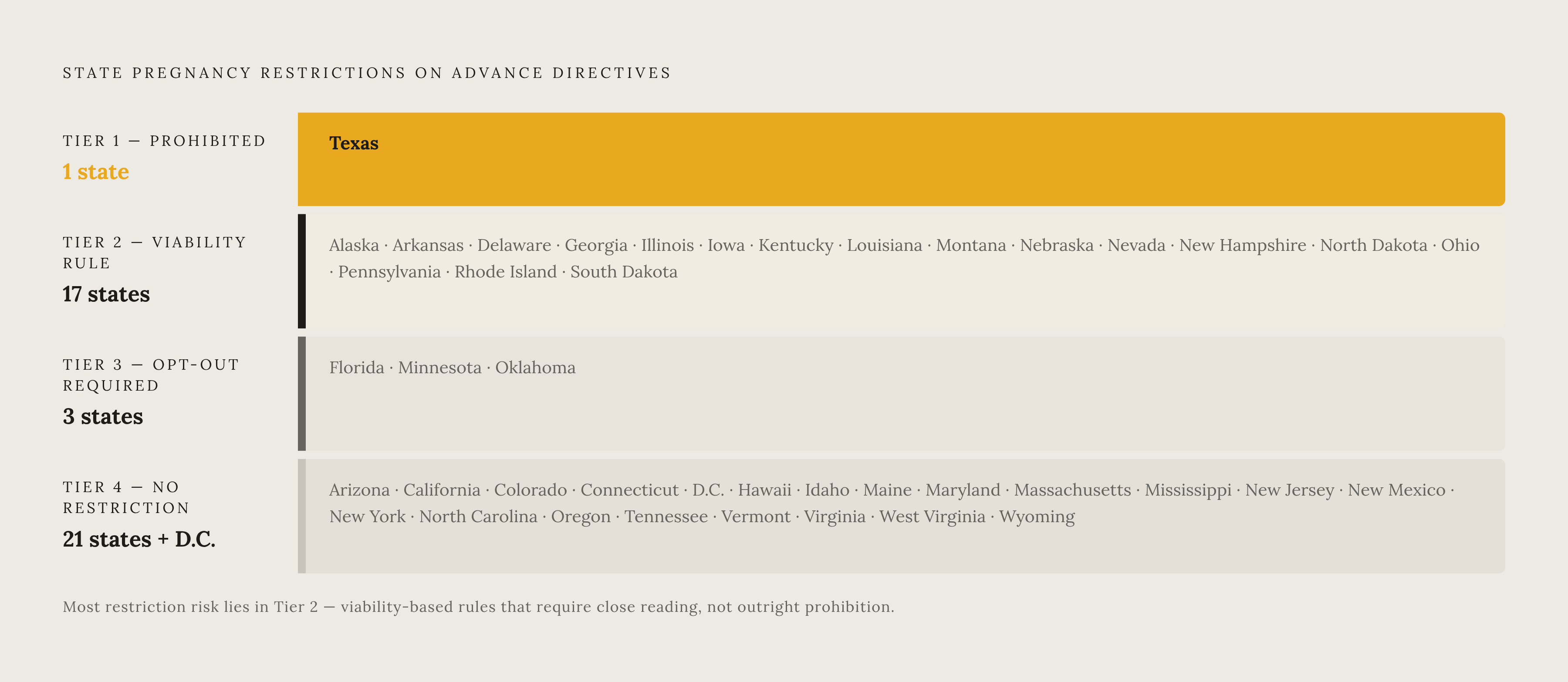
Pregnancy can change the effect of an otherwise valid directive. Restrictions in roughly half the states mean that proper execution does not always preserve a refusal of life-sustaining treatment. The rules fall into different tiers, from categorical prohibitions to conditions based on fetal viability or live birth.
Texas Health & Safety Code § 166.049 prohibits withholding or withdrawing life-sustaining treatment from a pregnant patient under that subchapter. A larger group of states instead restricts refusals when the fetus could reach viability or live birth. Some of those states make exceptions if the treatment would physically harm the pregnant person. By contrast, a substantial group of states and D.C. imposes no pregnancy restriction. Arizona’s sample form gives pregnant patients an explicit way to opt out.
Florida, Minnesota, and Oklahoma occupy a conditional category. They require explicit pregnancy instructions to opt out of default life-sustaining treatment. Florida also bars a surrogate from consenting to withdrawal before fetal viability without specific authorization. For someone who could become pregnant, the practical response is to include pregnancy-specific instructions and express agent authority, while recognizing that these cannot override a statutory prohibition. Someone moving between these tiers needs to understand the document’s status in both states.
What happens to your directive when you move, travel, or divide time between states
Some states accept out-of-state directives only if they meet the receiving state’s requirements. Even when a state accepts a directive, how it reads the instructions can still vary.
Consider a Florida directive presented at an Oregon hospital. The receiving provider must work out which legal standard applies, which may delay time-sensitive care and put the institution at risk. This is a provider-side burden as well as a patient-side uncertainty. Interstate recognition deserves attention before treatment decisions become urgent, even though some out-of-state directives will remain valid.
POLST presents a separate portability problem despite its clinical force. Although recognized across nearly all states, these forms often do not transfer across state lines and may require a new in-state form co-signed by a local provider. An order that travels with a patient is not necessarily an order recognized everywhere. Military directives provide a distinct exception. Directives executed through a military legal assistance office for service members and their dependents are exempt from state formality requirements and valid everywhere.
The practical response depends on the pattern of travel. People who regularly divide their time between states should examine both states’ acceptance rules and consider consistent state-specific directives. Consistency is essential because a contradictory second directive can nullify the first. A permanent move calls for a new directive for the new state, superseding the old one. In either situation, a copy needs to be accessible where care is received.
What enforcement actually looks like — and when directives are violated in clinical settings
Legal validity does not guarantee adherence at the bedside. An eight-year ICU cohort study published in the Journal of Critical Care found that directives were violated in roughly one in eleven ICU cases. Violations were more frequent during the COVID-19 pandemic period than before it. Patients whose directives were not followed had worse in-hospital outcomes, consistent with receiving treatments they had explicitly refused. The association does not, by itself, establish why each violation occurred.
The same study also provides a contrasting finding. Patients requesting limited care or comfort care received preference-consistent treatment at a very high rate when their directives were followed. Yet the findings do not show that any single document can prevent every conflict. Specificity, the appropriate medical order, and clear agent authority address different points where instructions can lose force.
Agent authority matters most when there is disagreement over care. Massachusetts, Michigan, and New York have no living-will statute, making the agent’s voice particularly consequential compared with a living will alone. A clinician-facing instruction and an authorized decision-maker are not interchangeable. A particular plan may be weak in its legal form, emergency applicability, or agent authority. Identifying that gap is the prerequisite for repairing it.
A state-by-state reference: execution requirements, pregnancy rules, and portability signals
The available state details support a grouped reference. States left out of this reference may still have requirements or restrictions. West Virginia, like North Carolina, calls for witnesses and a notary when the document is signed. South Carolina belongs in that category for its Living Will, but not its Health Care Power of Attorney. New Mexico, like Idaho, calls for neither witnesses nor notarization.
Florida requires at least one witness who is neither a spouse nor a blood relative. Michigan excludes spouses, parents, children, grandchildren, siblings, presumptive heirs, known devisees, and the named patient advocate. It also excludes the principal’s physician and employees of the principal’s healthcare facility, life or health insurer, home for the aged, or community mental health program. A general witness rule would miss that breadth.
The viability or live-birth restriction group includes Alaska, Arkansas, Delaware, Georgia, Illinois, Iowa, Kentucky, Louisiana, Montana, Nebraska, Nevada, New Hampshire, North Dakota, Ohio, Pennsylvania, Rhode Island, and South Dakota. The wording of the laws varies among the states in this group. Some provide exceptions for physical harm to the pregnant person. Their rules therefore require closer reading than a simple “restriction applies” label would suggest.
The no-pregnancy-restriction group includes Arizona, California, Colorado, Connecticut, D.C., Hawaii, Idaho, Maine, Maryland, Massachusetts, Mississippi, New Jersey, New Mexico, New York, North Carolina, Oregon, Tennessee, Vermont, Virginia, West Virginia, and Wyoming. Florida, Minnesota, and Oklahoma have the conditions described above. Texas has the categorical prohibition described in these notes. Those distinctions prevent a misleading two-column division between restricted and unrestricted states.
Portability cannot be inferred from either of these groupings. A state’s witness rules do not establish whether it accepts a document signed elsewhere, and its pregnancy rules do not establish whether it recognizes an out-of-state POLST. The reference provides starting points for those questions. It does not supply a state-by-state acceptance rule where none is given. Recognition of the directive and recognition of the medical order remain separate inquiries.
The practical checklist for making a directive that holds up wherever you are
To put this analysis into practice, start with witness eligibility. Exclude your agent, relatives, heirs, healthcare providers, and anyone financially responsible for your care, then compare the proposed witnesses with your state’s specific exclusions in the ABA study or statute. Do not stop at counting the signatures. If pregnancy is possible, add explicit pregnancy-specific instructions and give your agent express authority to make those decisions where the law permits. Spell out authorization where a surrogate cannot otherwise consent to withdrawal.
Pair the directive with a POLST if your condition warrants it. Have a direct conversation with your healthcare agent about the care you want and the treatments you would refuse. The document supplies the legal frame for that conversation. How well the agent understands the instructions helps shape how they are used under pressure.
For regular residence in more than one state, verify each state’s acceptance rules before relying on a single document. If you execute state-specific directives, keep their instructions consistent. After a permanent move, execute a new directive as soon as practicable. Keep copies at the hospital, with your primary care physician, and with your healthcare agent. Also keep a portable copy that you can produce quickly.
Eligibility and enrollment for Medicaid-funded home care, HCBS, and caregiver compensation programs can be as consequential to caregiving as the directive itself. AI-assisted benefit discovery tools can help caregivers identify programs they qualify for and navigate enrollment. That support serves a different purpose from legal planning.