Activities of Daily Living in Medicaid and Insurance Assessments
How function gets measured shapes who qualifies for long-term care support.

Activities of daily living and instrumental activities of daily living are the two measuring sticks that decide who gets long-term care support and who doesn't, across public assistance programs, certified home health agencies, and private insurance alike. Watching whether a person can bathe, dress, or get to the toilet without help turned out to be a workable stand-in for clinical need, and that proxy is now baked into nearly every long-term care program in the country. The six core ADLs most programs track are bathing, dressing, eating, toileting, transferring (the physical act of moving, say from bed to chair), and continence, and this six-item list forms the floor of what counts as independent daily functioning. Some sources tack on a seventh item, but the six-item version is the one used most often across Medicaid planning resources.
These six tasks don't fail all at once, and that matters for anyone trying to read where a person stands in the course of a decline. What determines need is how much that diagnosis interferes with daily tasks; function, not diagnosis, is what gets measured. That distinction, between having a condition and being functionally limited by it, is what the rest of this piece builds on, and it's also why the IADL-declines-first pattern becomes more than a clinical footnote: it sets up a policy problem addressed later, because most programs don't weigh IADL loss the way they weigh ADL loss, even when the IADL loss appears first.
The standardized tools that translate function into eligibility scores
Turning "can this person bathe themselves" into a number that a caseworker or insurance adjuster can act on requires a standardized instrument, and there isn't just one. Different programs, states, and care settings use different scales, and which scale gets used shapes what the assessment actually captures and how a borderline case gets scored. The same person, assessed the same week, can land in different eligibility categories depending on which tool is in the assessor's hand.
The Katz Index of Independence, developed by physician Sidney Katz in 1963, is probably the most familiar of these instruments. The Barthel Index works differently: a 10-item weighted scale running from 0 to 100 that gives partial credit for partial independence. That's a real design difference from Katz's binary approach, because someone who can manage half of getting dressed scores differently depending on which tool is used to measure them.
IADLs get their own instrument. The Lawton-Brody IADL Scale, developed in 1969 and still the most widely used tool of its kind, scores eight domains, telephone use, shopping, cooking, housekeeping, laundry, transportation, medication management, and money management, on a 0 to 8 range. Whether a program's assessment protocol even includes IADL scoring matters a great deal, because a protocol that skips it can miss decline that is already underway but hasn't yet shown up in ADL performance. For people living with Alzheimer's disease or a related dementia, general ADL tools may not capture functional loss accurately, so a 47-item instrument called the Cleveland Scale (CSADL) was built specifically for that population. And for certified home health agencies, none of the above is optional: they're required to use a standardized assessment tool that tracks ADL measures at start of care, recertification, transfer, and discharge, a completely separate system from whatever other programs or a private insurer uses. The assessment" is never one uniform process, but a patchwork of instruments built for different purposes, and that patchwork is where real-world inconsistency starts, a problem this piece returns to directly in the section on where these systems break down.
How Medicaid uses ADL counts to set tiered eligibility
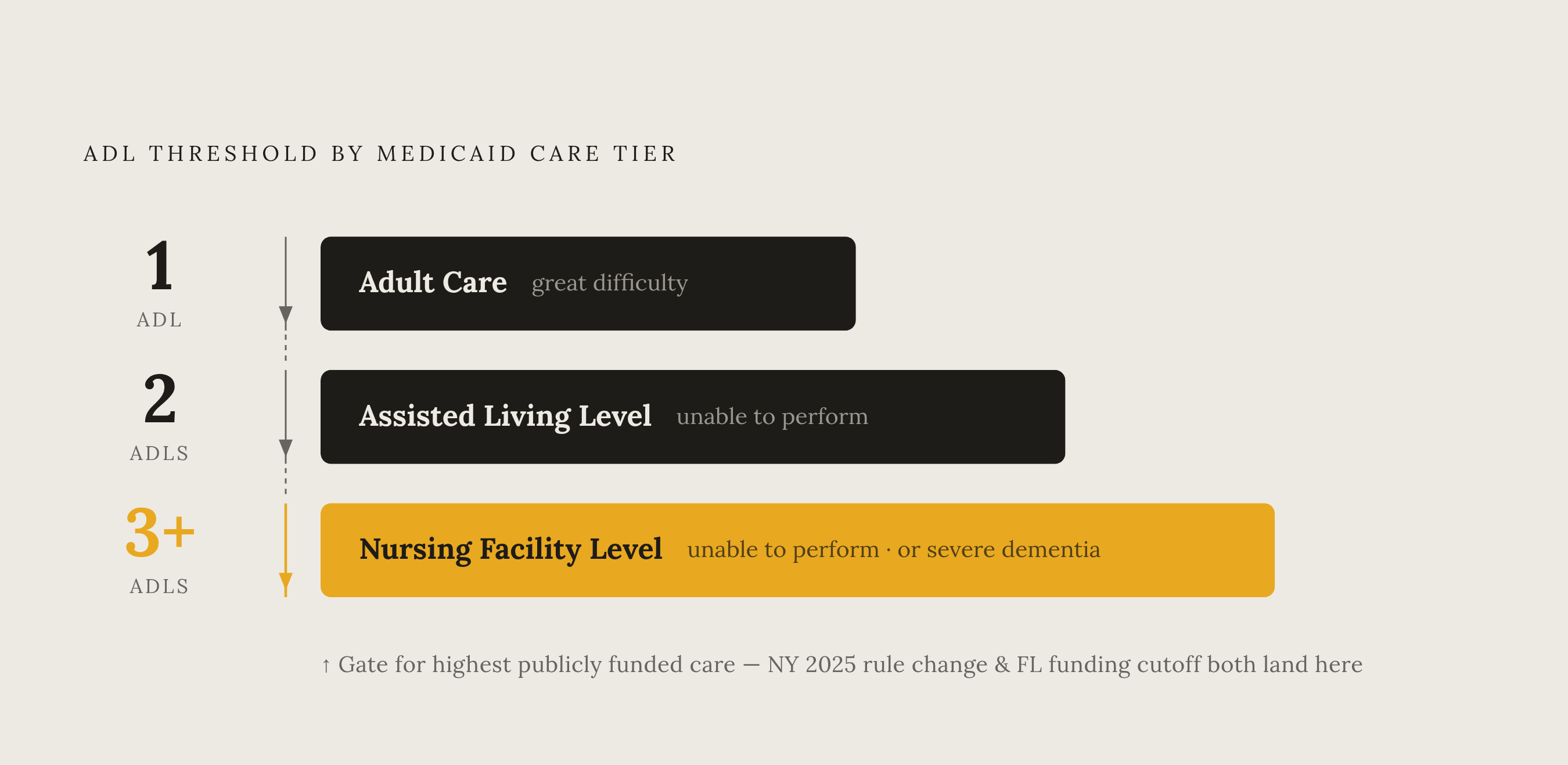
Once function has been converted into a number, Medicaid uses that number to do something consequential: it decides not just whether someone qualifies for help, but which tier of help they qualify for. The count of ADLs a person can't perform without assistance maps directly onto the level of care they're allowed to access, which makes the ADL count a structural gate, not just a clinical observation written in a chart.
Medicaid's long-term care programs break into three types, and each one carries its own functional bar. Nursing Home Medicaid requires a Nursing Facility Level of Care, shorthand for needing something close to 24-hour supervision, in every state, though the exact definition and measurement of that standard varies state by state. Aged, Blind, and Disabled Medicaid runs on a looser standard: the applicant has to show need for the specific benefit being requested rather than clearing the NFLOC bar across the board, so ABD recipients end up qualifying benefit by benefit.
Within that framework, the actual ADL-count progression follows a fairly concrete ladder. Great difficulty with one ADL qualifies an applicant for the lowest tier, adult care. Being unable to perform two ADLs moves someone into assisted living level of care. Needing assistance with three or more ADLs is what triggers nursing facility level of care, the highest tier, and a documented diagnosis of severe dementia can get someone to that same highest tier regardless of how many ADLs they've technically lost. Florida is a clear example of how this plays out on the ground: Florida Medicaid funds only those who reach nursing facility level of care, three or more impaired ADLs, and routes everyone below that threshold toward waiver or diversion programs instead. The Health and Wellness Waiver split off from the former Aged and Disabled Waiver on July 1, 2024, and now serves people 59 and under, while PathWays for Aging serves the older population. ADL impairment alone never decides Medicaid eligibility: financial eligibility, income and asset limits, has to be satisfied too, alongside the functional test.
Florida and Indiana aren't the whole country, which matters because states vary so widely in how they apply these thresholds. States vary in how many ADLs they require, how they define NFLOC, and how they weigh IADL findings alongside ADL findings, so an applicant's functional profile can clear the bar in one state and fall short in another. That variation isn't incidental. It sets up the most consequential example of state-level change in recent memory, which is what New York did in September 2025.
New York's September 2025 ADL threshold change
New York's new ADL minimum for Community Medicaid, effective September 1, 2025, is the most significant tightening of functional eligibility criteria anywhere in the country in recent memory, and it lands hardest on people whose care needs show up in IADLs and dementia-related supervision. Once that federal restriction lifted, New York moved forward with the standard it had passed five years earlier.
The new floor for applicants to the Consumer Directed Personal Assistance Program, known as CDPAP, requires either three or more ADLs (bathing, dressing, transferring, toileting, eating, mobility) needing limited assistance, or two ADLs needing supervisory assistance if the applicant has a documented diagnosis of Alzheimer's disease or another form of dementia. Stand-alone housekeeping services that local districts used to authorize, up to 8 hours a week, were also eliminated under the new thresholds, though people already receiving that service before September 1, 2025 keep it under grandfathered status. That housekeeping benefit functioned as a form of preventative care, catching people before their needs escalated into something that would require a far more expensive intervention.
One procedural detail buried in the new rule carries outsized consequences for applicants. Under the current standard, an applicant is only found to need ADL assistance if they actually received help, paid or from family, during one or more of the three days before the assessment takes place. Grandfathered recipients face a different kind of risk: a deferred one. But that protection depends entirely on uninterrupted enrollment, and any gap resets the clock.
The legislative response has already taken shape. Whether that legislation moves anywhere isn't something the record currently settles, but the fact that organized pushback exists at all says something about how consequential this threshold shift is seen to be.
How private long-term care insurance sets its ADL triggers
Private long-term care insurance runs on an ADL-based trigger that looks, at a glance, like a cousin of Medicaid's framework. It's built on different logic, and that difference determines when a policyholder actually sees a benefit check. Most tax-qualified long-term care policies use a standard trigger: the insured has to be certified as unable to perform at least two of six ADLs without substantial assistance, and that inability has to be expected to last at least 90 days, or the insured has to need substantial supervision due to severe cognitive impairment.
That 90-day duration requirement has no equivalent anywhere in Medicaid's ADL framework. The cognitive impairment pathway works independently of the ADL count. A person can be physically capable of bathing and dressing themselves and still qualify, if they lack the awareness, memory, or judgment to do those things safely without supervision. That's a meaningfully different gate than anything in the ADL-count ladder used by Medicaid.
IADLs, on the other hand, carry no weight at all under standard long-term care insurance policy language. Two very different institutions, public Medicaid and private insurance, have converged on the same blind spot: both treat ADL loss as the real signal and IADL loss as something closer to background noise.
Where ADL assessments break down
The entire ADL framework rests on an assumption that watching someone bathe or dress produces an objective, repeatable finding. In practice it converts a judgment call into a binary outcome, qualifies or doesn't, and that conversion opens real room for inconsistency and, in some cases, denial made in bad faith. A peer-reviewed review in the Annals of Geriatric Medicine and Research found that subjectivity and variability in ADL assessment outcomes trace back to individual assessors' experience and judgment, producing inconsistent results where rater training hasn't kept pace. Two assessors watching the same person can walk away with different conclusions, and nothing in the structure of most programs catches that divergence before it becomes an eligibility decision.
Private insurance carriers have found their own way to exploit the ambiguity built into these assessments. Carriers have also leaned more heavily on Independent Medical Examinations, often conducted by a physician who has never treated the policyholder and sometimes based on no more than a brief evaluation, specifically to challenge the findings of a treating physician who has actually followed the person's decline over time.
The structural gap around IADLs produces both of these problems. Early-stage dementia is the clearest case: the functional loss appears first in managing money, medications, or meals, long before it touches bathing or dressing, so by the time an ADL threshold is actually met, meaningful deterioration has already happened without triggering any support along the way. New York's September 2025 rules made this gap sharper by explicitly closing the IADL-only pathway that used to exist in Community Medicaid, which turns this from a quiet structural blind spot into a recent, deliberate policy choice. Layered on top of all of it is plain geographic inconsistency: an applicant with a given functional profile can clear the Nursing Facility Level of Care threshold in one state and fall short of it in another, simply because the two states use different instruments or apply different ADL counts to reach that determination. The same person, the same decline, two different outcomes depending on which side of a state line the paperwork gets filed.
Preparing for an ADL assessment
Caregivers who understand how these assessments actually get scored, and what an assessor is trained to look for, can take real steps that affect whether a genuine care need gets recognized on paper. In New York specifically, the three-day lookback rule means an applicant is only found to need ADL assistance if they actually received help, paid or from family, during one or more of the three days right before the assessment takes place. More broadly, every assessment is a snapshot of one day, so if the person being evaluated happens to be having a better day than usual, real limitations can go underreported, and caregivers are better served documenting what a typical day looks like.
Getting ADL and IADL limitations down in writing before the assessment even happens gives an assessor something more durable to work from than a single afternoon's observation. Because IADL limitations alone usually won't trigger benefits under programs that require a specific ADL count, documentation effort is often better focused on the ADL side where that's what the program actually asks for.
For private long-term care insurance claims specifically, the hands-on versus standby distinction is the single most common ground carriers use to deny a claim, so physician and care records need to describe what kind of assistance is required and what safety risk makes standby help necessary. If a carrier orders an Independent Medical Examination, the policyholder has the right to request and review that report, and the right to respond with counter-documentation from their own treating physician. When an outcome still seems wrong after all of that, appeal routes exist on both sides of the system: Medicaid determinations can be appealed, and in states like New York where the ADL thresholds have shifted so recently, legal advocacy organizations such as NYLAG offer guidance specifically on challenging denials under the new standard. None of this makes the underlying system simple, but understanding where its rules come from, how they differ by program and by state, and where their blind spots sit turns an opaque process into one that can actually be navigated.