Home Care vs Nursing Home Costs and Coverage
The hours of care needed each week determine whether home care or a nursing home costs less.

Whether home care or a nursing home costs less depends on one number most families never calculate: the hours of care needed each week. Because the two settings charge for fundamentally different units, a direct dollar comparison means nothing until someone plugs in a specific hours figure. At a moderate number of hours, home care tends to be the cheaper option by a wide margin; past a certain point, that relationship flips, and the nursing home's flat rate becomes the better deal. Many families meet this decision for the first time in a hospital discharge hallway, under pressure, with no framework for reasoning through it, which is the planning gap this piece tries to close by laying out the cost structures first and the math second.
How home care and nursing home costs are structured in 2026
Home care and nursing home care run on pricing systems that do not translate into each other without some arithmetic. Seeing those two structures side by side is what makes the later crossover math make sense.
On the home care side, the national median hourly rate for non-medical caregiver services reached $35 per hour in the 2025 CareScout/Genworth Cost of Care Survey, up from the year before. Most agencies also set a minimum visit length of two to four hours and offer volume discounts at higher weekly hours, so the effective rate a family pays doesn't scale in a perfectly straight line as hours increase.
Nursing homes price differently. The 2025 CareScout/Genworth survey puts the national median for a semi-private room at $315 per day, which works out to roughly $9,581 per month and $114,975 per year. The gap between the two, $40 a day, adds up fast over a stay that runs several years. These figures are private-pay rates; Medicaid-funded stays are usually shared rooms, and you generally need documented medical necessity or an out-of-pocket differential to get a private room under Medicaid.
National medians hide a lot. California shows the starkest split: the gap between a home health aide and a private nursing home room widens to nearly $93,000 a year there. None of this settles anything on its own. It just establishes the two cost structures a family needs before the hours math in the next section can mean anything.
The hours crossover: exactly where home care becomes more expensive than a nursing home
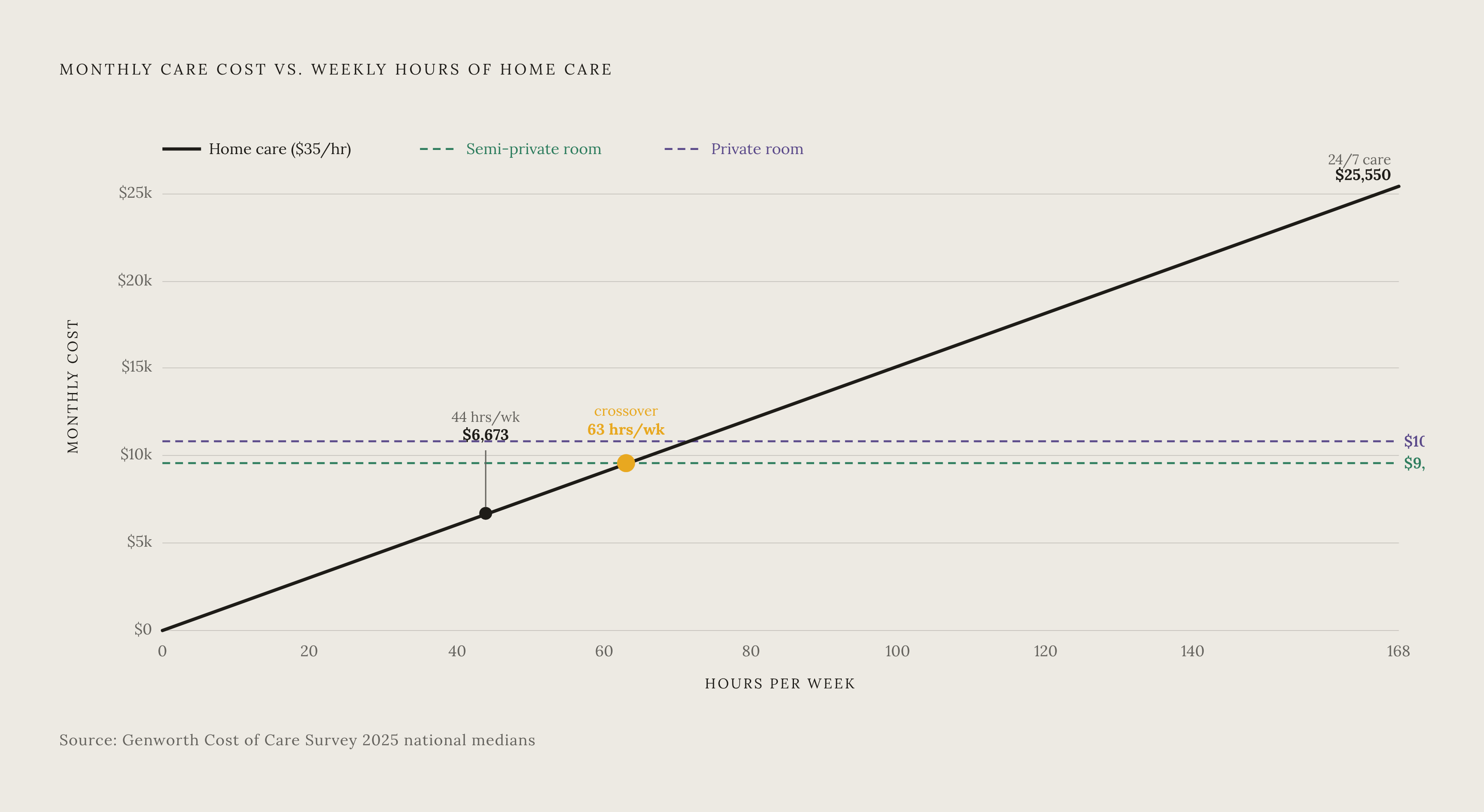
At the national median rate of $35 an hour and a standard 44-hour week, home care runs about $6,673 a month, well under the $9,581 for a semi-private nursing home room and the $10,798 for a private one. But that advantage doesn't hold forever. As weekly hours climb, the hourly home care bill climbs with them, but the nursing home's daily rate stays fixed no matter how much hands-on care a resident needs. That asymmetry is what produces a crossover point.
If you work from the $35-per-hour median, home care overtakes the cost of a semi-private nursing home room at roughly 63 hours of care a week. It overtakes a private room at around 71 hours a week. At the extreme, true around-the-clock home care, meaning multiple caregivers rotating shifts rather than one live-in aide, runs about $25,550 a month, more than double the cost of a private nursing home room. Annualized, that round-the-clock home care bill can top $300,000, against roughly $115,000 to $130,000 for a nursing home room over the same year.
A rough decision table follows from these numbers. Under about 40 hours a week, home care almost always costs less. Between 40 and 63 hours a week, home care is still the cheaper option, though the gap narrows, and assisted living can become a relevant middle option in that range. At round-the-clock needs, the nursing home is cheaper by a wide margin on pure cost grounds.
One objection deserves attention here. The math in this section answers what the paid-care bill looks like at a given hour count; it doesn't answer what a family can sustain, which is a separate and harder question tied to the Medicare and Medicaid rules covered next.
What Medicare pays for in each setting
Medicare pays for short-term skilled care in both home and facility settings, under conditions narrow enough that most families run into their limits quickly. That gap between what Medicare covers and what families actually need is the most expensive misunderstanding in this whole decision.
At home, Medicare covers skilled home health services when the beneficiary is homebound, needs skilled nursing or therapy, has a physician-ordered plan of care, and uses a Medicare-certified agency. What Medicare will not pay for at home is just as important: round-the-clock supervision, meal delivery, housekeeping, and personal care provided on its own, without a skilled nursing or therapy component attached.
In a skilled nursing facility, Medicare pays the full cost of a covered stay for the first 20 days after a qualifying hospital admission. From day 21 through day 100 in 2026, a coinsurance of $217 per day applies, and after day 100, Medicare pays nothing. Qualifying requires an inpatient hospital stay of at least three days; an observation stay, even a multi-day one, does not count toward that requirement, a detail that catches families off guard at the moment of discharge.
The limit that shapes everything downstream is simple: long-term custodial nursing home care, the kind built around help with daily living, dementia supervision, or managing a chronic condition over months or years, is not a Medicare benefit at any point. Medicaid, long-term care insurance, or private pay has to fund that kind of ongoing care instead. For most families, Medicare pays for short-term, post-hospital care but provides no funding for long-term care. The crossover math worked out earlier applies almost entirely in the private-pay or Medicaid world, not the Medicare one.
Families often confront this decision under time pressure, frequently in a hospital discharge hallway, without a clear sense of which option their coverage will actually fund. A service like Brevy, which helps families check eligibility for Medicare and Medicaid and understand what each program covers in each setting, can clarify that input before the hours-driven math gets run, since knowing what the benefits system will pay for changes what the real out-of-pocket comparison looks like.
Medicaid's coverage of each setting and the structural asymmetry that can force institutionalization
Medicaid funds long-term care in both home and facility settings, but it treats the two very differently. Nursing home coverage under Medicaid is a guaranteed entitlement, while funding for home-based care runs through state programs with a hard cap on how many people can be served at once. That difference can override a family's cost math and preference entirely, placing someone in a nursing home simply because it's the only pathway actually open to them.
Eligibility rules are the same across both settings. A single applicant typically needs monthly income under roughly $2,982 and countable assets under $2,000 to qualify, while a spouse still living in the community can retain assets up to roughly $162,660 under the Community Spouse Resource Allowance. Once approved, nursing home Medicaid has no day limit. It covers the full cost of care in a Medicaid-certified facility for as long as the resident continues to qualify.
The asymmetry sits in how each benefit is delivered. Nursing home Medicaid is a federal entitlement: anyone who meets the financial and clinical criteria must be served, with no waitlist involved. Home and Community-Based Services waivers, the Medicaid mechanism that pays for home care, adult day programs, and personal care aides, work differently. Each state sets its own enrollment cap, and once the slots fill up, eligible applicants go onto a waitlist. As of 2026, more than 800,000 people sit on HCBS waiver waitlists nationally, with wait times ranging from six months to more than ten years depending on the state and the specific program. A low-income senior who qualifies for both programs, prefers to stay home, and can't afford private-pay home care may have guaranteed access only to the institutional setting she was trying to avoid.
A 2026 federal legal opinion concluded that the ADA does not impose an integration mandate on states, narrowing how the ADA's integration requirement had previously been understood. The opinion doesn't repeal waiver authority, but it signals that you shouldn't assume home-based Medicaid services will stay readily accessible going forward. Documenting care needs and applying for a waiver early becomes a more urgent step given that signal, not a less urgent one.
Medicaid's reimbursement rates and coverage rules diverge so sharply between home care and nursing home placement that you need to know what Medicaid will and won't fund in each setting before you compare raw costs. For families near the income and asset thresholds, the real decision often comes down less to which setting costs less and more to which Medicaid pathway they can actually get into. Even where coverage is secured on paper, though, workforce shortages in both settings can still disrupt the plan, which is the subject of the next section.
Supply-side risks that can make the chosen option unavailable regardless of what families can pay or qualify for
Both home care and nursing home care face workforce shortages severe enough to make the financially correct, or even the Medicaid-approved, choice practically unreachable. Home care agencies in many markets are turning away new clients outright, and most nursing homes nationally are delivering less staffing than federal standards call for.
Nursing homes show a parallel problem from a different angle. Federal data from the first quarter of 2026 found that 88% of nursing homes provided less staffing than their residents' clinical needs called for, so they delivered noticeably less nurse staffing per resident day than acuity levels warranted. The Long Term Care Community Coalition released a national provider data report covering 14,690 federally certified nursing homes and found that chain-affiliated facilities averaged fewer staffing hours per resident day than expected, with roughly 96% falling below the expected level. CMS had established a minimum staffing rule in 2024 requiring at least 3.48 total nurse staff hours per resident day along with a 24/7 on-site RN, but that rule was repealed effective February 2, 2026, reverting to the older requirement of an RN on-site for only 8 consecutive hours a day. More than one in five nursing homes nationally carry a Special Focus Facility designation, Special Focus Facility Candidate status, or a one-star rating, together caring for a substantial number of residents. Cost and quality don't move together here, so the lowest-cost bed can carry real clinical risk.
The cost math from earlier sections establishes what's financially optimal, and the Medicaid rules establish what's covered, but neither guarantees availability. Families should start the provider search, and the Medicaid waiver application where relevant, well before care becomes urgent. Given these three layers, cost, coverage, and availability, the next section works through how to actually put them together into a decision.
Making a defensible decision: applying the hours math, the coverage rules, and the availability realities together
A defensible decision runs the hours-driven cost math against local rates first, then checks which Medicaid pathways are genuinely open, and only then stress-tests the resulting plan against availability constraints.
The first step is establishing the hours of care actually needed, not the hours a family happens to be using today. Needs tend to rise over time, especially with dementia and other progressive conditions, so it helps to model both the current hour count and a plausible higher one, to see where that trajectory lands relative to the crossover point over the next 12 to 24 months.
The second step is pricing both options against local rates. The national crossover points, roughly 63 hours a week for a semi-private room and 71 for a private one, shift meaningfully by state. In Texas, home care at a standard 44-hour week already costs more than a semi-private nursing home room, so the crossover arrives much earlier than the national figures suggest. Local agencies and facilities should be quoted directly, since local rates can diverge sharply from the national benchmark.
The third step is mapping the coverage landscape. Where Medicaid may be relevant, checking a state's HCBS waiver waitlist status now, rather than once care becomes urgent, is often the only way to keep the home-care option realistically open in a state with a long wait. Where private pay is the path, the crossover math from earlier applies directly, and any long-term care insurance policy on hand should be checked for which settings and how many hours it actually covers.
The fourth step is accounting for availability risk on top of all of it. Even if an option is financially optimal and fully covered by Medicaid, it may not be available right away: home care agencies are turning away referrals in many markets, and in some areas, nursing home beds that accept Medicaid and deliver decent quality are limited. Families who want to stay home should start the agency search and the Medicaid waiver application before a crisis forces the decision toward the nursing home entitlement pathway by default.
A handful of resources can make this four-step process concrete. Brevy, an AI assistant and enrollment support platform built for family caregivers and seniors, can surface which Medicare, Medicaid, and caregiver compensation programs a family qualifies for and walk them through enrollment, including whether an HCBS waiver is available in their state and what the current waitlist situation looks like there. For a family trying to act on this framework without spending weeks on hold with a state agency, it's a reasonable place to start. Area Agencies on Aging can connect you with local Medicaid waiver programs and current waitlist information.
None of this makes the decision easy, but it makes the decision answerable. The hours a loved one needs each week, priced against local rates, checked against what Medicare and Medicaid will actually fund, and tested against what's realistically available nearby, gives a family something firmer than instinct to stand on.