When to Start Medicaid Planning for a Parent
Start planning more than five years before a parent needs nursing home care to avoid coverage gaps.

Medicaid planning for a parent begins with a timing question. Many asset-protection steps can create a gap in care coverage if taken within the five-year look-back period. The strongest planning window is more than five years before an anticipated application, while a parent still has time to make choices without a care crisis dictating them.
Why long-term care falls entirely outside what Medicare covers
Medicare does not pay for long-term custodial care, including the ongoing help a parent may need in a nursing home. Under CMS’s skilled-nursing coverage rules, care is covered for only a short time in each benefit period. The CareScout 2025 Cost of Care Survey put the national median cost of a semi-private nursing home room at roughly six figures a year.
Without long-term care insurance or VA benefits, families may have to pay out of pocket until a parent qualifies for Medicaid. Even a sizable amount saved for retirement can be gone within a few years after a parent enters a nursing home. But a parent who needs care and cannot keep paying for it still has to meet the rules for eligibility. Medicaid also sets strict limits on how much the parent can have.
What Medicaid's asset and income limits actually require of a nursing home applicant
Most states use a countable asset limit of $2,000 for an individual applying for long-term care Medicaid. Ordinary retirement savings can put a parent well above it. Countable assets include bank accounts, investment accounts, and most real property other than the primary home. Income is assessed separately, against a state limit tied to a federal matching-funds threshold. The rules in the parent’s state therefore set the exact target.
Exempt assets include the primary home within the home equity cap, one vehicle, personal belongings, and a small burial fund. A plan may call for turning countable assets into exempt ones or transferring assets far enough ahead of time. For married couples, the community spouse, who is the spouse not entering care, may keep assets under the Community Spouse Resource Allowance. That protection preserves some savings, but rarely all of them.
Why not just give away what is over the limit before applying? Medicaid examines both the balance left on application day and how the applicant reached the asset limit.
How the five-year look-back period works mechanically
When a parent applies for long-term care Medicaid, the state reviews financial transactions during the 60 months immediately preceding the application. It looks for transfers made for less than fair market value. Social Security Act §1917(c) establishes the look-back, penalty calculation, and penalty start date. The Deficit Reduction Act of 2005 extended the review period from 36 to 60 months for transfers made on or after February 8, 2006.
The review requires five years of financial history. Bank statements, investment records, property transfers, and legal documents all fall within its scope. This rule concerns long-term care Medicaid, including nursing home care and Home and Community Based Services waivers, rather than regular Medicaid for basic healthcare coverage. How the rule works varies by state, but each state checks whether the parent gave up assets without getting the same value back.
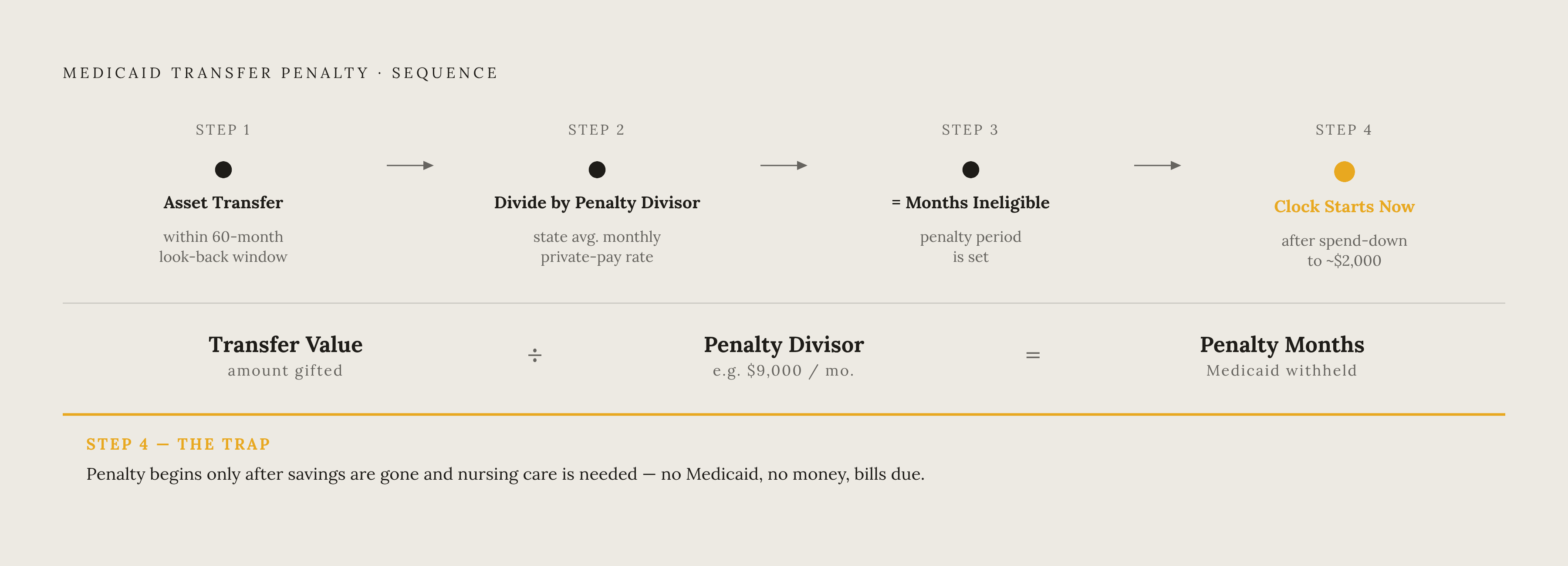
A disqualifying transfer produces a period when Medicaid will not pay for care. The state divides the transfer’s value by its penalty divisor, the average monthly private-pay nursing home rate in that state. The result determines the number of months of ineligibility. There is no cap on the penalty period, so a large transfer can produce a penalty longer than five years.
Crucially, the penalty begins when the applicant would otherwise qualify, once they need nursing home care and have spent down. The family can then have nursing home bills to pay without Medicaid coverage or any savings left to cover them.
What families lose when they start planning inside the five-year window
Waiting removes the time needed for transfers to age beyond the review period. A Medicaid Asset Protection Trust funded even a month too late can trigger a penalty just as a direct gift would. Creating the document is not enough. The funding date must sit outside the look-back period when the parent applies.
Ordinary gifts can create the same problem. Money for a grandchild’s education, a child’s down payment, or a holiday gift is subject to scrutiny when transferred within five years. A generous motive does not itself create an exception. Unless an exception applies, the gift may leave the parent facing a coverage penalty at precisely the point when private payment has become difficult.
The loss is not confined to an inheritance. Families without advance planning may have to pay privately until assets reach the eligibility limit or use narrower crisis-planning tools. A parent who cannot afford care but does not yet qualify may forgo services or remain at home without adequate support. Those gaps can worsen health and eventual care costs, making delay a care problem as well as a financial one.
Strategies available only when planning begins before the five-year window opens
A Medicaid Asset Protection Trust can place a home or investment accounts outside the applicant’s countable resources when properly established and funded more than five years before application. The trust is irrevocable, and a trustee, often an adult child, manages the assets. The loss of control is permanent. If nursing home care becomes necessary within five years of funding, the transfer remains exposed to the look-back rule.
That trade-off deserves a direct question. Is the parent willing to give up control over assets before knowing what care they will need? The five-year interval makes this strategy possible, but it does not make it suitable for every family. An elder law attorney is needed to put it in place and judge how well it fits the parent’s needs.
Gifts made more than five years before application fall outside the look-back and produce no transfer penalty. If a family plans around when the parent expects to apply, gifts must stop at least five years before that date. But a parent may need nursing home care sooner than expected, so that date can change.
An adult child who lived in the parent’s home for at least two years immediately before nursing home admission, and provided care that demonstrably delayed placement, may receive the home without a transfer penalty. Although this is not itself a five-year strategy, advance planning allows the caregiving role and its history to be documented before a crisis.
What crisis planning can and cannot do when the five-year window has already started
A parent who already needs care still has options. Experienced elder law attorneys can preserve some assets, but the available tools are narrower and more technical. Medicaid-compliant annuities can convert a lump sum of countable assets into an income stream. They play a central role in crisis planning for couples with excess countable assets, although converting assets into income is not the same as making every eligibility requirement disappear.
These annuities require a lasting financial commitment. A qualifying annuity must be irrevocable, non-transferable, and actuarially sound, and the money cannot later be cashed out as a lump sum. The state is typically named as remainder beneficiary, leaving heirs without the balance. Families therefore have to weigh eligibility planning against lost access to the funds and the effect on inheritance.
For single applicants, the “half-a-loaf” strategy combines an intentional partial gift with a Medicaid-compliant annuity that funds private-pay care during the resulting penalty. The annuity payments and penalty period are timed to end in the same month. Precision is essential to this arrangement. It requires an elder law attorney to coordinate the dates.
Families can use legitimate spend-down at any stage. Paying off a mortgage, prepaying funeral and burial costs, purchasing an exempt vehicle, and making home modifications convert countable assets into exempt ones. Even with these options, crisis planning generally preserves less than advance planning, costs more in professional fees, and involves more complex, irrevocable commitments.
State-level exceptions that alter the five-year rule in material ways
California eliminated its asset limit and look-back for nursing home Medi-Cal in 2024, then reinstated the asset limit on January 1, 2026. It also reinstated a look-back that phases in from 0 months to 30 months by July 2028. Only transfers made on or after January 1, 2026, fall under the reinstated rule. Transfers made between January 1, 2024, and December 31, 2025, remain protected from penalties under it.
New York draws a different distinction between care settings. Its nursing home Medicaid program retains the standard 60-month look-back. The state’s 2020 Medicaid Redesign Team II legislation authorized a 30-month look-back for community-based long-term care, but implementation has been repeatedly delayed, with a Section 1115 waiver amendment still pending CMS approval. As of the research available for this piece, home-care Medicaid applicants there still faced no asset transfer look-back.
Eligibility is also not the end of asset protection. Medicaid agencies must seek reimbursement from deceased recipients’ estates, often through the home that remains after other assets are spent. Massachusetts narrowed estate recovery under a law signed September 6, 2024, effective August 1, 2024, limiting claims to long-term care costs for recipients 55 and older. These differences make an attorney licensed in the parent’s state necessary for both application planning and estate recovery planning.
When in a parent's life the planning conversation should actually happen
Planning should work backward from anticipated need. More than five years before a Medicaid application gives transfers time to clear the look-back and leaves room for uncertainty. A parent in their late sixties or early seventies who is in reasonable health may be well placed to begin. Age is a prompt to begin planning, while lead time remains uncertain.
Updating a will, power of attorney, or healthcare directive can lead naturally to questions about who would provide care and how it would be paid for. The conversation need not begin with moving assets. It can begin with understanding the parent’s wishes and whether the existing plan accounts for long-term care.
When anticipated need is only one to three years away, the choices have already contracted. An irrevocable trust funded now will not have time to clear the standard look-back before the parent expects to apply, and gifts can lead to penalties. Attorneys instead work with exempt-asset conversions, spousal protections, and carefully structured annuities. A diagnosis, visible decline in driving or daily-living abilities, or discharge from a hospital or rehabilitation facility with ongoing care needs should prompt the conversation regardless of age.
At or after a care crisis, the next step is more urgent. Families should contact an elder law attorney immediately, because delay compounds losses even when some assets can still be preserved.
How to find the right help and what to bring to a first conversation with an elder law attorney
The right professional is an elder law attorney licensed in the parent’s state who handles Medicaid planning. A general estate planning attorney or a financial adviser working alone is not enough for this task. State rules, penalty divisors, and transfer calculations require specialized knowledge. The first conversation should address both current eligibility and the financial history that could affect an eventual application.
Before that meeting, a benefits-discovery check can broaden the picture. AI-powered enrollment tools can help families find Medicare, Medicaid, caregiver compensation, and Home and Community Based Services options to look into further. Some of those programs may fall outside an attorney’s narrow planning scope. These tools help families work out what to ask when they get legal guidance, and families still need advice based on their state’s rules.
For the legal review, families should gather five years of bank and investment statements, property deeds, vehicle titles, and existing trust documents. Life insurance policies, retirement account statements, and recent income records are also useful, including Social Security, pension, and annuity documentation. A record of gifts, property transfers, and asset sales should show the date and amount of each. That history helps the attorney spot possible penalties before the parent applies and has to deal with them right away.
Incomplete records need not postpone the first conversation. An attorney can begin with what is available and help reconstruct the missing history. Whether the first step is a benefits check or a legal consultation, beginning now leaves the family more room than waiting for a care crisis to force the decision.