Palliative Care vs Hospice Coverage Under Medicare
Medicare covers these as separate benefits with different eligibility rules and cost structures.

Palliative care and hospice get used as if they sit on the same sliding scale of comfort, with hospice as the more advanced stage. They are actually two separate Medicare coverage architectures, each with its own eligibility gate, its own cost structure, and its own trade-offs for the patient. Hospice is a subset of palliative care, not its reverse: all hospice care is palliative, but not all palliative care qualifies as hospice. Palliative care can begin the day of a serious diagnosis and run alongside chemotherapy or dialysis for years, with no terminal prognosis required, while hospice begins only when the goal has shifted from cure to comfort and a physician has certified a prognosis of six months or less. The detail families most often miss is that electing hospice means agreeing to stop curative treatment for the terminal illness, while palliative care asks for no such concession. Medicare pays for each through an entirely different mechanism, and that mechanism, more than any clinical label, determines what gets covered, what it costs, and what the patient gives up to receive it. Understanding that payment architecture is what makes every other decision in this piece legible.
How Medicare pays for palliative care under Parts A, B, and D
Palliative care has no dedicated Medicare benefit of its own. It reaches beneficiaries through whichever Part applies to the setting and the service, assembled piece by piece. That patchwork covers a great deal, and it asks for no special election and imposes no eligibility threshold beyond a physician's judgment that the care is medically necessary.
Medicare Part A, the hospital insurance piece, covers palliative care delivered during an inpatient hospital stay or a stay in a skilled nursing facility: pain management, symptom control, and comfort measures provided while the beneficiary is admitted. Medicare Advantage plans, offered under Part C, are required to match what Original Medicare covers at minimum, and many go further, extending additional palliative benefits; Special Needs Plans built for people with chronic conditions sometimes offer more generous coverage still.
The eligibility bar here is low by design. The cost structure follows the same logic as the coverage itself: the beneficiary pays the standard Part B deductible and then 20% coinsurance on each approved service, and those costs accumulate across every individual visit, device, and prescription over the course of the illness. CMS has clarified, in the CY2027 Home Health proposed rule, that community-based palliative care may be covered under the existing Medicare home health benefit when a beneficiary is homebound and has a skilled need, a signal that the agency is actively trying to close the gap where Original Medicare has no dedicated home-based palliative benefit.
How Medicare pays for hospice
Hospice works on the opposite principle. Where palliative care bills in pieces, hospice bundles.
Under Part A, the hospice benefit covers nursing care and the attending physician's services, medical equipment such as a hospital bed or oxygen, supplies, drugs for symptom and pain relief, home health aide visits, social work and chaplain support, short-term inpatient care when symptoms need more intensive management, and grief counseling for the family for up to a year after the death. Outpatient drugs for pain and symptom management carry a copayment of up to $5 per prescription. Inpatient respite care, a short stay that gives a worn-out family caregiver a chance to rest, costs 5% of the Medicare-approved amount, capped at the inpatient hospital deductible of $1,716 in 2026. For most hospice families, those two charges are the only out-of-pocket costs they will see.
Two exclusions can catch families off guard if nobody has explained them in advance. The generosity of the hospice wrapper and the strictness of its eligibility gate are two sides of the same coin: Medicare can afford to cover nearly everything because the beneficiary has agreed to stop pursuing a cure.
The benefit period structure protects patients from being discharged simply for living longer than expected. Coverage runs in two initial 90-day periods, followed by an unlimited number of 60-day periods, each requiring recertification that the patient still qualifies, with no lifetime cap on how many periods a patient can move through. And the aggregate cap Medicare places on hospice agencies, set at $35,361.44 per patient for FY 2026, up from $34,465.34 in FY 2025, is an accounting limit on what the agency gets paid in total. It is not a ceiling on what any individual patient can receive.
What it takes to qualify for hospice
The requirements for entering hospice are specific, and families who understand them before the conversation happens tend to make the decision with far less regret than those who learn the terms after the fact. To qualify, a beneficiary needs Medicare Part A and must meet three conditions together: both the hospice physician and the patient's attending physician, if one exists, must certify that the patient is terminally ill with a life expectancy of six months or less should the illness run its natural course; the patient must accept comfort care in place of curative care for that illness; and the patient must sign a hospice election statement naming the agency and confirming the choice of comfort over cure.
Two things surprise many families because hospice does not require them. A cancer diagnosis is not a prerequisite. Any terminal illness qualifies, from congestive heart failure to COPD to advanced dementia. Nor does electing hospice require a do-not-resuscitate order or an advance directive already in place.
The six-month prognosis has a particular way of functioning in practice. The FY 2026 Final Rule made one meaningful change to how patients get into hospice in the first place: it amended the regulations to specify that the physician member of the hospice interdisciplinary group may recommend admission, expanding who can initiate the process and potentially easing access for patients whose own physicians have not raised the subject.
The trade-off is that electing hospice means Medicare stops paying for curative or disease-modifying treatment of the terminal illness and related conditions. That decision can be revoked by the patient at any time, but it is the mechanism that makes the comprehensive, nearly cost-free hospice benefit financially sustainable for Medicare to offer.
The cost comparison for a typical family
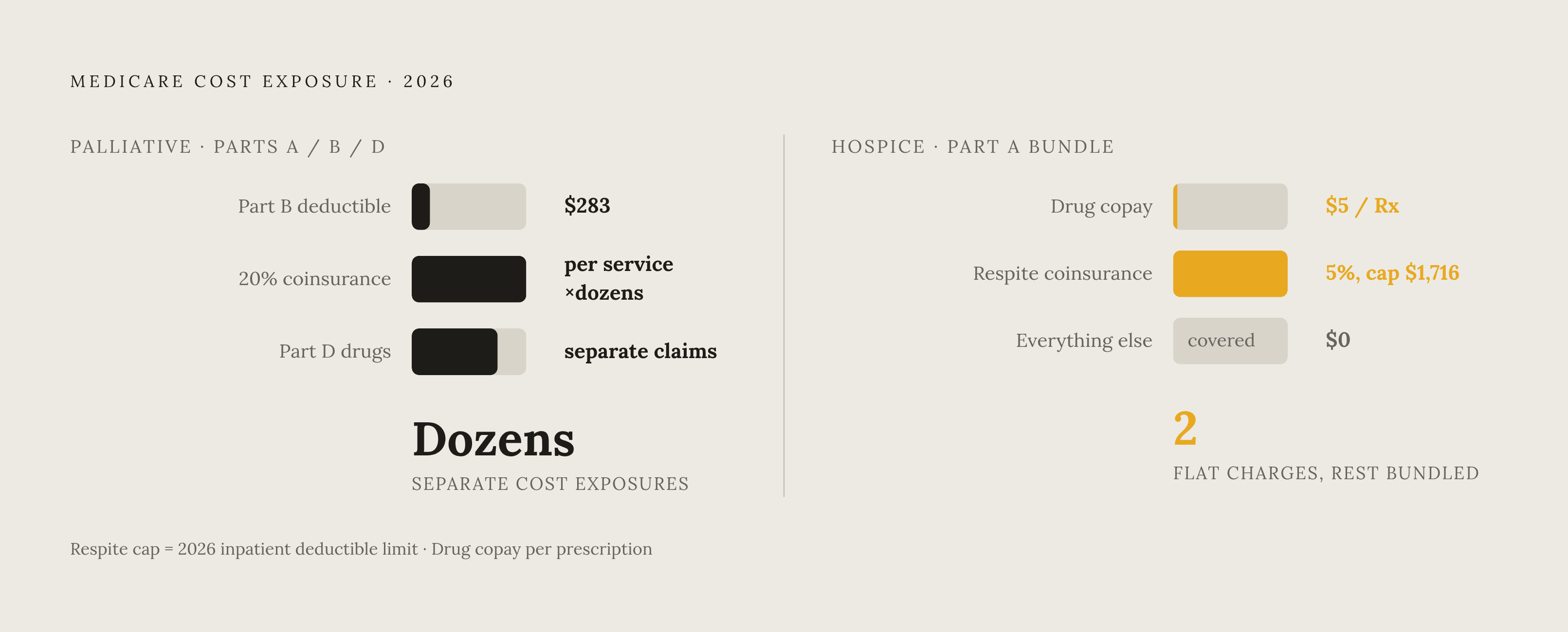
The financial contrast between the two paths is stark enough to shape which one families end up choosing, even when the clinical picture is more ambiguous than the cost picture. Under palliative care through Parts A and B, a beneficiary pays the standard Part B deductible, $283 in 2026, and then 20% coinsurance on every approved service, with drug costs running separately through Part D. Under hospice, most families see only the $5 drug copayment and the 5% respite-care coinsurance capped at $1,716 in 2026, because the comprehensive benefit converts what would otherwise be dozens of separate claims into something close to flat-rate cost-sharing.
That gap widens the longer a serious illness runs. The lower cost is inseparable from the trade-off that makes it possible: a family comparing the two is comparing two different sets of goals, with two different price tags attached to them.
A few structural details affect how that comparison plays out for a specific beneficiary. Medicare Advantage brings its own quirk into the picture: MA plans do not cover hospice. When an MA enrollee elects the hospice benefit, that beneficiary transitions to the traditional Medicare hospice benefit for hospice-related services, which can complicate coordination with the other benefits they were receiving through their MA plan.
The Medicare Care Choices Model and concurrent access to both
One might ask whether the binary between palliative care and hospice is really necessary from a clinical standpoint, or whether it is mostly an artifact of how Medicare structured the benefit decades ago. The Medicare Care Choices Model, which ran from 2016 to 2021, tested exactly that question. MCCM allowed beneficiaries with a prognosis of six months or less due to cancer, congestive heart failure, COPD, or HIV/AIDS to receive supportive services from hospice providers while continuing Medicare-covered curative treatment, rather than forcing them to choose one path and abandon the other.
The results argued strongly in favor of concurrent access. Enrollees were able to stay home longer as a result.
The equity findings complicate the success story in an instructive way. Participation was also narrower than the model's ambitions suggested: CMS approved 141 hospices to take part, but only 86 ever admitted a patient, and five of those hospices accounted for nearly half of all enrollments nationwide.
MCCM ended in 2021, and no permanent successor has taken its place. The structural binary it was designed to soften remains intact for most Medicare beneficiaries today, which leaves an open question for the policy discussions that follow: if concurrent care worked this well in a controlled model, what is standing in the way of making it permanent?
The live policy debates that could change what Medicare covers in this space
Three developments now underway are each chipping at the binary structure from a different angle, and together they suggest that the rules described in this piece are not fixed. The same rule expanded who may recommend admission to hospice by specifying that the physician member of the hospice interdisciplinary group can initiate that recommendation, a change that could ease access for patients whose treating physicians have not raised the subject on their own.
On the operational side, hospices were required to replace the Hospice Item Set with a new assessment tool, the Hospice Outcomes and Patient Evaluation tool, effective October 1, 2025. To avoid financial penalties, hospices must now meet a 90% submission threshold, meaning 90% of required HOPE records submitted within 30 days of the patient event. That shift affects how hospice providers operate day to day, and it indirectly shapes access by changing the administrative burden agencies carry.
A more consequential fight is playing out over Medicare Advantage and hospice. H.R. 3467, the Medicare Advantage Reform Act, was introduced in May 2025 with a provision that would require MA plans to pay for hospice care directly, rather than routing enrollees back to traditional Medicare the moment they elect hospice. Supporters argue that folding hospice into MA could make care transitions smoother and reduce a documented barrier to timely enrollment: patients who delay electing hospice because they fear losing the MA benefits they already rely on. Opponents, including senators who have voiced concern, argue that adding MA plan management to hospice would be duplicative and inefficient, introducing new administrative barriers such as prior authorization without any corresponding improvement in care. The legislation remains an open question as of now.
The development most likely to matter soonest for families managing a serious illness outside of hospice involves home health. CMS clarified, in the CY2027 Home Health proposed rule, that community-based palliative care may already be covered under the existing Medicare home health benefit when a beneficiary is homebound and has a skilled need. CMS has also said it plans to add further examples of palliative care as skilled care to the Medicare Benefit Policy Manual through sub-regulatory guidance, following publication of the CY 2027 HH PPS final rule. It is the most significant structural move toward non-hospice palliative coverage to appear in recent rulemaking, for any beneficiary receiving palliative care at home.
Choosing the Medicare door that fits your family's situation
The goal of care at this moment, not which benefit is objectively better, determines the right Medicare door, because that choice depends entirely on whether curative treatment is still on the table. If the burdens of ongoing treatment have come to outweigh what it offers, and comfort and time at home have become the priority, that points toward a conversation about hospice, entered with a clear understanding of what the election covers, what it excludes, and the fact that it can be reversed if circumstances change.
Some families will recognize their situation in neither description cleanly. Wanting to keep some treatment options open while also wanting hospice-level support at home describes exactly the gap that MCCM was built to address, and no permanent Medicare program currently fills that gap for most beneficiaries. Naming that gap honestly is more useful to a family than pretending the choice is cleaner than it is.
A few questions are worth bringing directly to the treating physician, starting with whether a palliative care referral would make sense now, while treatment continues. What would need to change for hospice to become the right choice? Is there a home health benefit that could cover palliative services given that the patient is homebound? And how does the beneficiary's coverage type, Original Medicare versus Medicare Advantage, affect how hospice would actually be administered?
The complexity rarely stops at the palliative-or-hospice decision itself. No family should have to make it without first understanding, clearly, what each path actually pays for and what it asks in return.