How AI Handles Medicaid Self-Direction Enrollment so Family Caregivers Get Paid Faster
AI streamlines the messy handoffs that delay pay for family caregivers.
AI-assisted Medicaid self-direction enrollment helps family caregivers get paid sooner by finding the right program and catching gaps in the paperwork before they hold up payment. Brevy pairs AI-powered eligibility checking with live enrollment specialists, while other tools help with outreach, enrolling caregivers, and getting payroll right. These tools can shorten the path from qualification to a first paycheck, but they cannot replace state approval or create an available program slot.
Why family caregivers who already qualify for Medicaid self-direction still wait months for a first paycheck
A family caregiver may already be providing daily care, reducing hours at another job, and meeting the relevant program’s requirements without receiving any payment. Qualification alone does not authorize a paycheck. When the care recipient’s Medicaid is already active, enrollment and first payment can come within weeks. When a Medicaid application must start from scratch, the process more commonly takes several months. That difference makes the starting point in the administrative process financially consequential.
Medicaid self-direction is the primary legal route through which family members get paid to care for relatives. Under the employer model, the care recipient hires a family member as the personal care worker, while a financial management services agency, or FMS agency, handles payroll and taxes. KFF’s 2025 survey found that forty-nine states let Medicaid enrollees self-direct home care in at least some cases, and every state that responded pays family caregivers under at least one program. Florida did not respond to the survey. Broad availability, however, is not the same as an approved arrangement for a particular family.
KFF focus groups found that family caregivers often struggled to make ends meet and reduced their hours at other jobs because of caregiving demands. Most self-direction programs pay only for hours worked on or after the authorized start date. A delay therefore does not simply postpone money already owed, but can leave ongoing care unpaid. Brevy is designed to address this administrative gap through AI-powered eligibility checking and live enrollment specialists. The task is to complete the requirements that stand between qualifying on paper and entering payroll.
The administrative chain a family caregiver must traverse before receiving any payment
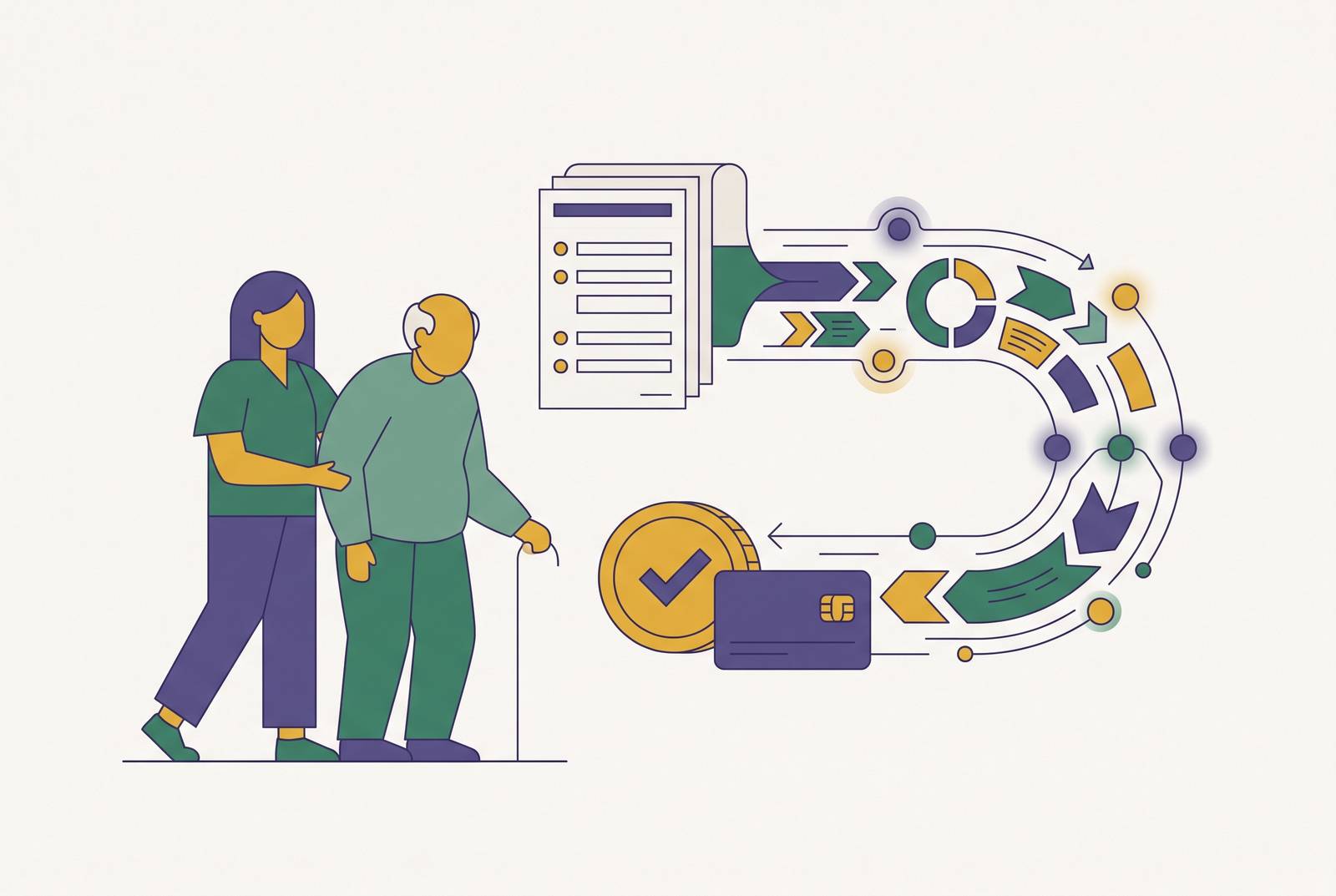
The process begins with the care recipient’s Medicaid eligibility determination or redetermination. It then moves to a level-of-care assessment and approval of a person-centered service plan. These are distinct decisions, so evidence that someone qualifies for Medicaid does not itself establish the authorized care arrangement. The caregiver must then enroll with the FMS agency, obtain background check clearance, and supply any required training certificates. At each handoff, missing parts of the records can bring the process to a stop.
MACPAC’s June 2025 Report to Congress identifies the range of organizations supporting self-direction, including beneficiary advocacy organizations, case management entities, information and assistance support professionals, FMS agencies, managed care organizations, and support brokerages. Their roles differ, and their systems often do not communicate with one another. The family is therefore navigating a chain of responsibilities rather than submitting one application to one decision-maker. Within that chain, the FMS agency is the fiscal intermediary between Medicaid, the beneficiary, and the caregiver under most authorities. Without FMS enrollment, there is no paycheck.
Once enrollment is done, getting paid still depends on timesheets that match authorized hours and meet the requirements for electronic visit verification, or EVV. A missing care-plan signature, a training certificate that has expired, or a background check still in progress can hold up a care arrangement that otherwise seems approved. Ohio’s Medicaid self-direction programs recognize one such bottleneck through conditional employment. The programs, operated through the Ohio Department of Medicaid and other Ohio agencies and using Public Partnerships LLC as FMS agent, allow caregivers to work for up to 60 days while a criminal record check is pending.
Why program complexity and documentation demands cause so many families to give up or stall out
Before families can assemble the right records, they must identify the right program. State names differ, including CDASS in Colorado, IRIS in Wisconsin, CDPAP in New York, CFSS in Minnesota, Personal Choices in Alabama, and CD-PASS in Oklahoma. What a family learns in one state may not apply in another. KFF’s 2025 survey found that family support programs are available in all responding states, but states most frequently allow self-direction in waivers serving people with intellectual or developmental disabilities. Access therefore depends on population and program type.
For families who do qualify, the problem becomes completing the process while continuing to provide care. Forms, verification steps, and handoffs across unconnected agencies can become reasons to disengage before a first paycheck arrives. Organization helps only when a family knows which requirements apply and which agency needs each document. Automated eligibility assessment and step-by-step support, including the approach offered by Brevy, can make that path more transparent.
The 2025 AARP and National Alliance for Caregiving report found that nearly half of the tens of millions of family caregivers in the United States reported at least one major financial impact, including debt, depleted savings, or inability to afford food. Research by Yiqing Kuang and Katherine E M Miller, drawing on 2021 TMSIS Medicaid claims data, found greater clinical needs among self-direction users and cited prior literature associating participation with higher rates of receiving paid care and a lower likelihood of nursing home placement. The stakes thus extend beyond completing paperwork. Yet some state officials and researchers raise a reasonable concern that faster enrollment could leave less time for vetting and oversight of care quality. Technology should cut out delays that can be avoided while keeping the checks that are needed.
Where AI is now being applied in the enrollment chain and what each application does
At the first stage, AI supports eligibility discovery and program identification. Tools can find the right state program, the eligibility rules, and the documents a family needs without making them search across several agency websites. Brevy’s AI assistant uses a family’s state, care situation, and eligibility profile to find the Medicaid self-direction program that applies and explain what the family needs to enroll. This is a structured starting point for the state’s eligibility determination. Its usefulness also depends on whether families with limited literacy or limited proficiency in the language used can use the guidance.
The next stage is making contact and initiating enrollment. Kern Family Health Care in California deployed an AI agent named Angelica to reach 387,000 Medi-Cal members through outreach calls. Angelica schedules appointments with human staffers who verify paperwork and reschedules appointments when conflicts arise.
AI systems can check for missing fields, expired certificates, and mismatched information before submission, reducing repeated requests for additional records. AI-assisted enrollment platforms can also identify gaps at handoffs and guide caregivers through completion rather than leaving them to discover a problem weeks later. Ankota offers integrated self-direction software for FMS agencies that handles caregiver enrollment, authorizations, timesheets, EVV, and payer billing in a unified system. That integration addresses fragmented administration, though a unified software platform should not be mistaken for evidence that every function uses AI.
After enrollment, the focus shifts from application completeness to payable hours. A timesheet can be returned because it exceeds authorized hours, arrives late, or lacks a required EVV check-in. AI-powered EVV systems combine GPS/geofencing, biometric or voice authentication, and machine learning anomaly detection to catch errors before submission. Correcting an error at that point can avoid the unpaid return and resubmission that pushes a paycheck into another cycle. This is payment support rather than eligibility support, but both affect how soon a caregiver receives money.
CMS now requires states to report the average time between initial approval and the start of homemaker, home health aide, personal care, and habilitation services under 42 CFR 441.311(d)(2). The reports cover people who have just started getting those services and report self-directed delivery on its own. The measure creates accountability for the interval that administrative tools seek to shorten. It does not measure the date of a first paycheck, so service-start acceleration and payroll accuracy remain distinct parts of the task.
What AI can and cannot fix about the self-direction enrollment bottleneck
The clearest boundary is between processing an application and having capacity to serve the applicant. KFF’s 2025 analysis of HCBS waiver waitlists found waiting list and interest list enrollment exceeding 600,000. AI cannot create a program slot where none is available. Some states with lower self-direction enrollment rely on waivers with enrollment caps or restrictive eligibility criteria. In those cases, program design rather than incomplete paperwork is the binding constraint.
Oversight presents a different boundary. Even when an AI system flags unusual EVV data after care is given, a background check or level-of-care assessment is still needed before authorization. The aim should be to make documentation and credential checks more efficient. MACPAC’s June 2025 report notes that limited data reporting and analysis capacities may hinder quality monitoring and oversight in self-direction. AI auditing tools that identify patterns of manual edits and geolocation anomalies can support that monitoring while administrative checks help applications move forward.
Users who are rural, elderly, non-English-speaking, or low-literacy may find it hard to enroll through an app even when the software works as it should. Tools that combine AI guidance with phone-based, multilingual, or assisted human support address that risk more fully than purely self-serve platforms. The meaningful comparison is not just how fast a tool responds, but whether the family can complete the next required step.
KFF’s 2025 issue brief notes that the 2025 reconciliation law is projected to make large cuts in federal Medicaid spending over the next decade. Because most home care programs are optional for states, those reductions could lead states to cut programs that technology is helping streamline. Administrative delay and funding limits are separate problems, and faster enrollment solves only the former.
How can you use AI-assisted tools to get paid through Medicaid self-direction as quickly as the system allows
Start by identifying the program that fits the care recipient’s state and circumstances. If the goal is to get paid to care for an elderly parent, a general statement that the state pays family caregivers is not enough. The applicable rules must allow the particular relative to be paid under the relevant program. Brevy’s AI assistant is one starting point for identifying those rules, including whether a spouse, adult child, or co-resident relative can serve as the paid caregiver.
Next, get the care recipient’s Medicaid eligibility confirmed or start that process while you prepare the paperwork for caregiver enrollment. Where those tasks can proceed together, doing them in parallel avoids waiting for one entire process to end before beginning another. Payment cannot begin until Medicaid is active and the level-of-care assessment is approved. AI guidance can clarify what needs to be prepared, but it cannot stand in for either approval.
Then focus on submitting a complete caregiver enrollment package the first time. Brevy’s live enrollment specialists and AI guidance offer support with understanding what enrollment requires, while completeness-checking tools can identify missing fields, expired certificates, and mismatched information. Where a state permits conditional employment, as Ohio does for up to 60 days pending background check results, use that provision once authorized to begin work before full clearance. Even with conditional employment, only hours worked after authorization can be claimed.
Finally, learn the authorized care plan and EVV requirements before the first shift. Use automated reminders and error-checking features in FMS-integrated platforms to keep your timesheets in line with approved hours and the rules for submitting them. A complete enrollment cannot prevent a delayed first paycheck if the first timesheet is returned unpaid. The care is already being given, and AI does not change what the program requires to pay for it. It helps families meet those requirements so payment can follow as quickly as the system allows.