Consumer-Directed Personal Assistance Program Eligibility
Four simultaneous requirements determine whether New York Medicaid enrollees qualify.
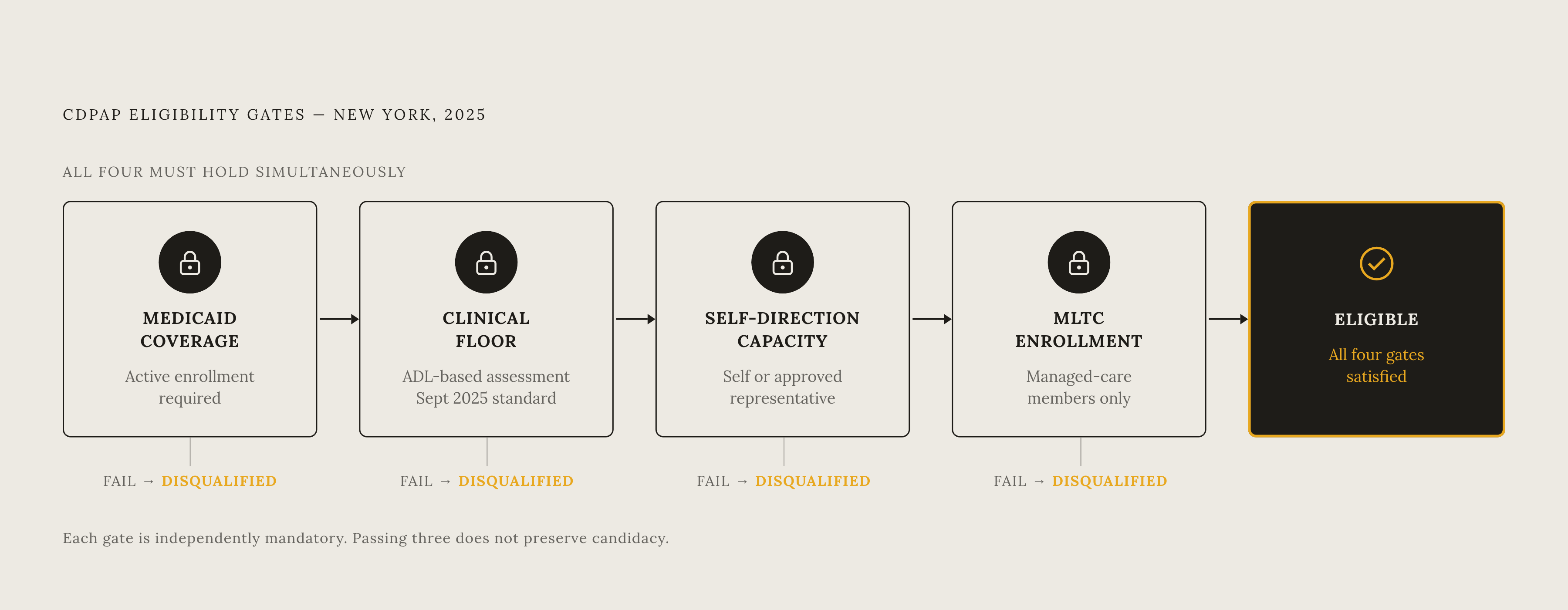
CDPAP eligibility in New York rests on four interlocking requirements: active Medicaid coverage, assessed need that meets the September 2025 clinical floor, capacity to self-direct or an approved designated representative, and Managed Long Term Care enrollment for managed-care members. All four must hold at the same time. Missing any one of them disqualifies a candidate, no matter how clearly the other three are met.
What CDPAP is and why its eligibility structure matters
The Consumer Directed Personal Assistance Program is a New York State Medicaid program that lets eligible home care recipients choose, hire, train, and supervise their own personal assistant, including a family member, rather than accepting an agency-assigned aide. The program is for chronically ill or physically disabled individuals who need help with daily activities or who require skilled nursing services. Unlike traditional personal care, a CDPAP personal assistant can perform nursing-level tasks such as medication administration, injections, wound care, and oxygen management. That expanded scope is possible because the consumer or designated representative provides the on-site training. No healthcare certification is required of the personal assistant.
Qualifying is not a single yes or no question. The state's eligibility framework involves four distinct requirements that must all be met simultaneously: Medicaid coverage, assessed need meeting the minimum-needs floor, capacity to self-direct or an approved designated representative, and MLTC enrollment where applicable. The sections that follow treat each gate in turn.
Gate one: active Medicaid coverage in New York State
CDPAP is entirely Medicaid-funded, so Medicaid enrollment is the threshold question before any other eligibility criterion is even considered. A person who is not eligible for New York State Medicaid cannot enter the program, regardless of how severe the care need or how willing the family member is to serve as the paid caregiver. The program creates no additional cost for the consumer beyond what Medicaid already covers, but that also means the program's financial foundation is inseparable from the state's broader Medicaid rules.
Dual eligibles, meaning individuals who carry both Medicare and Medicaid, automatically satisfy the financial requirement for CDPAP. Many older adults fall into this category, and for them the first gate is effectively already cleared. For those whose income exceeds the standard monthly limit, a spend-down option is available: countable income is reduced through documented medical expenses until the Medicaid threshold is met. That mechanism treats certain out-of-pocket medical costs as offsets against income, so a household that appears over the limit on paper may still qualify once those expenditures are tallied.
The first practical step for any family uncertain about Medicaid status is to confirm or pursue enrollment before evaluating any of the other three gates. A clinical assessment or a designated representative discussion is premature if the underlying coverage does not exist. Confirming Medicaid eligibility and exploring spend-down pathways can be opaque, because the relevant rules sit across state and county agencies. Services like Brevy, which specialize in free Medicaid enrollment assistance, help families navigate that first gate by clarifying what coverage they already have or can access before proceeding to the clinical and decisional requirements that follow.
Gate two: assessed need under the September 2025 Minimum Needs Requirements
The clinical floor changed on September 1, 2025, when the state implemented new Minimum Needs Requirements that set a stricter, ADL-based threshold for CDPAP and Personal Care Services eligibility. To meet the requirement, a person must be assessed as needing at least limited assistance with physical maneuvering in more than two Activities of Daily Living. For individuals with an Alzheimer's or dementia diagnosis, the standard is supervision with more than one ADL. This is a materially higher bar than the pre-2025 standard. Someone whose needs were primarily instrumental, such as managing medications, shopping, meal preparation, or finances, without documented ADL impairment will not qualify under the new test.
The requirement applies to Medicaid recipients age 21 or older seeking Personal Care Services or CDPAS, and to Medicaid recipients age 18 or older seeking to enroll in a Medicaid Advantage Plan or Managed Long Term Care Plan. It governs initial assessments and reassessments occurring on or after September 1, 2025. PACE enrollees are excluded from the Minimum Needs Requirement. More importantly for current recipients, individuals who were already authorized for or receiving PCS or CDPAS, or who were continuously enrolled in an MLTC plan as of September 1, 2025, continue under the previous eligibility criteria. They will not be subject to the new ADL threshold at reassessment, provided they remain continuously enrolled in any MLTC plan or retain Service Legacy status.
That grandfathered protection is the detail most likely to be misunderstood. Many current recipients believe their status is permanent. It is not. The protection holds until the next reassessment, and if enrollment lapses or the consumer shifts out of continuous MLTC coverage, the new ADL standard can apply. The assessment itself is conducted using a state-approved tool, and a physician's or medical professional's order documenting the need for home care services is required as part of the process. One might argue that an ADL-count metric is an imperfect proxy for medical complexity. Advocates have made exactly that case, contending that individuals with significant IADL needs, particularly those who rely on CDPAP for skilled nursing tasks like tracheostomy suctioning or insulin administration, face the starkest harm if disenrolled on a measure that does not capture their actual clinical burden. The September 2025 tightening has left many families uncertain whether their loved one's actual care profile, especially reliance on skilled nursing tasks, will survive the new ADL-based assessment. Understanding the exact wording of the requirement and how it will be applied is critical, and platforms that combine eligibility guidance with live specialist support, as Brevy does, can help families prepare documentation and frame their case before reassessment.
Gate three: self-direction capacity or an approved designated representative
CDPAP is built on consumer control. The recipient or their designated representative is responsible for recruiting, hiring, training, supervising, and if necessary terminating personal assistants, and for coordinating backup coverage and working with the fiscal intermediary on payroll. That responsibility is not incidental to the program. It is the program's operating premise. A consumer who cannot manage these responsibilities independently must have a designated representative who can make decisions on their behalf. Without one, the self-direction requirement is not met and CDPAP eligibility is not established.
The role constraints are specific. A personal assistant must be 18 or older, legally authorized to work in the United States, and capable of performing the tasks in the consumer's plan of care. Adult children can serve as a paid personal assistant for their parent, which is the most common arrangement in the program. Parents of an adult consumer may also be paid. No healthcare certification is required of the personal assistant, because training is provided by the consumer or designated representative. That is what allows personal assistants to perform skilled nursing tasks that certified home health aides may not perform.
Two exclusions deserve direct treatment. The designated representative cannot simultaneously serve as the consumer's personal assistant. The two roles are legally distinct. And a spouse cannot serve as the consumer's paid personal assistant. This exclusion applies regardless of separation status, household composition, or consumer preference, and it is the single most frequent source of disappointment at intake. The spouse exclusion is categorical and non-negotiable under current program rules. Families in this situation should understand it before beginning enrollment rather than discovering it at assessment. If the spouse exclusion eliminates the most obvious caregiver for your family, other Medicaid home care and caregiver compensation programs may apply. The CDPAP exclusion does not mean the caregiver cannot be paid through any program, which is a distinction that matters enormously for households built around spousal caregiving. An employee of the fiscal intermediary is also excluded from serving as a personal assistant.
Gate four: MLTC enrollment for managed-care members
The first three gates concern coverage, clinical need, and decisional capacity. The fourth concerns the administrative route by which services are actually authorized. For Medicaid recipients enrolled in managed care, CDPAP services must be authorized through a Managed Long Term Care plan. All counties and all mainstream Managed Care and MLTC plans are required to have a CDPAP program, which means the program's availability is not optional at the plan level. But availability is not the same as enrollment. A consumer who meets the first three criteria but is not enrolled in the correct managed care plan cannot access CDPAP services through that plan until enrollment is completed.
Outside mandatory MLTC counties, and for populations excluded from managed care, the pathway differs. Consumers under 21, residents of group homes certified by the state developmental-disabilities agency, and individuals with primary mental health diagnoses receiving state mental-health services fall outside the managed-care requirement. For them, CDPAP is administered by the local Department of Social Services in fee-for-service Medicaid. The managed-care and clinical gates also reinforce each other: the Minimum Needs Requirements described in gate two apply to MLTC enrollment as well, since Medicaid recipients age 18 or older seeking to enroll in an MLTC plan must meet the ADL threshold. Passing the financial, clinical, and decisional tests is not enough if the consumer has not identified and enrolled in the right plan type.
How the fiscal intermediary requirement intersects with eligibility in practice
Meeting all four eligibility gates does not by itself begin CDPAP services. The consumer and their personal assistant must also complete registration with Public Partnerships LLC, or PPL, the sole statewide fiscal intermediary authorized to process CDPAP payroll in New York. No other organization is currently authorized to provide fiscal intermediary services for the program, which makes PPL a mandatory partner in the enrollment sequence even though it does not make eligibility determinations. Its role is administrative: processing personal assistant wages and benefits, handling tax withholding, and maintaining required employment records.
The transition to PPL as the statewide intermediary has been contested. The Calderon v. PPL class action, filed April 25, 2025, alleged widespread wage payment failures, and a settlement providing substantial monetary and non-monetary relief was reached. A federal enforcement agency filed suit in June 2026 against PPL and state officials alleging fraud in how PPL was selected, misrepresentations about readiness and costs, and misconduct during the transition. Effective January 1, 2026, all CDPAP personal assistants received a wage increase. The appropriate takeaway for a family preparing to enroll is not that the program is broken, but that the administrative layer between eligibility and first paycheck is real, and it has its own timeline. Because CDPAP eligibility hinges on four simultaneous requirements, and because registration with the fiscal intermediary adds another step, families benefit from a systematic check of all four gates at once. Services designed to walk caregivers through the end-to-end enrollment process for Medicaid self-direction programs, which Brevy offers, can reveal which gate, if any, poses a barrier before a family invests time in assessments or applications.
How to determine whether you clear all four gates, and what to do if you are uncertain
The four gates operate in sequence, which means a family can rule a candidate in or out by working through them in order: Medicaid status, clinical need under the ADL threshold, self-direction or designated representative capacity, and managed-care enrollment pathway. Each gate is binary. A candidate who fails the second gate gains nothing from clearing the first. A candidate who clears all four but cannot complete fiscal intermediary registration has not yet secured paid care.
The step most likely to be misunderstood by returning applicants or current recipients is the scope of grandfathering. Grandfathered status under pre-September 2025 rules expires at the next reassessment, not indefinitely. Consumers who were enrolled before September 1, 2025 should confirm when their next reassessment is scheduled and whether they will meet the current ADL standard. That single check can prevent a surprise lapse in services. For households where the spouse exclusion eliminates the most obvious caregiver, the next move is to evaluate other Medicaid home care and caregiver compensation programs, because the CDPAP exclusion is specific to CDPAP and does not foreclose every payment pathway.
The benefits system governing CDPAP spans Medicaid enrollment, clinical assessment, plan type, and fiscal intermediary registration. It involves multiple agencies and steps that most families are navigating for the first time, often under time pressure from a health event or care transition. Brevy's AI-powered platform is designed for that situation: it surfaces which programs a specific household qualifies for based on their actual circumstances, walks through enrollment step by step, and combines automated guidance with human expertise. The four-gate determination becomes a free, fast, and certain process rather than a months-long research project. That is the practical difference between knowing the framework in the abstract and knowing whether one clear path exists for the person who needs care.
Sources
- Consumer Directed Personal Assistance Program (CDPAP)
- Medicaid Consumer Directed Personal Assistance Program (CDPAP) in New York State - NY Health Access
- Ny
- The Minimum ADL Test to Qualify for MLTC, CDPAP or Personal Care - Starting Sept. 1, 2025 - NY Health Access
- 11 OHIP/ADM-6 - Consumer Directed Personal Assistance Program (CDPAP) Scope and Procedures
- Section 505.28 - Consumer directed personal assistance program
- New Minimum Needs Requirements for Personal Care Services (PCS), Consumer Directed Personal Assistance Services (CDPAS) and Managed Long Term Care (MLTC) Eligibility