Medicaid vs Medicare for Long-Term Care Coverage
Medicare covers short-term skilled care only; Medicaid pays for most long-term care.

Medicare and Medicaid sound like siblings, and the names get used interchangeably in casual conversation, but when it comes to long-term care, they are not remotely the same program. Medicare, the federal health insurance most people get at 65, covers almost none of the extended care that a serious chronic illness or advancing dementia requires. Medicaid, a joint federal-state program built around financial need, ends up footing the bill for the majority of long-term care in the country. That gap between assumption and reality is the reason families get blindsided financially at the exact moment they can least afford a surprise. It is the reason families get blindsided financially at the exact moment they can least afford a surprise.
The confusion is widespread and well-documented. A survey from the American Council of Life Insurers found that 39% of middle-class households expect to rely on Medicare for long-term care needs. Older KFF polling found that roughly four in ten people incorrectly named Medicare as the main source of coverage for low-income people needing extended nursing or home care; more recent KFF polling shows that number easing to about one in four, with another 31% simply unsure which program applies. Progress, maybe, but still a lot of households making retirement decisions on a faulty premise.
Jeff Judge, a certified financial planner quoted in CNBC in September 2026, put it bluntly: "People assume Medicare is their long-term care plan. It isn't, and finding that out during a crisis is the worst possible time." That timing problem is the crux of it. According to data from the Department of Health and Human Services, someone turning 65 faces roughly a 70% chance of needing some form of long-term care during their lifetime. This is closer to a coin flip weighted heavily toward "yes, eventually, you or someone you love will need this." It is closer to a coin flip weighted heavily toward "yes, eventually, you or someone you love will need this."
None of this stems from bad luck or poor planning on any individual's part. Two federal programs share a similar name, a similar font in government pamphlets, and almost nothing else in terms of what they actually pay for. Untangling that distinction, and understanding what fills the space Medicare leaves empty, is the difference between a plan that survives a health crisis and one that collapses under it.
What long-term care costs, and why self-funding is out of reach for most families
Start with the numbers, because the numbers are what make this a financial planning problem rather than an abstract policy debate. The CareScout 2025 Cost of Care Survey, which collected data from more than 25,000 provider rates between July and November of 2025, puts a private nursing home room at $355 a day. Annualized, that is $129,575, up about 1% from the year before. A semi-private room runs $315 a day, or $114,975 a year, up 2% year-over-year. Since 2022, private room nursing home costs have climbed 16.4%, and assisted living has climbed even faster: 21.6% over the same stretch.
Home care, often assumed to be the cheaper option, is not much of an escape. The national median for non-medical caregiver services is $35 an hour, up 3% from the prior year. Run that at 44 hours a week for a full year, a realistic schedule for someone who needs substantial daily support, and the annual cost reaches $80,080. The AARP Public Policy Institute's report, cited in CNBC's coverage, shows home care costs have risen 39% since 2021, well outpacing general inflation. The one bright spot in the cost data is adult day health care, priced at $95 a day, or $24,700 a year, down 5% year-over-year, and worth noting for families exploring community-based options that keep someone at home most of the time while still getting supervised care during the day.
Setting those figures against household savings makes the math turn unforgiving fast. AARP's own conclusion is that the middle class is effectively priced out of nursing home care nationally. Yet the ACLI survey cited above found nearly 20% of middle-class households plan to self-fund their long-term care. What happens when a six-figure annual cost meets a retirement account built for a very different kind of retirement? Carolyn McClanahan, a certified financial planner quoted in CNBC, described watching this play out even among people who came in with substantial resources: "it's amazing how fast you can blow through your resources" paying for care.
At $129,575 a year for a private nursing home room, three years of care alone would run several times past that annual figure, before counting inflation in the annual rate. Self-funding is not impossible for everyone, but for most households it is a plan that survives contact with maybe twelve to eighteen months of real care before the numbers stop working. That is precisely why the question of who else pays, and under what rules, is not some footnote for the wealthy or the destitute. It determines whether ordinary families can sustain care at all, which is exactly the question the rest of this piece works through.
What Medicare covers for long-term care, and where it stops
Medicare is federal health insurance, and enrollment happens automatically at 65 only for people already receiving Social Security benefits, or after 24 months on qualifying disability benefits. Everyone else has to actively enroll. The program was built around acute, short-term medical needs, not the kind of extended personal care that chronic illness or cognitive decline requires, and that design choice explains almost everything about where its coverage stops.
Skilled nursing facility coverage exists, but it comes wrapped in conditions that are easy to underestimate. Three things have to be true simultaneously: a prior inpatient hospital stay of at least three consecutive days, admission to a Medicare-certified skilled nursing facility within 30 days of that hospital stay, and a physician-certified need for daily skilled care, such as IV medications or physical therapy, with documented improvement continuing under that therapy. If any one of those conditions is missed, the coverage does not apply.
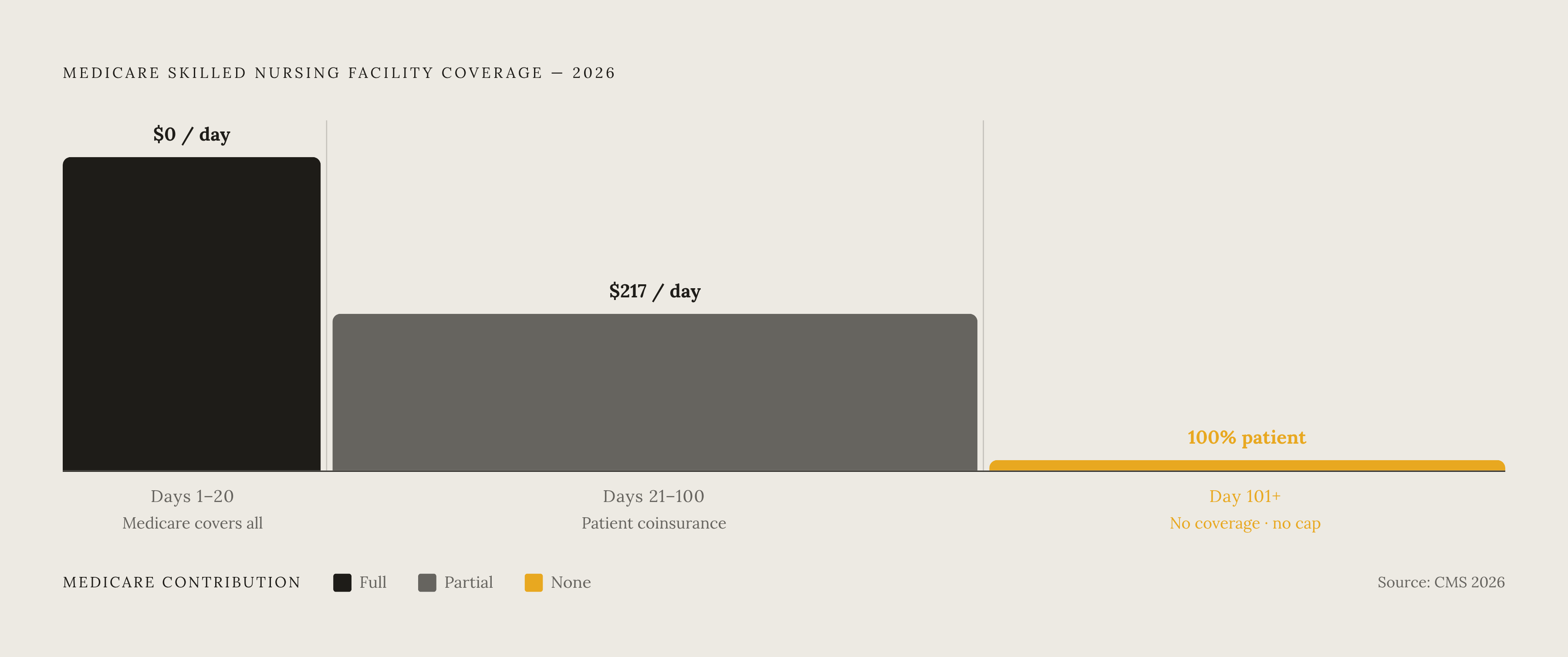
Even when all three conditions line up, the coverage is capped and shrinking as it goes. Days 1 through 20 are covered in full. Days 21 through 100 require a coinsurance payment of $217.00 per day in 2026, up from the prior year. After day 100, the patient is responsible for the entire cost, no exceptions, no extensions.
The real problem lies elsewhere, in what Medicare excludes entirely regardless of how many days are left on the clock. The real problem is what Medicare excludes entirely, regardless of how many days are left on the clock. Medicare.gov states that the program does not cover custodial care when that is the only kind of care a person needs. Custodial care means help with activities of daily living: bathing, dressing, eating, transferring, toileting. That happens to be exactly the kind of care most people living with dementia or a long-term chronic illness actually require, day after day, indefinitely. This is not a recent cutback or a benefit that got trimmed in some budget negotiation. Medicare never covered custodial care. It was built this way from the start, as insurance against acute medical events, not as a program to fund the slow, ongoing work of helping someone live with a body or mind that no longer manages daily tasks alone.
Costs on the Medicare side keep climbing too, even before any long-term care need enters the picture. The standard monthly Part B premium in 2026 is $202.90, a notable increase from the prior year. Medicare Advantage, or Part C, does offer some plans with dental, vision, and hearing benefits layered on top of Original Medicare, along with an annual out-of-pocket limit that Original Medicare lacks. But Medicare Advantage plans, like Original Medicare, do not cover extended custodial nursing home stays. The structure is the same underneath the added benefits.
Home settings are not off the table. Medicare does cover limited home health services, skilled nursing visits and physical therapy delivered for a defined period tied to a specific medical need. The boundary here is about duration and skill level, not a blanket refusal to pay for care delivered at home. A short course of physical therapy after a hip replacement, delivered in someone's living room, can be covered. Years of help getting dressed and using the bathroom cannot.
So what is left on the table once Medicare's boundaries are drawn? Ongoing nursing home stays, assisted living, and personal care aides for chronic daily needs, the very categories that make up the bulk of long-term care spending described in the previous section. These are exactly the gaps Medicaid was built to fill.
How Medicaid became the primary payer for long-term care in the United States
Medicaid pays for roughly 60% of all nursing home residents in the United States. That single figure does more to explain the American long-term care system than almost anything else, because it means the default payer for extended nursing home care, for most people, most of the time, is not private insurance and not Medicare. It is a program most people associate with poverty.
The dollar figures back up the scale. Medicaid spent about $228.6 billion on long-term services and supports in 2023, the official national total from Medicaid.gov's LTSS report. Of that, $145.9 billion went to home and community-based services, while $82.7 billion went to institutional care, meaning HCBS now accounts for 63.8% of long-term services and supports spending. That split signals a real policy shift over the past couple of decades, away from defaulting to institutional care and toward keeping people in their own homes and communities wherever that is workable. Long-term services and supports as a whole make up roughly one-third of all Medicaid spending nationally, which tells you how central this function is to the program's overall footprint.
There is a bridge population worth understanding here too, dual eligibles, people covered by both Medicare and Medicaid at once. About 11.9 million people fell into this category in 2025, including many low-income seniors along with people under 65 living with disabilities. For this group, Medicare pays first, covering the acute medical services it always covers, and Medicaid picks up what Medicare leaves behind, including long-term care, along with dental, vision, and hearing benefits that Medicare typically excludes or covers only partially.
The instinct to write this off as "a program for poor people" and move on deserves a direct challenge. Denise Lettau, an attorney quoted in A Place for Mom in an April 2026 update, framed it this way: Medicaid "was created for people with low incomes, but it's increasingly needed by people who have what could be considered middle class incomes." Go back to the cost figures from the first section. A private nursing home room running close to $130,000 a year does not stay affordable for long even to households that would never have described themselves as low-income at the start of a health crisis. The income and asset math simply catches up.
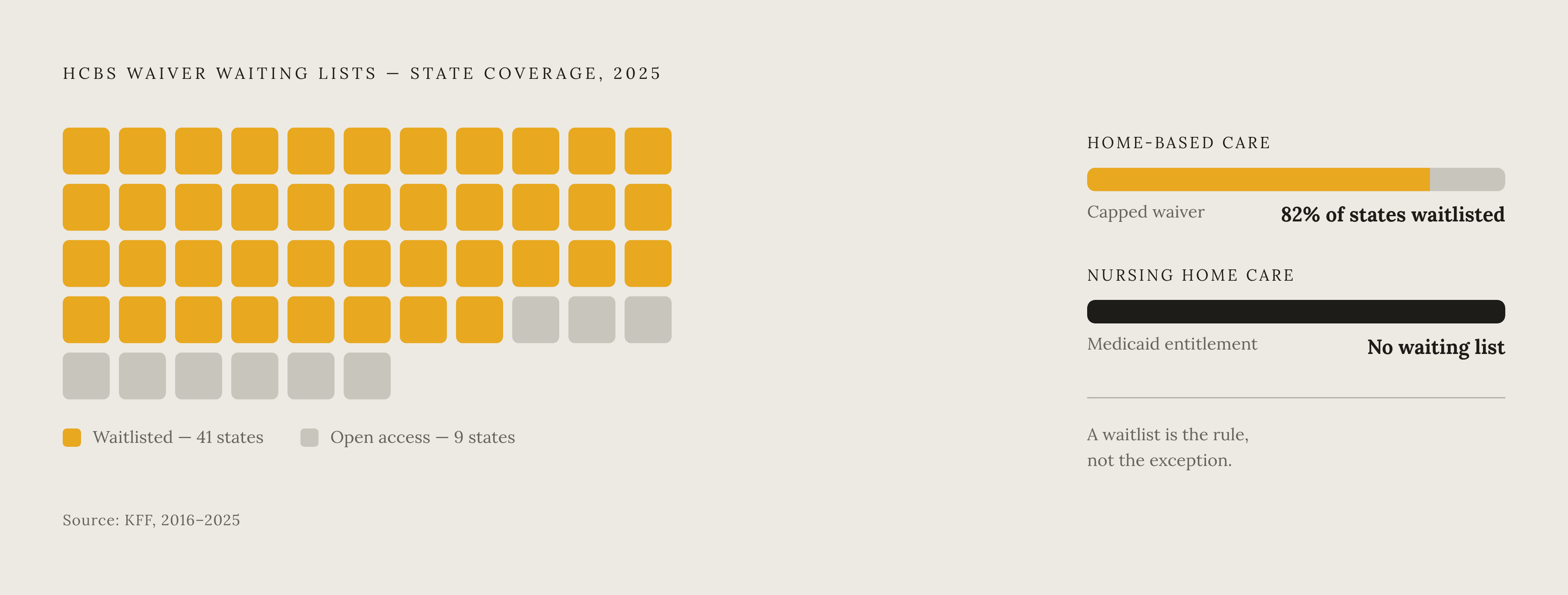
Three distinct Medicaid long-term care program types exist in most states: Nursing Home Medicaid, Home and Community-Based Services (HCBS) Waivers, and Aged, Blind, and Disabled (ABD) Medicaid. There is a structural distinction buried in those three names that matters more than it might first appear. Nursing Home Medicaid functions as an entitlement: meet the criteria, and coverage follows automatically. HCBS Waivers do not work that way. States cap enrollment, and waiting lists are common, a distinction with real consequences that gets its own full treatment later in this piece.
The financial eligibility rules that determine whether Medicaid will cover someone's care
Qualifying for Medicaid long-term care coverage means clearing two separate hurdles: an income test and an asset test. Both vary by state, sometimes dramatically, which means eligibility in one state tells almost nothing about eligibility in another.
Take income limits for 2026. In most states, the limit is $2,982 a month for an individual applying to either Nursing Home Medicaid or an HCBS Waiver. Illinois sets its limit far lower, at $1,304 a month. California takes a more permissive approach, with its HCBS Waiver individual income limit running at $1,801 a month as of the period running April 2025 through March 2026. New York, for a single applicant seeking Nursing Home Medicaid in 2026, requires income under $1,836 a month. Four states, four different thresholds, and none of them line up.
Asset limits show the same pattern of wide variation. Most states cap countable assets at $2,000 for an individual. Connecticut sets the bar lower still, at $1,600. Illinois allows up to $17,500. California allows up to $130,000, a gap of more than eightyfold between the strictest and most generous states in this list alone. New York, again for a single Nursing Home Medicaid applicant in 2026, requires assets under $33,038.
Not every asset counts against these limits, though. A primary residence is generally exempt from the asset calculation as long as the applicant or their spouse continues living there, subject to home equity caps that most states set at $752,000, though some states allow up to $1,130,000 in 2026. Distinguishing countable assets from exempt ones is often where families first realize the eligibility process is more nuanced than a simple bank balance check.
Married couples get additional protection built into the system, and this matters enormously for anyone trying to plan without impoverishing a spouse who stays at home. The Community Spouse Resource Allowance, as of January 1, 2026, lets the non-applicant spouse retain up to $162,660 in assets. The Monthly Maintenance Needs Allowance protects that spouse's income too, with a federal maximum in 2026 of $4,066.50 per month. These allowances exist for one specific reason: to prevent the spouse who remains at home from being financially wiped out by a partner's nursing home stay.
Once someone is actually approved and receiving Medicaid nursing home coverage, nearly all of their income gets redirected to the facility, an amount referred to as the "patient pay" or liability amount. Residents keep only a small Personal Needs Allowance, generally somewhere between $30 and $200 a month depending on the state, for personal expenses outside the facility's services.
Financial eligibility is necessary but not sufficient on its own. Applicants also have to meet a nursing facility level of care standard, essentially a determination that they cannot safely live independently without this support. The clinical details of that determination vary by state and go beyond the scope of a financial overview, but the existence of this functional test is worth knowing: passing the income and asset tests does not guarantee approval by itself.
For people whose income runs above the limit but who still need coverage, 34 states offered medically needy programs as of 2025, allowing applicants to spend down excess income on medical expenses until they reach the medically needy income threshold. That spend-down concept deserves its own deeper look, because it intersects with some of the most consequential and least understood rules in the entire Medicaid application process.
The look-back period and spend-down rules that catch families off guard
Here is where good intentions run headfirst into a rule most families never see coming until it is too late. Most states review 60 months, five full years, of financial history at the time someone applies for Medicaid long-term care. Any transfer of assets for less than fair market value within that window, a gift to a child, an inheritance passed along early, a house sold to a relative for a token dollar, triggers a penalty period.
The mechanics of that penalty, walked through with a real number attached, show how brutal the timing can get. Suppose a parent gave away $100,000 at some point within the look-back window, and nursing home care in that state costs $10,000 a month. Medicaid divides the gift by the monthly cost and imposes a ten-month penalty period, during which Medicaid will not pay for care. The family has to cover those ten months out of pocket, without access to the very money that was given away. The gift is gone, and so is Medicaid's help for as long as the penalty runs.
State rules on the look-back period itself are shifting under everyone's feet right now, which makes this a particularly bad area to plan around outdated information. California had been in the process of eliminating its 30-month look-back period entirely, but as of 2026, the state is reimplementing it. According to published guidance on New York Medicaid, the state currently applies no look-back period to long-term home and community-based services, but a 30-month look-back for those same community-based services has already been authorized by law and, as of mid-2026, still has not been implemented, with no confirmed start date. What was accurate two or three years ago in either state may simply no longer be true, and that instability is itself a planning risk.
Trusts trip up a lot of families who assume any trust protects assets equally. It does not work that way. A revocable trust still counts as an available asset for Medicaid purposes, because the person who created it retains control and can undo it at any time. Only an irrevocable trust, where the person permanently gives up access and control, removes those assets from the countable calculation, and even then only once the full five-year look-back period has passed since the trust was funded. Setting up an irrevocable trust four years before applying does nothing to help eligibility yet.
Some spend-down strategies exist specifically because they do not trigger a penalty. Spending on exempt assets, home renovations or a vehicle purchase, does not count as a disqualifying transfer. Medicaid-compliant annuities structured to specific state requirements are another route. Irrevocable trusts fall into this category too, with the five-year caveat attached. On the income side, in the 34 states offering medically needy programs as of 2025, applicants over the income limit can apply excess income toward medical expenses to bring themselves down to the medically needy threshold, a parallel process to asset spend-down but working on the income side of the ledger instead.
All of these strategies are legal and widely used. None of them are simple, and all of them are dependent on the specific state's rules at the specific moment of application. An error in execution, a transfer made at the wrong time, or a trust drafted with the wrong provision can reset a penalty period or disqualify an applicant. This section is meant to show how many ways there are to get this wrong even with good intentions and real effort behind the planning. It is meant to show how many ways there are to get this wrong even with good intentions and real effort behind the planning.
The HCBS waiver waiting list problem and what it means for families choosing home-based care
HCBS waivers exist to let people who meet a nursing home level of care get that same support somewhere other than a nursing home: at home, or in a community-based setting. That can mean personal care assistance, home-delivered meals, transportation, or home modifications like a wheelchair ramp or a walk-in shower. On paper, it is exactly the kind of program that answers the earlier cost data, where home care, despite rising fast, remains far more attractive to most families than institutional placement.
The catch sits in a structural distinction raised earlier in this piece. Nursing Home Medicaid is an entitlement: meet the criteria and coverage follows. HCBS waivers are not entitlements. States set enrollment caps, and once a cap is reached, new applicants wait. A KFF report shows that the number of states running HCBS waiting lists has fluctuated between 37 and 41 over the period from 2016 to 2025, and currently stands at 41 states. That is not a handful of outlier states with a management problem. That is the overwhelming majority of the country running some form of capped, waitlisted access to home-based Medicaid care.
What does a waiting list actually mean for a family in the middle of this? It means someone can pass every financial test, meet every medical criterion, and still not receive HCBS waiver services for months, or in some states, years. During that stretch, the choice narrows to two options: move into facility care, which the waiver was designed to help someone avoid in the first place, or pay for home care privately while the waitlist clock runs.
That second option lands right back on the cost data from earlier. Home care at $80,080 a year for 44 hours a week is the outcome families are trying to reach through the waiver system, precisely because it lets someone stay in their own home. But per the AARP Public Policy Institute report cited earlier, home care costs have risen 39% since 2021, outpacing inflation broadly and outpacing many household budgets specifically. Families waiting on a list that could take years are often paying market rate out of pocket in the meantime, for the very service they were hoping Medicaid would eventually cover. The waitlist just shifts who pays for care, for however long the wait turns out to last. It just shifts who pays for it, for however long the wait turns out to last.